Wildlife Guide · United Kingdom & Western Europe
Slow Worm
Anguis fragilis
The legless lizard that blinks, sheds its tail, and quietly eats your garden slugs.
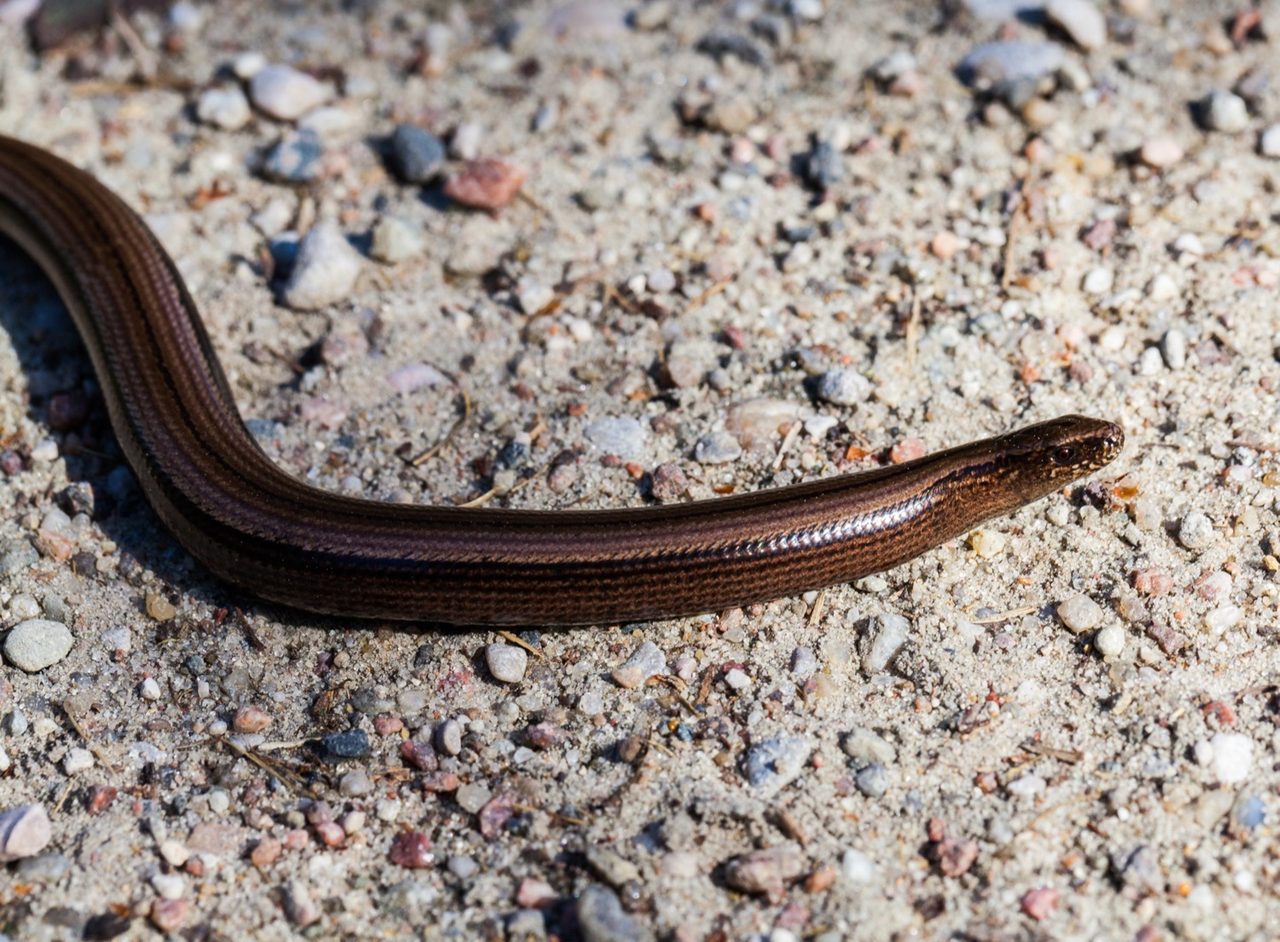
Source: Wikimedia Commons — “Lución (Anguis fragilis), Jurata, Península de Hel, Polonia, 2013-05-24, DD 07” by Diego Delso, CC BY-SA 3.0
In brief
A slow worm (Anguis fragilis) is a legless lizard native to Britain and Europe. Though snake-like, it is a true lizard: it can blink with movable eyelids and shed its tail to escape predators. It lives in gardens and grassland, eating slugs, snails and worms.
Also in Animals A to Z · Animals that start with S
By WARN Research & Conservation TeamLast updated
The slow worm (Anguis fragilis) is one of nature's great impostors: it looks like a small bronze snake, but it is in fact a legless lizard. Found across Britain and much of Europe, it spends most of its life hidden beneath logs, stones and compost heaps, emerging to hunt slow-moving prey such as slugs, snails and earthworms. Smooth-scaled and secretive, it can live for decades and is a familiar, welcome resident of gardens and allotments. Two features give away its lizard identity: it can blink, because it has eyelids that snakes lack, and it can shed its tail to escape a predator. In the UK it enjoys full legal protection.
Up to ~50 cm
length of a large adult, though most reach 40-45 cm
~30 years
typical lifespan in the wild, exceptional for such a small reptile
8-12
young born live in a typical late-summer litter
0
legs, despite being a lizard, not a snake
Figures sourced from Wikipedia: Common slow worm (Anguis fragilis), IUCN Red List, Encyclopaedia Britannica: Slowworm and other references on this page.
Slow Worm: Quick Facts
| Common name | Slow worm (also blindworm) |
|---|---|
| Scientific name | Anguis fragilis |
| Animal type | Legless lizard (not a snake) |
| Adult length | Typically 40-45 cm; up to about 50 cm |
| Diet | Slugs, snails, earthworms, insects, spiders |
| Habitat | Gardens, grassland, heath, woodland edge, compost heaps |
| Range | Britain and much of Europe |
| Reproduction | Ovoviviparous; gives birth to live young |
| Lifespan | Around 30 years in the wild |
| Legal status (UK) | Protected under the Wildlife and Countryside Act 1981 |
Scientific Classification
| Kingdom | Animalia |
|---|---|
| Phylum | Chordata |
| Class | Reptilia |
| Order | Squamata |
| Family | Anguidae |
| Genus | Anguis |
| Species | Anguis fragilis |
Conservation Status
- IUCN Status
- Listed as Least Concern on the IUCN Red List. The slow worm is widespread and common across much of Europe, but populations face pressures from habitat loss, intensive land management, road mortality and predation, including by domestic cats. In the United Kingdom it receives legal protection under the Wildlife and Countryside Act 1981, which makes it an offence to intentionally kill, injure, sell or advertise the species for sale.
- Population
- No reliable global total; considered common and widespread across its range.
- Trend
- Stable overall, though local declines occur where suitable habitat is lost.
- Assessed
- Assessed by the IUCN as Least Concern (most recent published assessment).
- CITES
- Not listed on CITES.
Because slow worms are long-lived and reproduce slowly, local populations can take many years to recover from significant losses, so protecting undisturbed habitat is especially important.
Key Facts: Slow Worm
- The slow worm is a legless lizard, not a snake or a worm, despite its appearance.
- It can blink and shed its tail, two abilities that betray its lizard identity.
- It feeds largely on slugs, snails and worms, making it a gardener's natural ally.
- Slow worms are remarkably long-lived, often reaching around 30 years in the wild.
- Females give birth to live young rather than laying eggs, usually in late summer.
- In the UK the species is fully protected by law, and it is classed as Least Concern globally.
Is a slow worm a snake or a lizard?
A slow worm is a lizard, not a snake, despite its limbless, serpentine body. It belongs to the family Anguidae, a group of lizards that have evolved to lose their legs as an adaptation to burrowing and slipping through dense vegetation. Two features reliably distinguish it from any British snake. First, a slow worm has movable eyelids and can blink, whereas snakes have a single fixed, transparent scale over each eye and cannot close them. Second, it can perform caudal autotomy, deliberately shedding part of its tail when seized by a predator; the discarded tail wriggles to distract the attacker while the lizard escapes. The regrown tail is only ever a short, blunt stub, never as long or neat as the original, which is why many adults look slightly truncated. Other clues include a smooth, polished body with non-overlapping scales, a more uniform colour, and a blunt head that is not clearly set off from the neck. Far from being dangerous, the slow worm is harmless, non-venomous and rather shy, spending much of its life hidden underground or beneath cover.
What do slow worms eat and where do they live?
Slow worms are slow-moving, ambush-style hunters that specialise in soft, slow prey. Their diet is dominated by invertebrates: small slugs and snails, earthworms, insects and spiders. This appetite for slugs makes them a quiet asset in any garden, allotment or vegetable plot, controlling pests without chemicals. Because they are semi-fossorial, meaning partly burrowing, slow worms spend most of their time out of sight beneath logs, flat stones, leaf litter and especially compost heaps, where decaying material generates gentle warmth and attracts the invertebrates they hunt. Rather than basking openly in the sun as many lizards do, they often warm themselves indirectly by lying beneath sun-heated objects such as sheets of corrugated metal or discarded paving. Their preferred habitats include rough grassland, woodland edges, heathland, hedgerows, railway embankments and humid, undisturbed corners of gardens. A wildlife-friendly garden with a log pile, a compost heap and some unmown grass offers nearly everything a slow worm needs, which is why these reptiles are among the most likely to be encountered by people across much of Britain and Europe.
How do slow worms reproduce and how long do they live?
Unlike most reptiles that lay eggs, the slow worm is ovoviviparous: the eggs develop and hatch inside the female's body, so she gives birth to live young. After mating in spring, females carry developing embryos through the summer and typically produce a litter of around eight to twelve young between mid-July and August, though litters can range more widely. Each newborn is a slender, golden creature only a few centimetres long, fully independent from birth. Slow worms are extraordinarily long-lived for such a small animal. In the wild they may reach roughly thirty years of age, and one famous captive individual at a European zoo is reported to have survived to around fifty, possibly the greatest age recorded for any lizard. This longevity, combined with low reproductive output, means populations recover slowly from losses. Colour offers a rough guide to sex: males tend to be plainer grey-brown, sometimes flecked with pale blue spots, while females often retain a dark stripe down the spine and darker flanks, echoing the patterning of the gold-and-black juveniles.
Slow worm vs snake: how to tell them apart
| Feature | Slow worm (legless lizard) | Snake |
|---|---|---|
| Eyelids | Movable eyelids; can blink | Fixed transparent eye scale; cannot blink |
| Tail | Can shed and partly regrow the tail | Cannot shed the tail |
| Body and scales | Smooth, glossy, non-overlapping scales; uniform colour | Often patterned; scales may overlap |
| Head | Blunt, not clearly distinct from the neck | Often a more distinct head and neck |
| Tongue | Notched, fleshy tongue | Deeply forked, flicking tongue |
What WARN Does
World Animal Rescue Network does not run field projects specifically for slow worms, which are widespread and not globally threatened; this guide is part of WARN's free educational work to help people identify and value the wildlife around them. The same pressures that affect slow worms, especially habitat loss, intensive land use and the destruction of undisturbed corners, also threaten many of the animals WARN does protect in its partner countries, so understanding one species helps support them all.
If this guide helped you see a familiar garden animal in a new light, a small gift helps us keep wildlife education free and support the habitats that animals everywhere depend on.
Slow Worm: Frequently Asked Questions
Is a slow worm a snake?
Are slow worms dangerous or venomous?
What do slow worms eat?
How long do slow worms live?
Why is it called a slow worm if it is not a worm?
How can I attract or protect slow worms in my garden?
Where do slow worms live?
How big is a slow worm?
Sources & References
Population figures, conservation status and biological facts on this page are drawn from authoritative scientific and intergovernmental sources.
Terms used on this page
Plain-English definitions, from our wildlife and conservation glossary.
Latest Slow Worm Stories
Quick, fact-checked reads on the slow worm — amazing facts, key questions and the threats it faces.
Guides
UK Animal Charities Explained: A Friendly Guide to 10 of the Biggest, and How They Differ
Who does what across UK animal welfare? A neutral, supporter-friendly guide to ten of the biggest UK animal charities — RSPCA, Dogs Trust, Battersea, Cats Protection, Blue Cross, PDSA, The Donkey Sanctuary, Brooke, Wood Green and Mayhew — with each charity's own donate link, and an honest section on where international field rescue fits in.
Read the storyGuides
What Is an Animal Sanctuary? How Sanctuaries Work, Who They Help, and How to Support One
Animal sanctuary, animal shelter, animal rescue — the terms are often used interchangeably, but they mean different things. This guide explains the difference, what life inside a sanctuary looks like, and how you can support sanctuaries in the UK and internationally.
Read the storyGuides
Fostering a Rescue Dog in the UK: A Complete Guide for New and Experienced Foster Carers
Fostering a rescue dog gives a dog in a shelter or rescue centre a temporary home while they wait for adoption — and it can make an enormous difference to their behaviour, health and chances of finding a permanent family. This guide covers how dog fostering works, what to expect, and how to get started.
Read the storyExplore more animals
Discover more animals, their habitats and their conservation status in the WARN wildlife-guide library.