Wildlife Guide · Pacific Ocean & Atlantic Ocean
Starfish (Sea Star)
Class Asteroidea
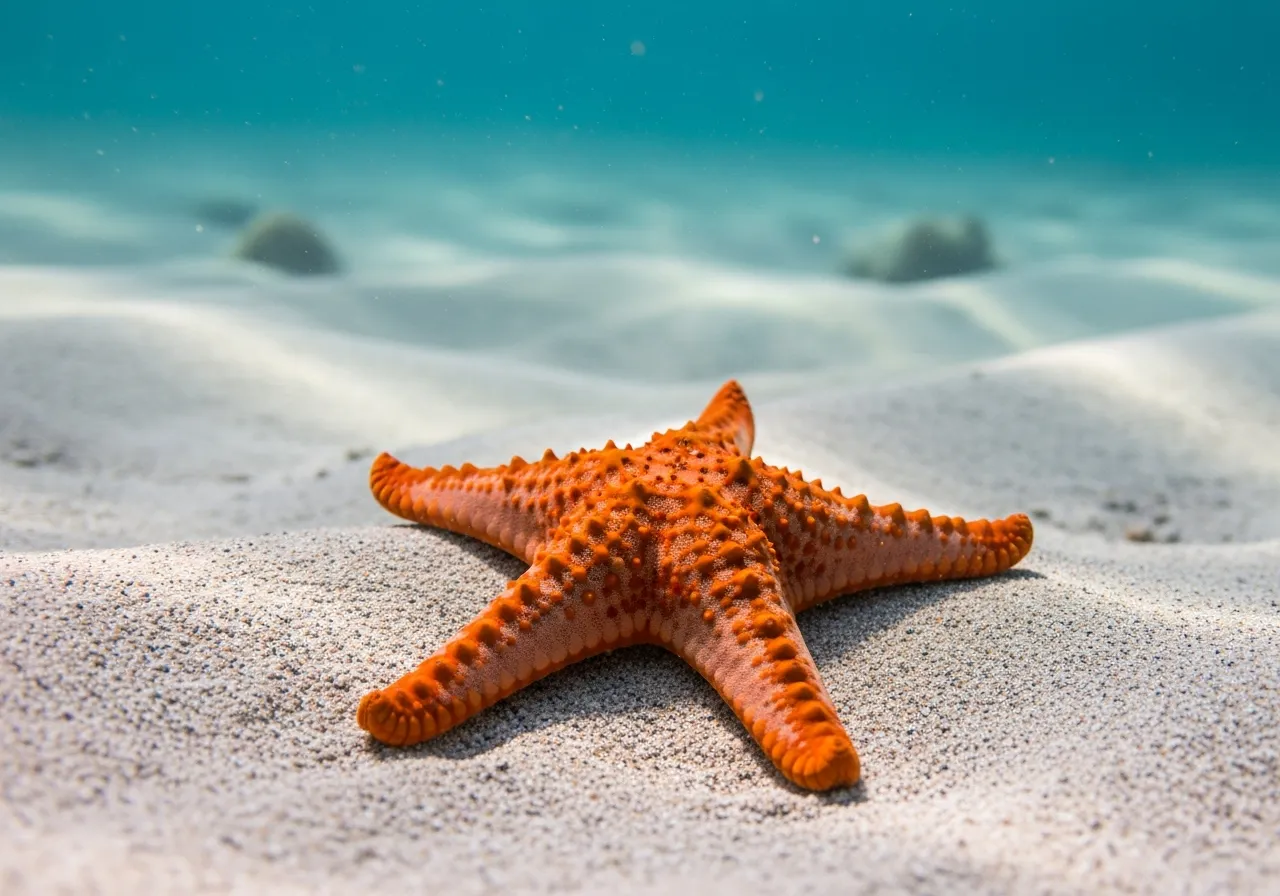
Spiny, five-armed echinoderms that regrow lost limbs and eat by turning their stomachs inside out.
Source: Global Animal Guide (WARN)
In brief
A starfish, or sea star, is a marine invertebrate in the class Asteroidea (about 1,900 species). It is an echinoderm, not a fish, with radial symmetry, a central disc and usually five arms lined with tube feet. Many can regenerate lost arms and feed by everting their stomach.
Also in Animals A to Z · Animals that start with S
By WARN Research & Conservation TeamLast updated
Starfish, more accurately called sea stars, are marine animals in the class Asteroidea, with roughly 1,900 living species. Despite the name, they are not fish at all: they are echinoderms, relatives of sea urchins and sea cucumbers, built on a five-part radial body plan rather than a head-and-tail design. Most have a central disc and five arms, though some species carry ten, twenty or even forty. They live in every ocean, from rock pools to the deep abyss, gliding on hundreds of tiny tube feet. Famous for regenerating lost arms and for feeding by pushing their stomach out through their mouth, sea stars are among the sea's most distinctive and ecologically important invertebrates.
~1,900
Living species in class Asteroidea
>6,000 m
Depth they reach, from rock pools to the abyss
5+
Arms typically, but some species have 40 or more
100s
Tube feet per animal, used to move and grip prey
Figures sourced from Starfish — Wikipedia, Sunflower sea star — Wikipedia, Echinoderm — Wikipedia and other references on this page.
Starfish (Sea Star): Quick Facts
| Common name | Starfish or sea star |
|---|---|
| Scientific group | Class Asteroidea (echinoderms) |
| Number of species | About 1,900 living species |
| Body plan | Radial symmetry, central disc with arms |
| Typical arms | Usually 5, but up to 40 or more in some species |
| Movement | Hundreds of water-powered tube feet |
| Diet | Shellfish, algae, sponges, coral, detritus; many are predators |
| Notable feeding trick | Everts its stomach to digest prey externally |
| Habitat | All oceans, from tide pools to depths beyond 6,000 m |
| Special ability | Regenerates lost arms; some regrow from one arm |
Scientific Classification
| Kingdom | Animalia |
|---|---|
| Phylum | Echinodermata |
| Subphylum | Asterozoa |
| Class | Asteroidea |
| Common name | Starfish / sea star |
| Living species | About 1,900 |
| Example | Sunflower sea star (Pycnopodia helianthoides) |
Conservation Status
- IUCN Status
- Varies by species. Most of the roughly 1,900 sea star species have not been formally evaluated on the IUCN Red List. Some species are assessed and considered of low concern, while others are threatened: the sunflower sea star (Pycnopodia helianthoides) was assessed as Critically Endangered in 2020 after sea-star wasting disease caused mass mortality across the eastern Pacific from 2013 onwards.
- Population
- No global total; the class contains about 1,900 species and population data exist only for a minority of them.
- Trend
- Mixed and largely unknown overall, but sharply declining for species hit by sea-star wasting disease, such as the sunflower sea star.
- Assessed
- 2020 (sunflower sea star, IUCN)
- CITES
- Starfish are not generally listed on the CITES appendices.
Key threats include sea-star wasting disease, warming and marine heatwaves, pollution and habitat loss. The decline of predatory sea stars can trigger wider damage, such as urchin overgrazing of kelp forests.
Key Facts: Starfish (Sea Star)
- Starfish are echinoderms, not fish, which is why many biologists prefer the name sea star.
- Their bodies show radial symmetry, usually with five arms around a central disc.
- Most sea stars feed by everting their stomach out of their mouth and digesting prey externally.
- Many species can regenerate arms, and a few can regrow a whole body from a single arm and part of the disc.
- Sea stars live in every ocean, from intertidal pools to depths beyond 6,000 metres.
- Most species are unassessed, but some, such as the sunflower sea star, are now Critically Endangered after disease outbreaks.
Are starfish actually fish?
No. Starfish are not fish, which is why scientists increasingly call them sea stars. They belong to the phylum Echinodermata, the same group as sea urchins, brittle stars, sea cucumbers and feather stars. Fish are vertebrates with backbones, gills and fins; sea stars have none of these. Instead they have an internal skeleton of calcium-carbonate plates (ossicles) embedded in their body wall, and they breathe through tiny skin gills and their tube feet rather than through gills like a fish. The most striking difference is their body plan. Most animals we know well, including fish, have bilateral symmetry with a clear front and back. Adult sea stars instead have radial symmetry, typically arranged in fives, with no head and the mouth set in the centre of the underside. They also possess a feature unique to echinoderms: a water vascular system, a network of fluid-filled canals that powers hundreds of tube feet. By pumping water in and out, a sea star extends and grips with these feet to creep across the seabed, climb rocks and prise open shells. So while the everyday name has stuck for centuries, biologically a sea star sits far from any fish.
How do starfish eat and move?
Sea stars move using a hydraulic system found nowhere else in the animal kingdom. Sea water is drawn in through a sieve-like plate on the upper surface (the madreporite) and channelled into rows of tube feet running along grooves beneath each arm. By changing the water pressure, the animal extends, anchors and retracts each foot in turn, allowing it to glide slowly but powerfully across the seabed and grip vertical surfaces. Many sea stars are active predators. A common target is bivalves such as mussels and clams. The sea star humps over its prey, grips both shells with its tube feet and pulls steadily until the shell gapes by even a fraction of a millimetre. It then performs one of nature's strangest feeding tricks: it pushes its stomach out through its mouth, slides the everted stomach into the shell and digests the soft body externally before drawing the partly liquefied meal back inside. Other species swallow prey whole, graze on algae, sponges and coral, or sweep up drifting particles. Light-sensitive eyespots at the tip of each arm help them sense brightness and shadow as they hunt.
Can starfish really regrow their arms?
Yes. Regeneration is one of the sea star's most famous abilities. If a predator or accident removes an arm, most species can slowly regrow it over months, sometimes more than a year. The new limb gradually rebuilds its skeleton, tube feet and internal organs, including a branch of the digestive and reproductive systems that extends into every arm. In a number of species the power goes further still. Because vital organs are distributed along the arms rather than concentrated in a single head, some sea stars can regenerate an entire body from a single severed arm, provided enough of the central disc remains attached. A few, such as certain Linckia species, can even regrow from an arm fragment alone, briefly forming a tiny new disc nicknamed a comet. This ability long caused trouble for shellfish gatherers who chopped up sea stars and threw the pieces back, unwittingly multiplying them. Beyond curiosity value, sea star regeneration is studied by biologists interested in how animals rebuild complex tissues, offering clues that connect to wider questions about healing and growth across the animal kingdom.
Why do starfish matter to ocean health?
Sea stars are important players in many marine ecosystems, and some are classic keystone species, meaning their influence on a habitat is far greater than their numbers alone suggest. On rocky North Pacific shores, predatory sea stars keep mussels and other shellfish in check; remove the sea stars and a few dominant species can crowd out everything else, collapsing local diversity. This idea, developed from experiments on rocky coasts, helped shape the whole concept of keystone species in ecology. Sea stars also recycle nutrients by scavenging dead animals and grazing surfaces clean. Their importance becomes painfully clear when they vanish. Since 2013 a mass mortality known as sea-star wasting disease has killed billions of sea stars along the eastern Pacific, with the large, fast sunflower sea star among the hardest hit, prompting an IUCN assessment of Critically Endangered in 2020. Losing this voracious predator allowed sea urchins to multiply and graze down kelp forests in many areas, harming a habitat that shelters countless other species. Healthy sea star populations are therefore a useful sign of a balanced, resilient coastal sea.
Sea star vs brittle star: telling echinoderm cousins apart
| Feature | Sea star (Asteroidea) | Brittle star (Ophiuroidea) |
|---|---|---|
| Class | Asteroidea | Ophiuroidea |
| Arm and disc | Arms merge broadly into a thick central disc | Long thin arms join a clearly set-off round disc |
| Movement | Glides slowly on tube feet | Wriggles arms rapidly, often quite fast |
| Tube feet | Used for walking and gripping prey | Mainly for feeding and sensing, not walking |
| Feeding | Often everts stomach to digest prey | Filters particles or scavenges small food |
What WARN Does
WARN does not run field projects dedicated specifically to starfish, which live in oceans far beyond the countries where our partners work; this guide is part of our free educational work to help people understand the wildlife that shares our planet. Yet the pressures that threaten sea stars, including warming seas, disease, pollution and habitat loss, are the same broad forces that endanger the coastal and freshwater animals WARN does help protect, so learning about one corner of nature supports care for all of it.
If this guide deepened your wonder at the natural world, a small gift helps keep our wildlife education free and supports the animals in our care.
Starfish (Sea Star): Frequently Asked Questions
Is a starfish a fish?
How many arms does a starfish have?
How do starfish eat?
Can a starfish grow back a lost arm?
What do starfish eat?
Where do starfish live?
Are starfish dangerous?
How long do starfish live?
How big is a starfish?
Sources & References
Population figures, conservation status and biological facts on this page are drawn from authoritative scientific and intergovernmental sources.
Terms used on this page
Plain-English definitions, from our wildlife and conservation glossary.
Latest Starfish (Sea Star) Stories
Quick, fact-checked reads on the starfish (sea star) — amazing facts, key questions and the threats it faces.
Species
12 Amazing Facts About the Dugong, the Ocean's Only Vegetarian Sea Cow
From mermaid myths to tonnes of seagrass and 70-year lifespans, here are 12 remarkable facts about the dugong, the only marine mammal that lives entirely on plants.
Read the storySpecies
12 Amazing Facts About Clownfish (They All Start as Males)
Sequential hermaphroditism, immunity to anemone stings, and why the film made life harder for them. Twelve facts.
Read the storyExplore more animals
Discover more animals, their habitats and their conservation status in the WARN wildlife-guide library.