Wildlife Guide · Tropical and subtropical oceans worldwide & Temperate coastal seas
Stingray
Order Myliobatiformes
The ocean's gliding pancakes — gentle bottom-dwellers armed with a venomous tail spine for defence.
Source: Global Animal Guide (WARN)
In brief
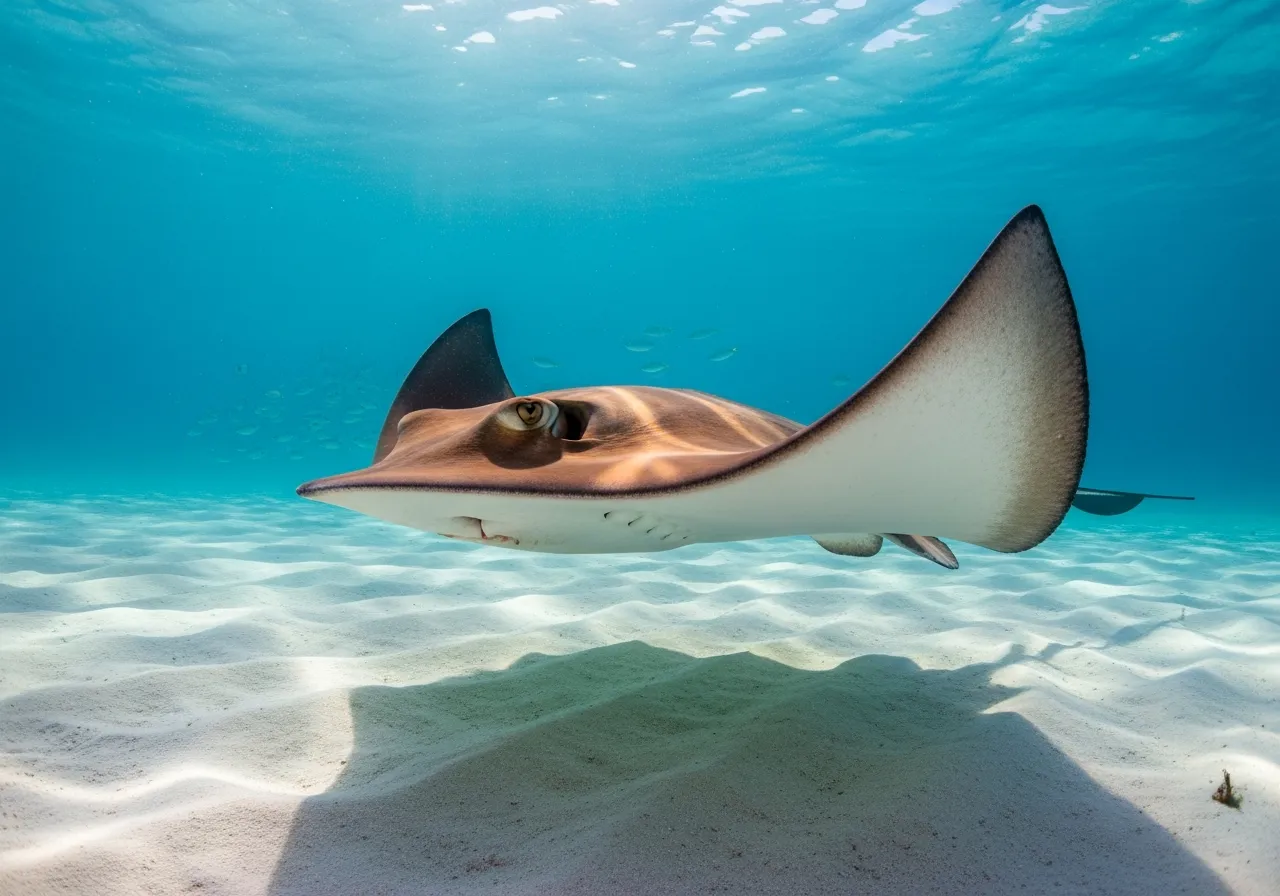
A stingray is a flat-bodied cartilaginous fish in the order Myliobatiformes, related to sharks. Its broad pectoral fins form a disc that flaps for swimming, and most species carry a venomous, barbed tail spine used only for defence. Most are bottom-dwelling ambush predators of shellfish.
Also in Animals A to Z · Animals that start with S
By WARN Research & Conservation TeamLast updated
Stingrays are flattened, cartilaginous fish in the order Myliobatiformes, close relatives of sharks. Their bodies are broadened into a smooth disc by enlarged pectoral fins, which ripple or flap to "fly" through the water. Most species live on the seabed, where their flat shape lets them bury in sand and ambush prey such as molluscs, crustaceans and small fish, crushing shells with plate-like teeth. Their best-known feature is a barbed, venom-coated spine partway along the tail, used purely in self-defence. Stingrays inhabit warm coastal seas worldwide, with some living in open ocean and a remarkable group thriving in South American rivers. Many species are now threatened by fishing pressure.
~220
species across roughly a dozen families
7 m
disc width of the giant oceanic manta ray
0
bones — the skeleton is entirely cartilage
45+
species listed Vulnerable or Endangered by the IUCN
Figures sourced from Stingray — Wikipedia, Myliobatiformes — Wikipedia, Stingray — Encyclopaedia Britannica and other references on this page.
Stingray: Quick Facts
| Common name | Stingray |
|---|---|
| Group | Rays (cartilaginous fish, relatives of sharks) |
| Order | Myliobatiformes |
| Number of species | ~220 |
| Skeleton | Cartilage, not bone |
| Body shape | Flattened disc formed by pectoral fins |
| Defence | Venomous, barbed tail spine |
| Diet | Shellfish, crustaceans and worms; mantas filter plankton |
| Habitat | Coastal and open seas worldwide; some in fresh water |
| Reproduction | Live-bearing (ovoviviparous) |
Scientific Classification
| Kingdom | Animalia |
|---|---|
| Phylum | Chordata |
| Class | Chondrichthyes (cartilaginous fish) |
| Subclass | Elasmobranchii |
| Order | Myliobatiformes |
| Families | Around a dozen, e.g. Dasyatidae, Potamotrygonidae, Mobulidae |
| Species | Approximately 220 |
Conservation Status
- IUCN Status
- Varies by species. Many stingrays remain relatively common, but a large number are threatened: dozens are listed as Vulnerable or Endangered on the IUCN Red List, with some coastal and freshwater species Critically Endangered. There is no single status for the whole order.
- Population
- No overall population estimate exists; stingrays comprise around 220 species with widely differing abundance and trends.
- Trend
- Decreasing for many species, driven by fishing pressure
- Assessed
- Ongoing (various IUCN assessments)
- CITES
- Manta and devil rays (family Mobulidae) are listed under CITES; many other stingrays are not
Slow growth, late maturity and small litters make stingrays especially vulnerable to overfishing and slow to recover, while habitat loss adds pressure on inshore and freshwater species.
Key Facts: Stingray
- Stingrays are cartilaginous fish in the order Myliobatiformes, making them close cousins of sharks rather than bony fish.
- Their flat, disc-shaped bodies are formed by enlarged pectoral fins that they flap or ripple to swim.
- The barbed tail spine delivers venom for defence only; stingrays are not aggressive and sting when stepped on or cornered.
- Most species are bottom-dwellers that crush shellfish with flattened teeth, though mantas and devil rays filter-feed on plankton in open water.
- Some stingrays live entirely in fresh water, notably the river rays of South America.
- Overfishing for meat, fins and gill plates has pushed dozens of stingray species toward the threatened categories of the IUCN Red List.
How does the stingray's venomous tail spine work?
The stingray's defining weapon is one or more barbed spines, or stingers, set partway along the whip-like tail. Each spine is a modified denticle made of a hard, tooth-like material called vasodentine, edged with backward-pointing serrations. Running along grooves in the spine is venom-producing tissue, and the whole spine is wrapped in a thin skin sheath that tears on contact to release the venom. Crucially, this is a purely defensive system. A stingray cannot 'shoot' its spine; instead, if it feels cornered or is trodden on, it whips the tail upward and drives the barb into the threat. The venom causes intense pain, swelling and, in serious cases, tissue damage, while the serrated barb can inflict a deep, ragged wound. Human stings are uncommon and almost always happen when someone accidentally steps on a buried ray in shallow water, which is why beach-goers are advised to do the 'stingray shuffle', sliding their feet to nudge rays away. Fatalities are extremely rare. The spine is shed and regrown periodically, so a ray is never disarmed for long.
Where do stingrays live and what do they eat?
Stingrays are found in warm and temperate seas across the globe, mostly in shallow coastal waters where they rest on sandy or muddy bottoms. Some, such as the pelagic stingray and the manta and devil rays, live out in open water instead, swimming with graceful flaps of their wing-like fins. A distinctive group, the river rays of the family Potamotrygonidae, lives permanently in the fresh waters of South American rivers, including the Amazon. Most bottom-dwelling stingrays are ambush predators. They glide over the seabed or lie buried with only their eyes and breathing holes (spiracles) exposed, then use their flexible discs to trap prey and their flattened, pavement-like teeth to crush molluscs, crustaceans and worms. Their mouths sit on the underside of the body, so they sense food using electroreception and smell rather than sight. By contrast, mantas and devil rays are gentle giants that filter tiny plankton from the water through specialised gill plates. This range of feeding styles, from shell-crushing to filter-feeding, helps explain why rays occupy so many different marine habitats.
Are stingrays endangered?
Conservation status varies enormously across the stingray family, which is why no single label fits the whole group. Many smaller, widespread species are still relatively common, but a large number are in trouble. As of recent IUCN assessments, dozens of stingray and related ray species are listed as Vulnerable or Endangered, and some river and coastal species are Critically Endangered. The main threat is fishing. Rays are caught both deliberately and as bycatch, and demand for their meat, and for the gill plates of manta and devil rays, has driven sharp declines. Because rays grow slowly, mature late and produce only small litters of live young, populations recover very slowly once depleted. Habitat loss, river pollution and the degradation of mangroves and seagrass beds add further pressure, especially for freshwater and inshore species. In response, manta and devil rays have been given protection under CITES, the international convention regulating trade in threatened wildlife, and several countries have introduced sanctuaries and fishing limits. For most stingray species, however, monitoring and protection still lag well behind the scale of the threat.
Stingray vs manta ray
| Feature | Typical stingray | Manta ray |
|---|---|---|
| Lifestyle | Bottom-dwelling, often buried in sand | Open-water, constantly swimming |
| Feeding | Crushes shellfish and crustaceans | Filters plankton from the water |
| Size | Often under 1 m disc width | Up to about 7 m fin-tip to fin-tip |
| Tail spine | Functional venomous barb for defence | Vestigial; cannot sting effectively |
| Behaviour toward humans | Stings only if stepped on or cornered | Harmless and often curious |
What WARN Does
WARN does not run field projects dedicated specifically to stingrays, which live mostly outside the countries where our partners work — this guide is part of our free educational work to help people understand and value wildlife worldwide. The threats that endanger many rays, especially habitat loss, water pollution and overfishing, are the same pressures harming the coastal and freshwater animals WARN does help protect.
If learning about these gentle gliders sparked your curiosity, a small gift helps keep our wildlife guides free and supports the animals WARN protects on the ground.
Stingray: Frequently Asked Questions
Are stingrays dangerous to humans?
Is a stingray a fish?
What do stingrays eat?
Do stingrays lay eggs?
How big can stingrays get?
What is the difference between a stingray and a manta ray?
Where do stingrays live?
How long do stingrays live?
Sources & References
Population figures, conservation status and biological facts on this page are drawn from authoritative scientific and intergovernmental sources.
Terms used on this page
Plain-English definitions, from our wildlife and conservation glossary.
Latest Stingray Stories
Quick, fact-checked reads on the stingray — amazing facts, key questions and the threats it faces.
Explore more animals
Discover more animals, their habitats and their conservation status in the WARN wildlife-guide library.