Wildlife Guide · Philippines & Indonesia
Tarsier
Tarsiidae
Tiny nocturnal hunters with enormous eyes and an island-by-island conservation story.
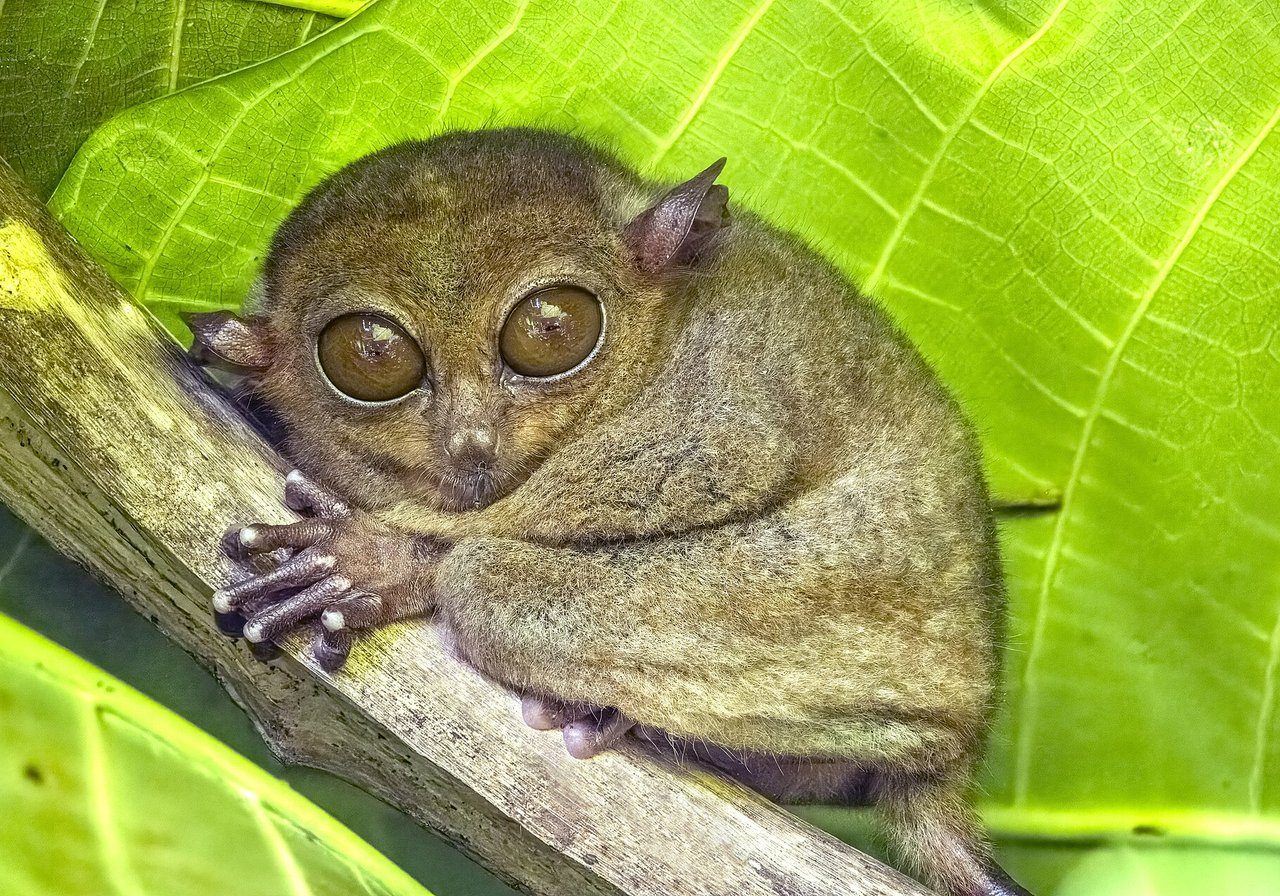
Photo: Charles J. Sharp / Wikimedia Commons (CC BY-SA 4.0). Cropped and resized. · Original photograph · Licence
_Bohol.jpg)
Philippine tarsier (Carlito syrichta), photographed in Bohol, Philippines on 2 March 2026. This is a species photograph, not a Kalimantan incident image.
In brief
Tarsiers are small nocturnal primates in the family Tarsiidae, native to parts of Southeast Asia. They hunt animal prey and move through vegetation by clinging and leaping. They are neither monkeys nor lemurs. Conservation status differs by species, from the Near Threatened Philippine tarsier to the Critically Endangered Siau Island tarsier.
Also in Animals A to Z · Animals that start with T
By WARN Research & Conservation TeamChecked against Mammal Diversity Database, primate research and published acoustic evidenceLast updated
A tarsier gripping a slender branch looks almost all eyes and fingers. After dark, that small body becomes a specialised hunter, listening and watching before leaping towards prey. Tarsiers belong to their own living primate family, Tarsiidae. The Mammal Diversity Database lists 14 living species across three genera as reviewed in September 2026. They are found in parts of the Philippines, Indonesia, Malaysia and Brunei, but no one species occupies that whole range. This distinction changes almost every useful question about them: where they live, how they socialise and which threats require attention. This guide introduces the family, then separates the Philippine, western and eastern groups. It also corrects popular claims that all tarsiers are endangered, that they are the smallest primates, or that every species shares the same ultrasonic call. Their real biology is remarkable without those simplifications.
14 species
MDD family list reviewed September 2026
3 genera
Carlito, Cephalopachus and Tarsius
Nocturnal
Active mainly after dark
Animal prey
A specialised carnivorous primate diet
Figures sourced from MDD — Tarsiidae family and current species list, MDD — Philippine tarsier, MDD — western tarsier and other references on this page.
Tarsier: Quick Facts
| Species covered | Family overview, with 14 species in the reviewed MDD list |
|---|---|
| Diet | Animal prey, particularly insects; differs by species |
| Activity | Nocturnal |
| Movement | Vertical clinging and leaping, alongside other movement |
| Lifespan | No single reliable wild lifespan for the whole family |
| Conservation | Assess the exact species rather than the family name |
Scientific Classification
| Class | Mammalia |
|---|---|
| Order | Primates |
| Suborder | Haplorhini |
| Infraorder | Tarsiiformes |
| Family | Tarsiidae |
Conservation Status
- IUCN Status
- Varies by species; see the comparison and linked records
- Population
- No reliable family-wide estimate
- Trend
- Species-specific; no combined trend asserted
- Assessed
- Assessment dates vary; source records reviewed September 2026
- CITES
- Trade controls must be checked for the exact species and jurisdiction
This family overview is not an IUCN assessment. Near Threatened, Vulnerable and Critically Endangered examples must not be conflated.
Did you know?
A Philippine tarsier can make a call that requires ultrasonic recording equipment for people to hear or analyse.
Key Facts: Tarsier
- Tarsiers are haplorhine primates, more closely related to monkeys and apes than to lemurs, but are not monkeys themselves.
- The Philippine, western and eastern tarsier groups occupy different island regions; a photograph of one cannot represent every species.
- Large eyes, sensitive hearing and elongated hind limbs support nocturnal hunting and leaping.
- An ultrasonic call documented in Philippine tarsiers should not be attributed automatically to Sulawesi species.
- Tarsiers are wild animals. Choose quiet, hands-off viewing and avoid attractions that offer handling or pose animals for selfies.
- A family-wide page has no single IUCN category or meaningful combined population total.
What kind of animal is a tarsier?
A tarsier is a primate in the family Tarsiidae and the infraorder Tarsiiformes. It sits within the haplorhine branch of primates, alongside the branch containing monkeys and apes. Lemurs and lorises belong to the other major living branch, the strepsirrhines. Similar nocturnal habits and large eyes do not make a tarsier a small lemur. “Prosimian”, a term still seen in older books, can obscure that evolutionary distinction.
The current MDD family list contains one Carlito species, one Cephalopachus species and 12 Tarsius species. Counts may change as research revises the boundaries between populations. This is why the date and taxonomic source matter. The Wisconsin primate factsheet remains useful for its research summaries, but its taxonomy was last updated in 2010. We use the newer database for names rather than copying the older species total into a current guide.
Where do the different tarsiers live?
The Philippine tarsier, Carlito syrichta, is endemic to the Philippines. Bohol is a familiar viewing location, but the species is not confined to that island. The western tarsier, Cephalopachus bancanus, occurs in the Sunda region, including Borneo and parts of Sumatra and nearby islands. On Borneo, its range crosses national boundaries, so “Indonesian tarsier” and “Malaysian tarsier” do not necessarily describe separate species.
The eastern group, Tarsius, occurs on Sulawesi and surrounding islands. Some species have very restricted distributions. The Siau Island tarsier is one example: its island-specific range makes local habitat conditions especially consequential. These distinctions also matter when interpreting news. A fire report from Kalimantan concerns Indonesian Borneo; it is not direct evidence of an impact on Philippine or Sulawesi tarsiers. Even within Borneo, a hazard report needs a location and wildlife evidence before it becomes a claim about affected tarsiers.
Why are their eyes so large?
Tarsier eyes occupy a striking proportion of the face and are part of a sensory system adapted to activity in dim light. Their gaze is supported by head movement, while hearing helps locate prey. Large eyes do not make an animal blind during the day, and a daytime portrait does not show when it normally hunts. Resting animals may still open their eyes when disturbed.
The striking appearance invites exaggerated comparisons, such as saying that every eye is larger than the brain or that all species have an identical head rotation. Measurements depend on the structure being compared and the species. The useful explanation is functional: a nocturnal hunter must detect small, moving prey and judge a landing point in a complex three-dimensional habitat. Do not use flash, repeated close approaches or moving a branch to force a better view of the eyes. A photograph is not worth interrupting a resting animal.
How do tarsiers jump and catch prey?
Elongated ankle bones and powerful hind limbs give tarsiers their characteristic clinging-and-leaping movement. The name itself refers to the tarsal region of the foot. They can grip narrow supports with their digits, reposition and launch towards another support or prey. This is a specialised way to use vegetation; it should not be simplified to a maximum jumping distance shared by all species.
A leap connects a starting support, a route and a landing place. That makes vegetation structure important as well as the total area labelled forest. Clearing low vegetation or removing a sleeping site can alter the usable habitat even when taller trees remain. This is a reason to assess habitat at the scale of an animal’s actual movements. A plantation or garden sighting can document use of a modified landscape without proving that the landscape supports a healthy population through breeding, dry seasons and other pressures.
What do tarsiers eat?
Tarsiers are specialised consumers of animal prey. Insects form a major part of the diet studied in several species, and some also take small vertebrates. They are not fruit-eating miniature monkeys. A natural-history account of prey, however, is not a feeding prescription for keeping one in a cage. Species, prey availability, hunting opportunities and the individual’s condition all matter.
Animal Diversity Web describes variation in prey capture within Tarsius, while the Wisconsin review assembles field and managed-care studies. Such sources should be read with attention to the animals observed: a feeding success rate in an enclosure is not a wild hunting success rate. A photograph of a tarsier eating a lizard also cannot tell us the proportion of lizards in its normal diet. The important welfare conclusion is that these are active, specialised hunters with needs that cannot be reduced to offering a bowl of convenient food.
Do tarsiers communicate in ultrasound?
Philippine tarsiers can produce calls above the range of human hearing. Ramsier and colleagues reported a purely ultrasonic vocalisation with a dominant frequency around 70 kHz in their 2012 study. That result concerned the Philippine species, then often named Tarsius syrichta and now Carlito syrichta. The paper also found unusually high-frequency hearing.
A mouth opening without a sound audible to a visitor therefore need not be a silent yawn. But it also does not justify identifying every apparently silent video as an ultrasonic call. Recording ultrasound requires suitable equipment. Other tarsiers use different calls, including the conspicuous vocal interactions studied in eastern species. Keep the call, equipment, species and study together. The same animal family can contain very different communication systems.
Do they live alone or in families?
There is no single tarsier social arrangement. Field studies summarised by Wisconsin describe differences in sleeping associations, ranging and social contact. Some eastern tarsiers share sleeping sites in groups, whereas western and Philippine animals are more often encountered alone. Solitary resting does not mean an animal has no social interactions; a shared sleeping tree does not tell us that all members spend the night foraging together.
Females invest heavily in their young, and infants develop within the conditions of their own species and habitat. A visitor should not separate a small tarsier from vegetation or move it towards an adult assumed to be its parent. Research on parenting depends on repeated observation and reliable individual identification. From a short encounter, the responsible approach is to note what happened, keep distance and avoid supplying a story about abandonment, fear or affection that the observation cannot establish.
Are tarsiers endangered?
Some are highly threatened, but “tarsier” does not have one Red List category. MDD reports the Philippine tarsier as Near Threatened, the western tarsier as Vulnerable and the Siau Island tarsier as Critically Endangered. These examples span three very different conservation situations. The linked records provide the species names and their underlying references; the September 2026 review date on this guide is not a new IUCN assessment date.
Small island ranges can make local habitat damage especially serious. Conservation needs to consider usable vegetation, prey, hunting or capture pressures and the people who share those landscapes. No reliable family-wide population total is presented here. A count at a visitor site is not a count of wild tarsiers across an island, and seeing animals regularly along a familiar path is not, by itself, evidence of a stable population.
How to watch tarsiers without adding pressure
Choose an operator who explains the animals’ needs before the visit and permits quiet observation from a respectful distance. Avoid handling, flash photography, baiting and moving an animal to a convenient branch. Keep voices low and follow local guidance on group size and lighting. If staff promise a guaranteed close selfie with an animal held in place, choose another activity. These are practical welfare choices, not a claim that WARN has certified a particular attraction.
Do not repeat the unsupported statement that tarsiers intentionally “commit suicide” when stressed. Stress, injury and poor survival in unsuitable care are welfare concerns that can be discussed without assigning a human intention. If you encounter a tarsier for sale or one that appears injured, seek advice from the relevant local wildlife authority. Avoid buying it as an improvised rescue or sharing precise sleeping-site locations publicly.
Three tarsier groups, different conservation contexts
| Group | Example | Range overview | Status reported by MDD |
|---|---|---|---|
| Philippine | Carlito syrichta | Philippines | Near Threatened |
| Western | Cephalopachus bancanus | Borneo, Sumatra and nearby islands | Vulnerable |
| Eastern | Tarsius species | Sulawesi and surrounding islands | Varies; Siau Island tarsier is Critically Endangered |
What WARN Does
WARN publishes this family guide as education and does not claim a dedicated tarsier rescue programme. The Kalimantan appeal describes a proposed grant response and explicitly identifies the current recipient-selection status.
Read the dated Kalimantan evidence and fund terms before deciding whether to support the appeal.
Tarsier: Frequently Asked Questions
Is a tarsier a monkey or a lemur?
How many tarsier species are there?
Are tarsiers the smallest primates?
Are all tarsiers endangered?
Can a tarsier be kept as a pet?
Can humans hear tarsiers calling?
Do tarsiers deliberately harm themselves because they are sad?
Are Kalimantan fires a threat to every tarsier species?
Sources & References
Population figures, conservation status and biological facts on this page are drawn from authoritative scientific and intergovernmental sources.
- MDD — Tarsiidae family and current species list
- MDD — Philippine tarsier
- MDD — western tarsier
- MDD — Siau Island tarsier
- Groves & Shekelle (2010) — genera and species of Tarsiidae
- Wisconsin National Primate Research Center — tarsier research review (2010)
- Animal Diversity Web — Tarsius natural history
- Ramsier et al. (2012) — primate communication in the pure ultrasound
Terms used on this page
Plain-English definitions, from our wildlife and conservation glossary.
Latest Tarsier Stories
Quick, fact-checked reads on the tarsier — amazing facts, key questions and the threats it faces.
Briefings
Kalimantan forest fires 2026: orangutans, smoke and how to help
What official reports say about Kalimantan’s forest fires, Sempurna the orangutan, smoke and wildlife rescue—and how to help through informed giving or sharing.
Read the storyBriefings
Three Rehabilitated Orangutans Released Back Into the Wild in East Kalimantan
Three Bornean orangutans — Bagus, Eboni and Ruby — were released into a protected forest in East Kutai, East Kalimantan, on 23 June 2026, after years of rehabilitation following rescue from the illegal pet trade. All three are Critically Endangered Pongo pygmaeus.
Read the storySpecies
Why Are Orangutans Endangered? Palm Oil, Deforestation and the Rescue Crisis in Borneo
Orangutans are endangered because of a single dominant cause: deforestation. All three remaining species have been reduced to small, fragmented populations in what remains of Borneo's and Sumatra's lowland and peat-swamp forests — and the crisis is getting worse, not better.
Read the storyExplore more animals
Discover more animals, their habitats and their conservation status in the WARN wildlife-guide library.