Wildlife Guide · United Kingdom and Ireland & Mainland Europe
Common Toad
Bufo bufo
The warty wanderer of European ponds and gardens.
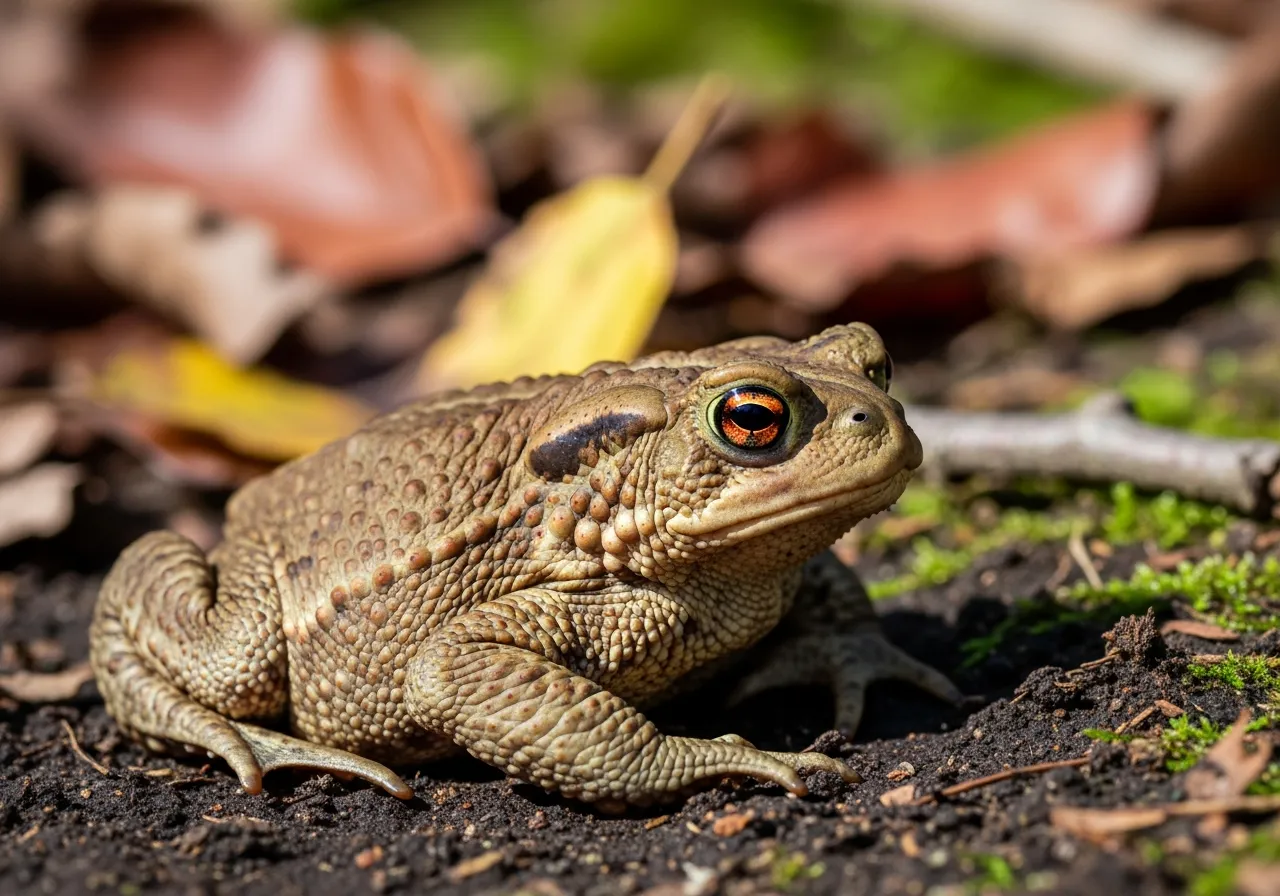
Source: Global Animal Guide (WARN)
In brief
A toad is a tail-less amphibian, typified by the common toad (Bufo bufo), with dry, warty skin, short legs and toxin-secreting parotoid glands behind the eyes. Unlike frogs, toads usually walk rather than leap, live mostly on land, and return to ponds each spring to breed.
Also in Animals A to Z · Animals that start with C
By WARN Research & Conservation TeamLast updated
The common toad (Bufo bufo) is a squat, warty-skinned amphibian found across much of Europe, north-west Africa and western Asia. Unlike the smooth, leaping frog, a toad has dry, knobbly skin and short legs, so it tends to walk or make small hops rather than long leaps. Behind each eye sits a swollen parotoid gland that secretes a defensive toxin, deterring many predators. Toads spend most of the year on land in woods, gardens and hedgerows, hunting slugs, worms and insects at night. Each spring, adults migrate—often hundreds of metres—back to the ponds where they were born to breed.
Up to 15 cm
Length of a large female common toad
10-12 yrs
Typical lifespan in the wild
1,500-6,000
Eggs laid in long double strings
2,500 m
Highest altitude it is found at
Figures sourced from Common toad - Wikipedia, IUCN Red List - Bufo bufo, Bufo bufo - Encyclopaedia Britannica (true toad / Bufonidae) and other references on this page.
Common Toad: Quick Facts
| Common name | Common toad (European toad) |
|---|---|
| Scientific name | Bufo bufo |
| Type | Amphibian (true toad) |
| Length | Typically 8-13 cm; up to ~15 cm |
| Lifespan | About 10-12 years in the wild |
| Diet | Slugs, snails, worms, insects and other invertebrates |
| Breeding | Spring; eggs in long double strings |
| Defence | Bufotoxin from parotoid glands |
| Range | Europe, NW Africa, western and northern Asia |
| IUCN status | Least Concern (declining in parts of the UK) |
Scientific Classification
| Kingdom | Animalia |
|---|---|
| Phylum | Chordata |
| Class | Amphibia |
| Order | Anura (frogs and toads) |
| Family | Bufonidae (true toads) |
| Genus | Bufo |
| Species | Bufo bufo |
Conservation Status
- IUCN Status
- Least Concern on the IUCN Red List, owing to its very wide distribution and large overall population. Despite the favourable global assessment, the common toad is declining in some regions, including parts of the United Kingdom, due to loss of breeding ponds, habitat fragmentation, road mortality during spring migrations, pollution and disease.
- Population
- Not precisely quantified; abundant and widespread across its global range, though declining locally in some areas.
- Trend
- Stable globally; declining in parts of the UK and some other regions
- Assessed
- 2009 (IUCN Red List assessment)
- CITES
- Not listed on CITES
Conserving and creating garden ponds, maintaining safe migration routes across roads, and protecting damp terrestrial habitat all help local toad populations recover.
Key Facts: Common Toad
- Toads and frogs are both amphibians, but toads have dry, warty skin, shorter legs and walk rather than leap.
- Parotoid glands behind the eyes secrete bufotoxin, a defence that makes most predators avoid eating toads.
- Each spring, common toads migrate back to ancestral breeding ponds, often crossing roads in large numbers.
- Females lay eggs in long double strings (not clumps like frogs), wrapped around water plants.
- Globally the common toad is listed as Least Concern by the IUCN, but it is declining in parts of the UK.
- Toads are gardeners' allies, eating large numbers of slugs, snails, beetles and other invertebrates.
What does a common toad look like?
The common toad is a robust, broad-bodied amphibian with dry, warty skin in shades of olive, brown, grey or dull yellow, helping it blend into leaf litter and soil. It typically reaches 8-13 cm in length, though large females can grow to around 15 cm; males are usually smaller and slimmer. The eyes are striking, with a horizontal pupil and a copper, orange or gold-coloured iris. The most distinctive feature is a pair of large, raised parotoid glands set behind the eyes, which secrete a defensive toxin. Toads have relatively short hind legs compared with frogs, which is why they tend to crawl or make small, awkward hops rather than the long, powerful leaps of a frog. Their skin is rougher and drier to the touch, and they lack the dark 'mask' marking common in frogs. Southern populations are generally larger than northern ones, and females are consistently stockier than males, a difference that becomes obvious in the breeding season.
How do toads breed and migrate?
Common toads spend most of the year on land, but in early spring they undertake a remarkable mass migration back to the ponds where they themselves hatched, sometimes travelling several hundred metres or more. Many follow the same routes year after year, which is why toads are so often seen crossing roads on mild, damp spring nights. At the pond, smaller males grip larger females in a mating embrace called amplexus, and a male may be carried to the water on a female's back. The female lays a long, paired string of eggs—often 3 to 4.5 metres long and containing roughly 1,500 to 6,000 eggs—winding it around submerged plants. Unlike frogs, toads do not lay rounded clumps of spawn. The eggs hatch into small, dark tadpoles after about ten days. Toad tadpoles are mildly toxic, which helps protect them from fish and other predators, and they gradually develop legs before emerging from the water as tiny toadlets in summer.
Are toads poisonous, and what do they eat?
Toads are not venomous in the sense of biting or stinging, but they are mildly poisonous to eat. The parotoid glands behind the eyes, along with smaller glands across the skin, secrete bufotoxin—a bitter, irritating substance that can sicken or deter a predator that tries to swallow the toad. This chemical defence means many animals learn to leave toads alone, although hedgehogs, grass snakes, rats, crows and birds of prey can still take them, and some predators skilfully avoid the toxic skin. The toxin can cause drooling, vomiting or worse in pet dogs or cats that mouth a toad, so curious pets are best kept away. As hunters, toads are voracious nocturnal predators of invertebrates, eating slugs, snails, worms, beetles, ants, woodlice, caterpillars, flies and spiders; large individuals occasionally take tiny mice. This appetite for slugs and other garden pests makes the toad a welcome, natural form of pest control.
Toad vs frog: how to tell them apart
| Feature | Common toad | Common frog |
|---|---|---|
| Skin | Dry, warty, rougher | Smooth, moist, often shiny |
| Legs and movement | Shorter legs; walks or short hops | Longer legs; long leaps |
| Parotoid glands | Prominent, behind the eyes | Absent |
| Eggs (spawn) | Long double strings around plants | Rounded clumps of jelly |
| Typical habitat | Mostly on land, returns to ponds to breed | Often near water year-round |
What WARN Does
WARN does not run field projects specifically for the common toad, which lives largely outside the countries where our partners work. This guide is part of our free educational work to help people understand and value wildlife. The threats that affect toads—habitat and pond loss, busy roads cutting across migration routes, pollution and disease—are the same pressures that harm many amphibians and other animals WARN does protect, so learning about one helps protect them all.
If this guide deepened your appreciation for wildlife, a small gift helps keep WARN's educational work free for everyone.
Common Toad: Frequently Asked Questions
What is the difference between a frog and a toad?
Are toads poisonous to touch or to dogs?
What do toads eat?
How long do common toads live?
Why do toads cross roads in spring?
Are common toads endangered?
Where do common toads live?
Are common toads dangerous?
How big is a common toad?
Sources & References
Population figures, conservation status and biological facts on this page are drawn from authoritative scientific and intergovernmental sources.
Terms used on this page
Plain-English definitions, from our wildlife and conservation glossary.
Explore more animals
Discover more animals, their habitats and their conservation status in the WARN wildlife-guide library.