Wildlife Guide · Central America & South America (Amazon Basin)
Toucan
Family Ramphastidae
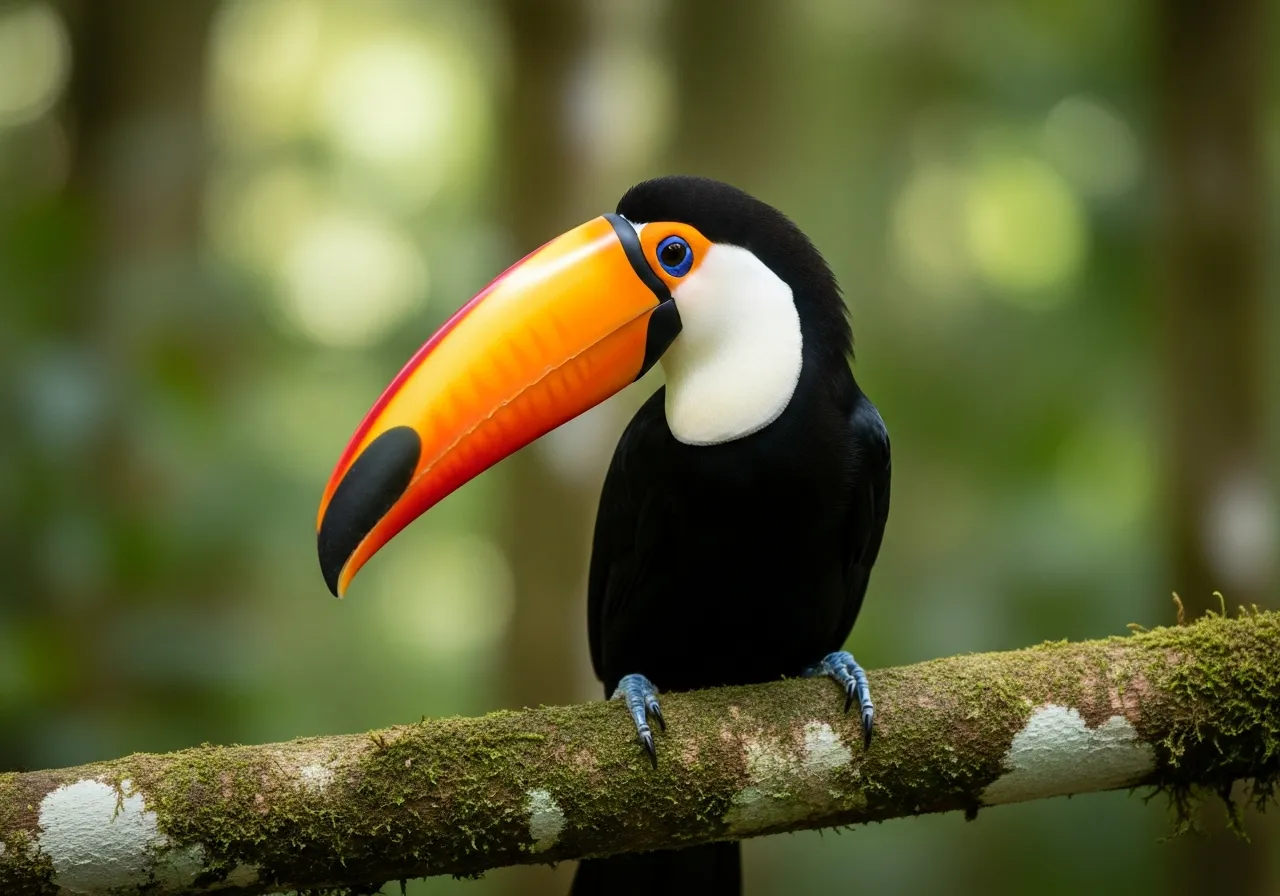
The rainforest's gardeners, carrying a bill that is part feeding tool, part radiator.
Source: Global Animal Guide (WARN)
In brief
A toucan is a brightly coloured, fruit-eating rainforest bird of the family Ramphastidae, native to Central and South America. Around 40 species exist, all recognised by an enormous yet lightweight bill used for feeding, display and heat regulation. They are important seed dispersers in tropical forests.
Also in Animals A to Z · Animals that start with T
By WARN Research & Conservation TeamLast updated
Toucans are the brightly coloured, large-billed birds of the family Ramphastidae, found only in the forests of Central and South America. The family contains around 40 species across five genera, ranging from tiny araçaris to the crow-sized toco toucan. Their most famous feature is an oversized, surprisingly lightweight bill that helps them reach fruit, sparring partners and even regulate body heat. Mainly fruit-eaters, toucans are vital seed dispersers, planting the next generation of rainforest trees as they feed. Most species are currently classed as Least Concern, but several are slipping toward threatened status as their forest homes shrink, making them both a familiar emblem and a quiet conservation barometer.
~40
species in family Ramphastidae
Up to 1/2
of body length taken up by the bill
30-60%
of body heat the bill can shed
2-4
white eggs per clutch
Figures sourced from Toucan - Wikipedia, Toco toucan - Wikipedia, Toucan - Encyclopaedia Britannica and other references on this page.
Toucan: Quick Facts
| Common name | Toucan |
|---|---|
| Family | Ramphastidae |
| Number of species | Around 40 |
| Range | Southern Mexico through Central and South America |
| Habitat | Mainly tropical rainforest; some montane forest |
| Diet | Mostly fruit; also insects and small animals |
| Size | About 29-63 cm long, 130-680 g |
| Bill | Lightweight; up to over half the body length |
| Clutch | 2-4 white eggs in a tree cavity |
| Conservation | Varies; most Least Concern, some threatened |
Scientific Classification
| Kingdom | Animalia |
|---|---|
| Phylum | Chordata |
| Class | Aves |
| Order | Piciformes |
| Family | Ramphastidae |
| Genera | Ramphastos, Pteroglossus, Aulacorhynchus, Selenidera, Andigena |
| Species | Around 40 species |
Conservation Status
- IUCN Status
- Varies by species. Of the roughly 40 species in the family Ramphastidae, most are assessed by the IUCN as Least Concern, including the toco toucan (Ramphastos toco) and keel-billed toucan (Ramphastos sulfuratus). Several species, however, are listed as Near Threatened or Vulnerable, chiefly due to deforestation and trapping for the wildlife trade.
- Population
- No reliable family-wide total; varies by species. Widespread species remain common, while range-restricted forest species are declining.
- Trend
- Mixed; stable for many widespread species, decreasing for several forest-restricted ones
- Assessed
- Per-species; see IUCN Red List for each species' latest assessment
- CITES
- Several toucan species, including the toco toucan, are listed on CITES Appendix II, which regulates international trade.
Because toucans depend on intact forest and large old trees for food and nesting, habitat loss is the dominant threat across the family, even for species not yet classed as threatened.
Did you know?
A toucan's giant bill is also a built-in radiator: by adjusting blood flow to it, the bird can dump or conserve a large share of its body heat, much like an elephant uses its ears to stay cool.
Key Facts: Toucan
- Toucans belong to the family Ramphastidae, around 40 species native only to Central and South America.
- The huge bill is built from a foam-like keratin over bony struts, making it strong but very light.
- Research shows the bill works as a heat radiator, shedding a large share of the bird's body heat.
- Toucans are mainly frugivores and act as key seed dispersers for many rainforest trees.
- They nest in tree cavities and typically lay two to four eggs; chicks hatch naked and helpless.
- Most species are Least Concern, but several are Near Threatened or Vulnerable as forests are cleared.
Why is a toucan's bill so big and what is it for?
The toucan's bill is its signature feature, reaching more than half the body length in the largest species such as the toco toucan. Despite its size it weighs very little, because it is made of a thin, hollow shell of keratin supported inside by a delicate lattice of bony struts and foam-like tissue. This light construction lets the bird wield a long reach without overbalancing. The bill is genuinely useful: toucans use it to pluck fruit from branches too slender to perch on, to reach into tree holes for food, to peel and manipulate items, and in social sparring matches that appear to settle dominance. Perhaps most remarkably, scientists have shown the bill doubles as a thermal radiator. Rich in blood vessels and lacking insulating feathers, it can release a large proportion of the bird's body heat, with studies finding it responsible for roughly 30 to 60 per cent of heat loss depending on conditions, comparable in effect to an elephant's ears. Toucans can adjust blood flow to the bill, dumping heat when warm and conserving it when cool. So the bill is feeding tool, display banner and built-in air conditioner all at once.
What do toucans eat and why do forests need them?
Toucans are primarily frugivores, feeding on a wide range of fruits from figs and palm fruits to guavas and peppers. They are not strict vegetarians, though: opportunistically they take insects, spiders, lizards, and the eggs and nestlings of other birds, which adds valuable protein, especially while raising young. A toucan typically grabs a fruit at the bill tip, then tosses its head back to flick the food into its throat. This fruit-heavy diet makes toucans some of the most important seed dispersers in tropical America. As they move between fruiting trees, often in noisy groups, they swallow seeds whole and deposit them, intact and ready to germinate, far from the parent tree. Large toucans can swallow big seeds that smaller birds cannot, so they help spread tree species that few other animals can move. This service knits the forest together, influencing which trees grow where and supporting the wider web of rainforest life. When toucan numbers fall in a forest, the dispersal of certain large-seeded trees can decline with them, a quiet but real ecological cost.
How do toucans live, breed and behave?
Most toucans are non-migratory residents of lowland and montane forest, with some Andean species living at surprisingly cool, high altitudes. They are social and often noisy, gathering in groups of a handful up to twenty or more, communicating with croaks, yelps and rattling calls that carry through dense canopy. Many species engage in playful-looking bill fencing and food-tossing, behaviour thought to reinforce pair bonds and social rank. For nesting, toucans rely on tree cavities, frequently old woodpecker holes or natural hollows, rather than building elaborate nests. A pair typically lays two to four glossy white eggs, and both parents share incubation. Chicks hatch blind, naked and helpless, with no down, and develop slowly inside the safety of the cavity, supported by pads on their heels that protect them on the bare nest floor. This dependence on tree holes ties toucan breeding success closely to the presence of large, old trees. Outside the breeding season, their bold colours, sociability and habit of perching in the open make them one of the most conspicuous and beloved sights of the neotropical forest.
Toucan vs hornbill: similar look, separate families
| Feature | Toucan | Hornbill |
|---|---|---|
| Family | Ramphastidae | Bucerotidae |
| Where found | Central and South America | Africa and Asia |
| Bill | Large, light, often very colourful | Large, often with a hollow casque on top |
| Order | Piciformes (near woodpeckers) | Bucerotiformes |
| Nesting | Nests in open tree cavities | Female often sealed inside the nest cavity |
| Relationship | Not closely related; resemblance is convergent evolution | Not closely related; resemblance is convergent evolution |
What WARN Does
World Animal Rescue Network does not run dedicated field projects for toucans, which live in Central and South American forests outside the countries where WARN's partners work partner countries. This guide is part of WARN's free educational work, helping people understand the wildlife that shares our planet. The threats that press hardest on toucans, above all rainforest loss and the wildlife trade, are the same forces that endanger many of the animals WARN does protect, so caring about toucans and caring about WARN's work pull in the same direction.
If this guide deepened your wonder at the natural world, a small gift helps keep WARN's free educational work and its frontline animal rescue going.
Toucan: Frequently Asked Questions
Are toucans endangered?
How big is a toucan and how heavy is its bill?
What do toucans eat?
Why is the toucan's bill so colourful and large?
Where do toucans live?
Can toucans be kept as pets?
Are toucans dangerous?
How long do toucans live?
Sources & References
Population figures, conservation status and biological facts on this page are drawn from authoritative scientific and intergovernmental sources.
Terms used on this page
Plain-English definitions, from our wildlife and conservation glossary.
Latest Toucan Stories
Quick, fact-checked reads on the toucan — amazing facts, key questions and the threats it faces.
Explore more animals
Discover more animals, their habitats and their conservation status in the WARN wildlife-guide library.