Wildlife Guide · Brazil & Peru
Uakari
Cacajao calvus (bald uakari); genus Cacajao
The Amazon's scarlet-faced sentinel of flooded forests
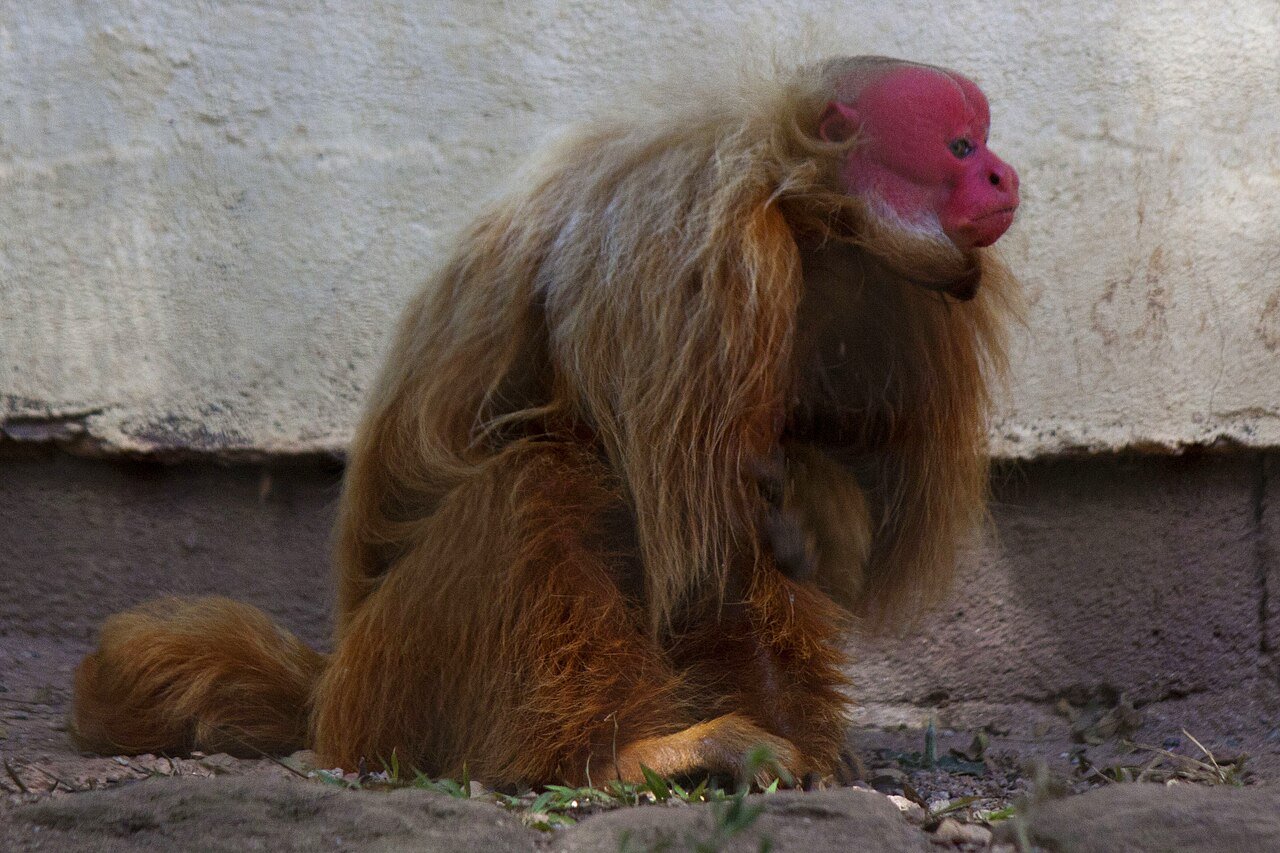
Photo: Nayeryouakim / Wikimedia Commons (CC BY-SA 4.0)
In brief
The bald uakari (Cacajao calvus) is a short-tailed, crimson-faced primate found exclusively in the seasonally flooded forests of the western Amazon; its fiery red face signals health to potential mates and makes it one of the most distinctive monkeys in South America.
Also in Animals A to Z · Animals that start with U
By WARN Research & Conservation TeamLast updated
Deep in the seasonally flooded forests of the western Amazon, the bald uakari stands out as one of South America's most striking primates. Its bare, vivid crimson face and bald head contrast sharply with a long, shaggy coat that ranges from white to rusty red depending on the species. Unlike most New World monkeys, it has a remarkably short tail — a stubby appendage that barely clears its haunches. The uakari belongs to the family Pitheciidae and the genus Cacajao, which recent DNA analyses have split into several distinct species. These monkeys are ecological specialists, tied almost entirely to várzea and igapó flooded forests along Amazonian river systems in Brazil, Peru, and Colombia — habitats now under mounting pressure from deforestation, climate-driven changes to flood cycles, and sustained hunting.
~45 cm
Head-body length
~3 kg
Adult weight
~15 cm
Tail length
15–20 yrs
Lifespan in wild
Figures sourced from IUCN Red List — Cacajao calvus (2024), Animal Diversity Web — Cacajao calvus, Royal Society Open Science — Proximate causes of the red face of the bald uakari (2015) and other references on this page.
Uakari: Quick Facts
| Habitat | Várzea and igapó flooded forests |
|---|---|
| Diet | Hard seeds, fruit pulp, insects, small invertebrates |
| Group size | Fission-fusion societies up to 100 individuals |
| Gestation | Approximately 6 months (c. 182 days) |
| Offspring per birth | Single young; one birth every ~2 years |
| Tail | Non-prehensile; unusually short (~15 cm) |
Scientific Classification
| Kingdom | Animalia |
|---|---|
| Phylum | Chordata |
| Class | Mammalia |
| Order | Primates |
| Family | Pitheciidae |
| Genus | Cacajao |
| Species (bald uakari) | Cacajao calvus Geoffroy, 1847 |
Conservation Status
- IUCN Status
- Least Concern (C. calvus, 2024); varies by species
- Population
- No global estimate; effective population sizes of C. rubicundus as low as ~700–1,100 individuals in some river catchments
- Trend
- Decreasing
- Assessed
- 2024
- CITES
- Appendix I
Recent taxonomic revision split Cacajao calvus into multiple full species. C. calvus was downlisted from Vulnerable to Least Concern in 2024 due to protected-area coverage; climate change and altered flood cycles remain the principal long-term threat. C. rubicundus has very small effective population sizes in parts of its range.
Did you know?
A pale face is a warning sign: uakaris infected with malaria lose the vibrant red colouration from their face as haemoglobin drops, making facial colour one of the few visual health diagnostics in the primate world.
Key Facts: Uakari
- The uakari's bare crimson face is a genuine health signal — pale-faced individuals are more likely to be ill with malaria or other blood-borne diseases.
- Uakaris are among the only short-tailed New World monkeys, with a stubby tail around 15 cm long.
- They are ecological specialists of Amazonian flooded forests (várzea and igapó), making them highly sensitive to climate-driven disruptions in annual flood cycles.
- Their powerful jaws let them crack open hard-shelled seeds inaccessible to most other primates, making them important seed dispersers in their ecosystem.
- Females reproduce slowly — one offspring every two years after a roughly six-month gestation — meaning populations recover very slowly from hunting pressure.
- Recent (2024) IUCN reassessments split the former Cacajao calvus into multiple species; conservation status and population size now vary significantly between them.
What is a uakari monkey?
The uakari (pronounced wah-KAH-ree) is a medium-sized New World primate in the genus Cacajao, family Pitheciidae — a group that also includes sakis and titis. What immediately sets uakaris apart from other Amazonian monkeys is a combination of features found nowhere else in the New World: a completely bald head, a shockingly crimson or scarlet face devoid of fur, and an unusually short tail that represents only a fraction of the animal's body length. Most New World monkeys have long, often prehensile tails; the uakari's stubby tail — roughly 15 cm, compared to a 45 cm body — is the most dramatic exception. The coat varies by species from white or cream in the white bald uakari (Cacajao calvus) to deep russet-orange in the red bald uakari (C. rubicundus). Adults typically weigh between 2.75 and 3.5 kg, with males slightly larger than females. Taxonomically, the genus has been revised substantially: DNA analyses published around 2022 elevated each former subspecies of the old Cacajao calvus grouping to full species status, so the number of recognised Cacajao species is now larger than it was a decade ago. All species share the genus's hallmark dental toolkit — enlarged canines and flat, crenulated molars for processing hard seeds — and all are restricted to the Amazon basin.
Where do uakari monkeys live?
Uakaris are habitat specialists of exceptional precision. They are found almost exclusively in the seasonally flooded forests of the western Amazon basin — primarily the várzea (white-water floodplain forests) and igapó (black-water flooded forests) that line the Amazon and its major tributaries in western Brazil, eastern Peru, and southern Colombia. These forests flood for several months each year, sometimes by as much as ten metres of water, and the uakari has evolved to exploit this dynamic environment with remarkable agility — swimming between trees when necessary and foraging in the forest canopy during peak flood season. During the dry season, when waters recede, uakaris descend to the forest floor to forage for fallen seeds and seedlings. Their range is strongly correlated with the distribution of specific tree species whose hard-shelled fruits they depend on, meaning that even subtle alterations to forest composition can render an area unsuitable. Home ranges are large — groups have been recorded travelling several kilometres per day — and the monkeys aggregate in fission-fusion societies of up to 100 individuals that temporarily break into smaller foraging subgroups and reconvene. The core range of the white bald uakari (C. calvus) straddles the Brazilian state of Amazonas and adjacent Peru, while the red bald uakari (C. rubicundus) is restricted to floodplain forests of the Solimões River basin in Brazil.
Why is the uakari's red face so important?
Few features in the primate world carry as much biological information as the uakari's bare crimson face. Research published in Royal Society Open Science (2015) confirmed that the intense red colouration is produced not by pigment but by the exceptionally high density of superficial blood capillaries visible through thin, largely amelanotic (non-pigmented) skin — the same phenomenon that makes humans blush, but permanent and extreme. This arrangement allows the colour of the face to function as an honest signal of health: a deeply red face indicates strong vascular flow, high haemoglobin levels, and freedom from blood-borne disease. In contrast, a pale or washed-out face suggests illness. This matters because the Amazon's flooded forests are a prime breeding ground for malaria-carrying mosquitoes, and uakaris are susceptible to Plasmodium falciparum, the same malaria parasite that infects humans. Females consistently prefer mates with the most intensely coloured faces, using facial redness as a proxy for immune fitness — a classic example of honest signalling driven by parasite pressure. The bald head itself likely arose to reduce ectoparasite load and enhance thermoregulation in a hot, humid canopy environment. Interestingly, captive uakaris kept away from natural sunlight often develop a paler face, which may explain their historical reputation for looking 'sickly' in older zoo collections compared to wild individuals.
What do uakari monkeys eat?
Uakaris are classified as seed predators and frugivores, with a dietary strategy that sets them apart from most other Amazonian primates. Their most distinctive feeding adaptation is their ability to crack open the hard outer shells of unripe fruits and woody seed pods that are entirely inaccessible to other mammals. Powerful jaw muscles, enlarged canines, and flat, heavily crenulated molar teeth allow them to bite through structures that would defeat most primate dentitions. During the wet season, when the forest floor is submerged and the canopy is laden with fruit, uakaris feast on seeds and pulp high in the trees, often processing dozens of hard fruits per day. As floodwaters recede in the dry season, they descend to forage on fallen seeds, seedlings, insects, and occasionally small vertebrates. This dietary flexibility is critical for survival across the dramatic seasonal flux of Amazonian flooded forests. Despite being seed predators — meaning they often destroy the seeds they eat rather than dispersing them intact — uakaris do contribute to forest regeneration by dropping and moving partially processed seeds and by consuming fruit pulp and passing smaller seeds in their dung. Their foraging behaviour and reliance on specialist tree species means they function as important bio-indicators: the presence of a healthy uakari population reliably indicates a structurally intact, species-rich flooded forest beneath them.
Are uakari monkeys threatened, and what are the key dangers?
The conservation picture for uakaris is nuanced and shaped by recent taxonomic revision. In 2024, the IUCN updated assessments for the now-separate Cacajao species: the white bald uakari (C. calvus) was downlisted to Least Concern, reflecting that much of its range falls within legally protected areas with relatively low human population density. However, the IUCN notes that climate change represents the most imminent future threat, as predictions point to significant disruption of the annual precipitation cycle in Amazonian flooded forests — the very habitat upon which C. calvus depends entirely. Other species within the genus, including C. rubicundus, face more acute pressure; genomic analyses have revealed effective population sizes of under 1,000 individuals in some river catchments. Across the genus, the two most persistent threats are hunting — uakaris are targeted for bushmeat in Peru and used as fishing bait in parts of Brazil — and the progressive degradation of flooded forest from agricultural expansion (cattle ranching, soy cultivation), illegal logging, and dam construction that alters river flood regimes. Uakaris' slow reproductive rate — one offspring every two years, after a gestation of approximately six months — means local populations struggle to recover from even modest hunting pressure. All Cacajao species are listed on CITES Appendix I, prohibiting commercial international trade, and national laws in both Brazil and Peru provide additional protections.
What WARN Does
WARN runs active rescue and conservation projects in Brazil, putting it directly within the uakari's core range in the Amazon basin. Protecting flooded forest habitat in Brazil is central to the long-term future of these primates, and awareness among the public — knowing why these forests matter and what makes species like the uakari so ecologically irreplaceable — is one of the most powerful tools conservation partners have. This guide is offered as free educational content to build that awareness.
Amazonian flooded forests — the only home the uakari has ever known — are vanishing to agriculture and dams. Supporting WARN's work in Brazil helps protect the river-edge habitats these scarlet-faced primates cannot live without.
Uakari: Frequently Asked Questions
Why does the uakari have a red face?
Why does the uakari have such a short tail?
What is the difference between várzea and igapó forest?
How many uakari species are there?
Are uakari monkeys dangerous to humans?
What do bald uakaris eat?
Where do bald uakaris live?
How long do bald uakaris live?
How big is a bald uakari?
Sources & References
Population figures, conservation status and biological facts on this page are drawn from authoritative scientific and intergovernmental sources.
Terms used on this page
Plain-English definitions, from our wildlife and conservation glossary.
Latest Uakari Stories
Quick, fact-checked reads on the uakari — amazing facts, key questions and the threats it faces.
Briefings
The Pink River Dolphin: Why the Amazon's Most Unusual Mammal Is Endangered
The pink river dolphin — the boto — is one of only a handful of freshwater dolphin species left on Earth. It lives in the rivers of Colombia and Peru, and it is now formally listed as Endangered on the IUCN Red List. A briefing on what it is, why it is in trouble, and what frontline rescue work can still do.
Read the storyBriefings
The Kinkajou: The Rainforest Mammal Most People Have Never Heard Of
The kinkajou is a small, golden-brown rainforest mammal with a prehensile tail and enormous dark eyes. It lives in the forests of Colombia and Peru. Its biggest threats are habitat loss and the exotic pet trade — and that is exactly where rescue and sanctuary work can help.
Read the storyBriefings
The Capuchin Monkey: The Tool-Using Primate at the Heart of the South American Pet Trade Problem
Capuchin monkeys are among the most intelligent primates in the Americas — and one of the most heavily trafficked. They live across the forests of Colombia and Peru, and they are a regular caseload at rescue centres dealing with the South American illegal pet trade.
Read the storyExplore more animals
Discover more animals, their habitats and their conservation status in the WARN wildlife-guide library.