Wildlife Guide · Southern hemisphere forests & New Zealand, Australia, Chile and tropical montane forest
Velvet Worm
Phylum Onychophora — about 200 described species
An ancient lineage that hunts by squirting glue — neither worm nor insect, but its own phylum.
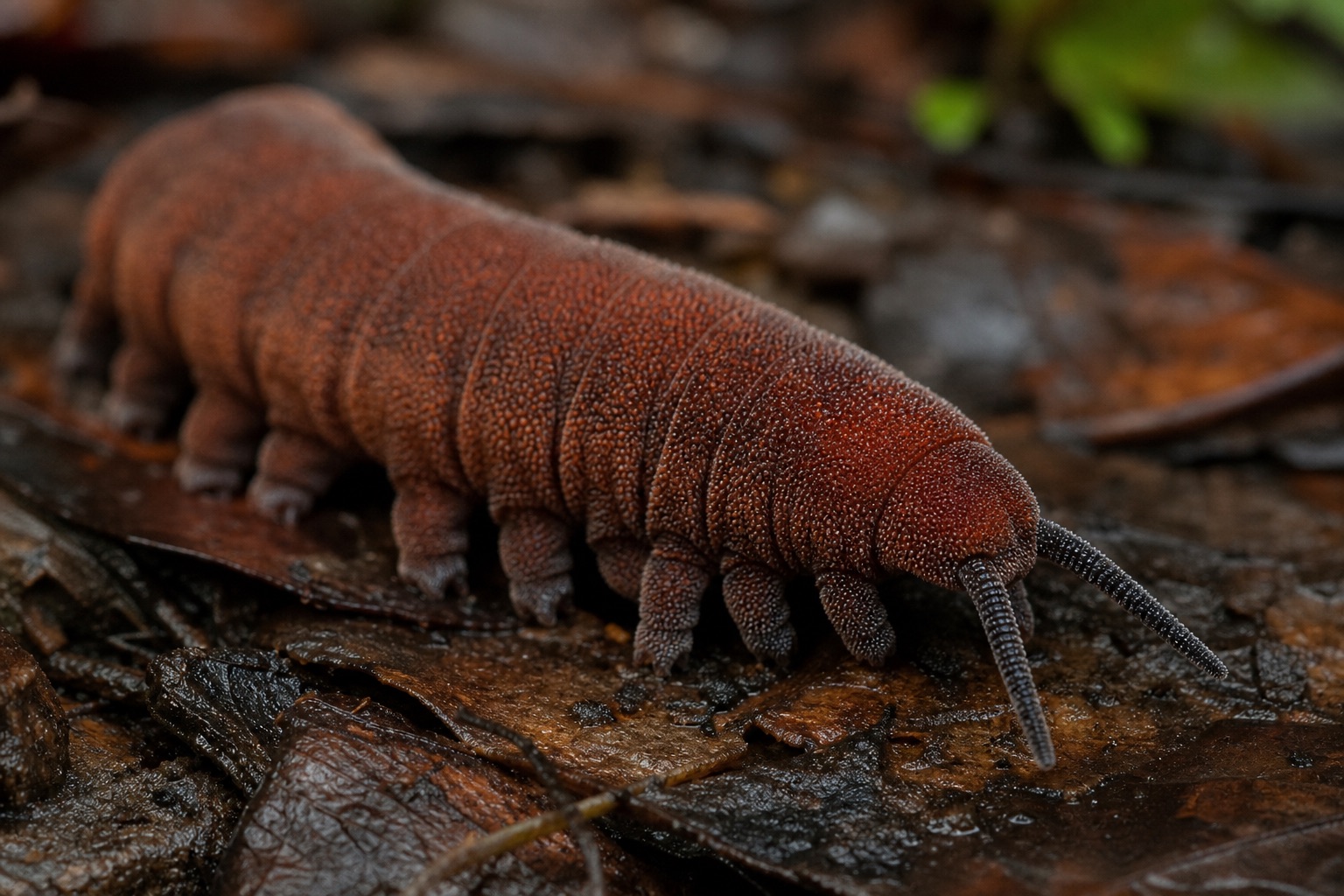
AI-generated educational wildlife portrait — World Animal Rescue Network · AI visualisation, not a photograph
In brief
Velvet worms (phylum Onychophora) are soft-bodied terrestrial animals neither worms nor insects, numbering about 200 species in moist southern hemisphere forests; they capture prey by firing adhesive slime jets from oral papillae and are mostly unassessed on the IUCN Red List.
Also in Animals A to Z · Animals that start with V
By WARN Research & Conservation TeamLast updated
Velvet worms belong to phylum Onychophora — neither annelid worms nor arthropods, though they share traits with both. About 200 species live in moist leaf litter and rotting logs in southern hemisphere forests, especially Australia, New Zealand and Chile. The body is soft, velvety, segmented, with stubby unjointed legs and a pair of antennae. Hunting is unique. Velvet worms squirt twin jets of sticky slime from oral papillae near the head, trapping insects at a distance. The prey is bitten, injected with saliva, and eaten. Fossils suggest onychophorans have changed little for hundreds of millions of years — a living glimpse of early animal diversification.
~200
Described species in phylum Onychophora
Own phylum
Not Insecta, not Annelida — Onychophora
Slime jets
Twin adhesive streams fired at prey
Ancient
Fossil lineage spanning hundreds of millions of years
Figures sourced from Animal Diversity Web — Onychophora, Australian Museum — Velvet worms, Encyclopedia of Life — Onychophora .
Velvet Worm: Quick Facts
| Length | Roughly 2–10 cm depending on species |
|---|---|
| Phylum | Onychophora — unique lineage |
| Hunting | Slime jets from oral papillae |
| Habitat | Moist leaf litter in southern forests |
| Legs | Stubby unjointed legs with claws per segment |
| IUCN status | Not Evaluated for most species |
Scientific Classification
| Kingdom | Animalia |
|---|---|
| Phylum | Onychophora |
| Classes | Two extant classes — Udeonychophora and Euonychophora |
| Described species | About 200 worldwide |
| Not | Not Insecta, not Annelida, not Arachnida |
| Habitat | Moist forest litter and rotting wood |
| Defence/hunting | Adhesive oral slime jets |
Conservation Status
- IUCN Status
- Not Evaluated
- Population
- No reliable estimates
- Trend
- Unknown; forest litter moisture loss is the main pressure
- Assessed
- Most species not assessed
- CITES
- Not listed
Endemic onychophorans on single mountains or forest patches can disappear without ever receiving a Red List entry.
Did you know?
Velvet worms can recycle their own hunting slime — eating what misses the target rather than wasting the protein.
Key Facts: Velvet Worm
- Velvet worms are phylum Onychophora — a distinct lineage separate from insects, spiders and earthworms.
- They fire twin jets of adhesive slime from oral papillae to trap insects at range, then bite and feed.
- About 200 species live in moist leaf litter and rotting wood in southern hemisphere forests.
- Stubby legs are unjointed but end in claws; movement is slow and deliberate.
- Fossil onychophorans extend the lineage deep into Palaeozoic time with minimal change in body plan.
- Most species are Not Evaluated; habitat loss and dryness are local threats for moisture-dependent animals.
Neither worm nor bug — a phylum of its own
Onychophorans were once classified as annelids, then as arthropods. Molecular work places them in their own phylum, related to both but distinct. The body wall is thin and must stay moist; velvet worms die quickly in dry air.
Each segment bears paired stubby legs with claws — not jointed like insect legs, not bristled like earthworm segments. Antennae are sensory; eyes, when present, are simple. They breathe through a tracheal system with spiracles, like insects, but without a hard exoskeleton moult in the insect style.
The slime attack
When prey — crickets, termites, other litter invertebrates — comes within range, velvet worms eject quick-setting slime from glands opening at oral papillae. Two streams can cross in mid-air and gum the victim in place. The worm approaches, bites with mandibles inside the mouth, injects digestive saliva, and eats.
Slime is proteinaceous and contracts as it sets, pulling prey toward the attacker. Unused slime can be eaten to recycle protein — nothing wasted. Range is modest, a body length or so, but the mechanism is unlike any spider web or insect trap.
Living fossil — with caveats
Fossils such as lobopodians from Cambrian deposits resemble onychophorans closely enough that textbooks call velvet worms 'living fossils'. That label overstates stasis — modern species occupy specific niches in litter communities — but the body plan is genuinely ancient.
Understanding onychophorans informs debates about how arthropods evolved segmented bodies and legs. They are not ancestral arthropods themselves, but they illuminate the neighbourhood of early animal evolution.
Moist litter and assessment gaps
Velvet worms require humid microhabitats. Logging, fire and climate drying remove litter moisture they depend on. Most species have tiny ranges on single mountains or forest patches — ideal setup for local extinction without global assessment.
Almost no onychophoran species carry IUCN listings. They are rarely traded or noticed by the public, which keeps them off priority lists even when endemic species occupy single cloudforest peaks.
What WARN Does
WARN publishes education for ancient, overlooked lineages whose habitat disappears quietly. Velvet worms are moisture specialists in litter nobody surveys until the forest is logged.
If this guide helps you understand wildlife and the pressures it faces, a gift to WARN supports habitat protection and free public education in our partner countries.
Velvet Worm: Frequently Asked Questions
What do velvet worms eat?
Where do velvet worms live?
Are velvet worms dangerous?
How long do velvet worms live?
How big are velvet worms?
Are velvet worms insects or worms?
Are velvet worms endangered?
Sources & References
Population figures, conservation status and biological facts on this page are drawn from authoritative scientific and intergovernmental sources.
Terms used on this page
Plain-English definitions, from our wildlife and conservation glossary.
Explore more animals
Discover more animals, their habitats and their conservation status in the WARN wildlife-guide library.