Wildlife Guide · Kenya & Tanzania
Zebra
Equus (subgenus Hippotigris) — Equus quagga, Equus zebra, Equus grevyi
Three striped species, one icon of the African plains — and one of them is sliding toward extinction.
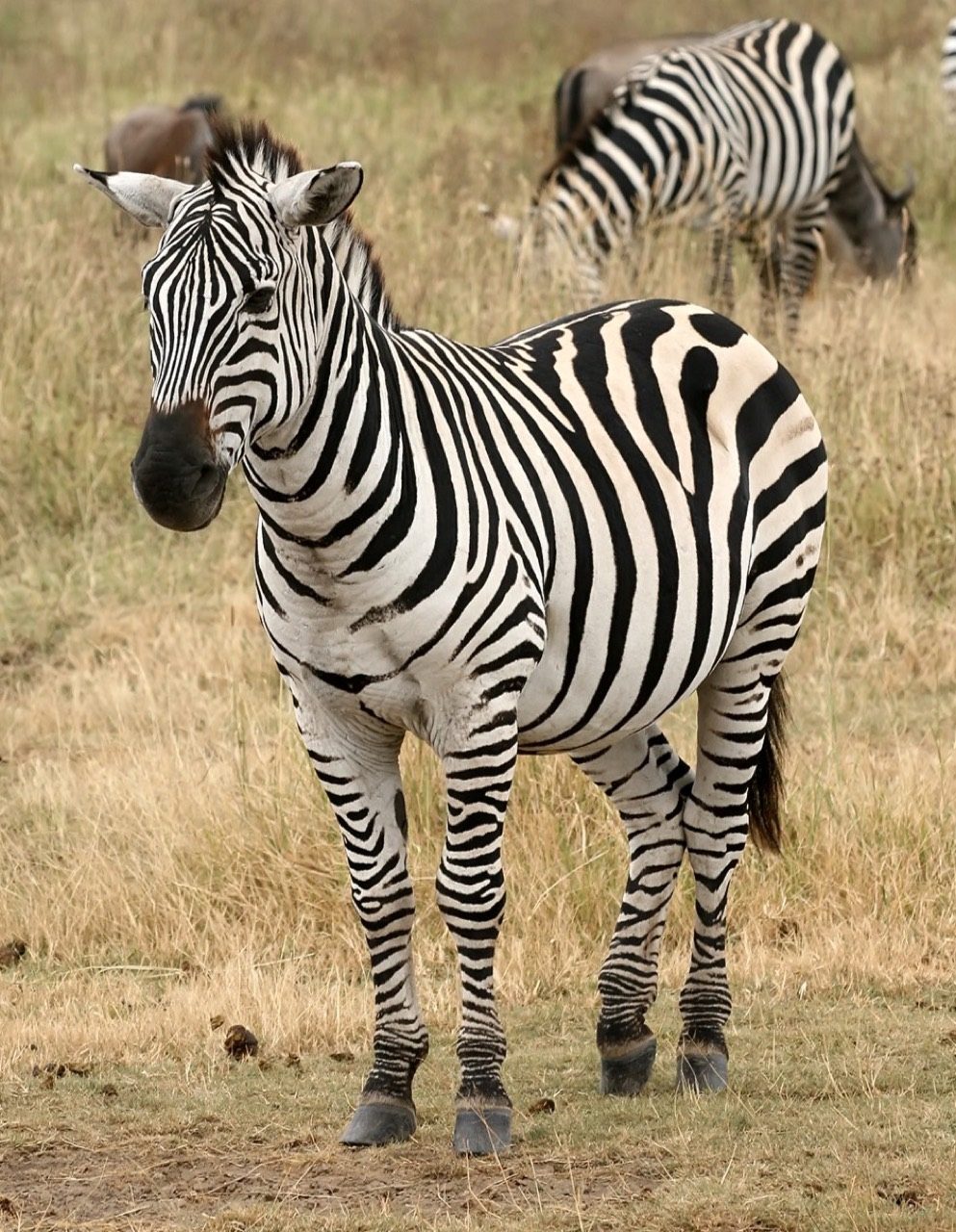
Source: Wikimedia Commons via Wikipedia “Zebra”
In brief
A zebra is a striped African member of the horse genus Equus; there are three species — plains, mountain, and Grevy's — ranging from Near Threatened to the Endangered Grevy's zebra, of which fewer than about 2,000 mature animals survive.
Also in Animals A to Z · Animals that start with Z
By WARN Research & Conservation TeamLast updated
Zebras are striped members of the horse family that live across the grasslands and arid scrub of eastern and southern Africa. There are three living species — the plains zebra, the mountain zebra, and Grevy's zebra — and each carries a different conservation story. The plains zebra is still the most numerous and recognisable, the familiar dazzle of the safari savanna, while the larger, narrow-striped Grevy's zebra has collapsed to a fraction of its former numbers. No two zebras wear the same pattern of stripes, a fingerprint-like coat that has fascinated scientists for more than a century. This guide explains how the three species differ, what stripes are actually for, and why the rarest zebra now ranks among Africa's most endangered large mammals.
3
Living species
~2,000
Mature Grevy's zebra left (IUCN, 2016)
Up to 65 km/h
Top running speed (~40 mph)
390 days
Grevy's zebra gestation
Figures sourced from IUCN Red List — Plains zebra (Equus quagga), IUCN Red List — Grevy's zebra (Equus grevyi), IUCN Red List — Mountain zebra (Equus zebra) and other references on this page.
Zebra: Quick Facts
| Lifespan | 20–30 years in the wild; up to ~40 in captivity |
|---|---|
| Weight | 175–450 kg (plains to Grevy's zebra) |
| Size | 1.1–1.6 m tall at the shoulder |
| Diet | Herbivore — mainly grasses (grazer) |
| Gestation | ~12–13 months (about 390 days in Grevy's zebra) |
| Young per birth | Usually a single foal |
| Baby name | Foal |
| Group name | A dazzle (also called a herd or zeal) |
| Top speed | Up to ~65 km/h (40 mph) |
| CITES | Grevy's & Cape mountain zebra Appendix I; Hartmann's mountain zebra Appendix II |
Scientific Classification
| Kingdom | Animalia |
|---|---|
| Phylum | Chordata |
| Class | Mammalia |
| Order | Perissodactyla |
| Family | Equidae |
| Genus | Equus |
| Subgenus | Hippotigris (plains and mountain zebra); Dolichohippus (Grevy's zebra) |
| Species | Equus quagga, Equus zebra, Equus grevyi |
Conservation Status
- IUCN Status
- Varies by species — Near Threatened (plains), Vulnerable (mountain), Endangered (Grevy's)
- Population
- Plains zebra ~150,000–250,000 mature individuals; mountain zebra ~9,000 mature; Grevy's zebra fewer than 2,000 mature (~2,250 total)
- Trend
- Plains zebra decreasing; mountain zebra increasing overall; Grevy's zebra recently stabilised after steep historic decline
- Assessed
- 2016 (plains and Grevy's zebra); mountain zebra 2019
- CITES
- Grevy's zebra and Cape mountain zebra: Appendix I; Hartmann's mountain zebra: Appendix II
As a group page, the listed status reflects three separate IUCN assessments rather than a single figure; Grevy's zebra is the most threatened.
Did you know?
Each zebra's stripe pattern is as unique as a fingerprint — foals learn to recognise their mother by the exact arrangement of her stripes, along with her scent and call.
Key Facts: Zebra
- There are three zebra species — plains (Equus quagga), mountain (Equus zebra), and Grevy's (Equus grevyi) — not one.
- Conservation status varies sharply: the plains zebra is Near Threatened, the mountain zebra is Vulnerable, and Grevy's zebra is Endangered.
- Grevy's zebra has declined from roughly 15,000 animals in the 1970s to about 2,250 today, with fewer than 2,000 mature individuals.
- Every zebra has a unique stripe pattern, like a human fingerprint; no two are identical.
- Stripes likely deter biting flies and may help with temperature regulation and social recognition, rather than simple camouflage.
- Main threats are habitat loss, competition with livestock for water and grazing, fencing that blocks migration, and hunting for hides and meat.
The three species of zebra
Zebras are not a single animal but three distinct species. The plains zebra (Equus quagga) is the most widespread and the one most safari-goers picture: medium-sized, with broad stripes that often carry faint brown 'shadow' lines between the black bands. The mountain zebra (Equus zebra), found in the rocky uplands of southern Africa, has a distinctive dewlap on its throat and a grid-like pattern on its rump. Grevy's zebra (Equus grevyi) is the largest and most horse-like, standing up to about 1.6 m at the shoulder, with narrow, closely spaced stripes, large rounded ears, and a white belly. Grevy's zebra is restricted today mainly to northern Kenya and small pockets of Ethiopia, which makes its decline especially serious.
What zebra stripes are actually for
The purpose of zebra stripes is one of biology's long-running puzzles, and the evidence now points away from old ideas of camouflage against tall grass. The strongest experimental support is that stripes deter biting flies such as tsetse and horseflies, which struggle to land cleanly on the high-contrast pattern — important because those flies carry disease. Researchers have also proposed that stripes help with cooling, by setting up small air currents over the skin, and that they aid individual and social recognition within a herd, since each animal's pattern is unique. Several of these benefits may work together rather than there being a single 'reason' for stripes.
Why Grevy's zebra is endangered
Grevy's zebra has suffered one of the steepest declines of any large African mammal. In the 1970s the global population was estimated at around 15,000 animals; today only roughly 2,250 remain, with fewer than 2,000 of them mature breeding adults. The causes are habitat loss and fragmentation, competition with domestic livestock for scarce water and grazing in arid rangelands, reduced access to water sources, and historic hunting for their striking skins. Because the species is now concentrated in a small area of Kenya and Ethiopia, local droughts and disease outbreaks can have an outsized impact. Plains and mountain zebras are in a stronger position overall, but plains zebra numbers are falling across much of their range as well.
Behaviour, herds and life cycle
Plains and mountain zebras live in tight family groups led by a stallion, with mares and their foals, and these harems often gather into larger herds at water or on migration. Grevy's zebra is more loosely social, with males holding territories rather than permanent harems. A zebra foal can stand and run within an hour of birth — a vital defence against lions, hyenas and wild dogs — and is born brown and white before darkening with age. Gestation runs roughly 12 to 13 months depending on species, and a single foal is the norm. Zebras are grazers, feeding mainly on grasses, and can survive on coarser, drier vegetation than many of the antelopes they share the plains with.
The three zebra species compared
| Species | Scientific name | IUCN status | Distinguishing feature |
|---|---|---|---|
| Plains zebra | Equus quagga | Near Threatened | Broad stripes, often with faint brown shadow stripes; most widespread |
| Mountain zebra | Equus zebra | Vulnerable | Throat dewlap and grid-like rump pattern; rocky southern uplands |
| Grevy's zebra | Equus grevyi | Endangered | Largest; narrow stripes, big rounded ears, white belly; northern Kenya and Ethiopia |
What WARN Does
WARN publishes this guide for education and is developing support through assessed animal-welfare grants. A species range, source citation or photograph does not establish a recipient or funding agreement. Check /about/where-your-money-goes/#grant-register for published grant and payment records; records not yet published must not be read as zero activity. Browse /appeals/ for the purposes currently available to support.
Zebras live beyond the regions WARN currently funds, but the threats they face — vanishing habitat and the wildlife trade — are the same ones your gift fights every day. Support Habitat Protection to help WARN safeguard the wild places that endangered species depend on.
Zebra: Frequently Asked Questions
How many species of zebra are there?
Are zebras endangered?
Why do zebras have stripes?
Is a zebra black with white stripes or white with black stripes?
Are zebras and horses the same thing?
How fast can a zebra run?
Sources & References
Population figures, conservation status and biological facts on this page are drawn from authoritative scientific and intergovernmental sources.
Terms used on this page
Plain-English definitions, from our wildlife and conservation glossary.
Latest Zebra Stories
Quick, fact-checked reads on the zebra — amazing facts, key questions and the threats it faces.
Briefings
Why Africa's Elephants Are Being Lost to Wire — Not Bullets
Ivory poaching gets the headlines, but across much of East Africa the bigger threat to elephants is cheap snare wire set for bushmeat.
Read the storyBriefings
Bushmeat and the Selous–Niassa Corridor: A Quiet Wildlife Emergency
The forest corridor connecting Tanzania's southern reserves with Mozambique is one of Africa's most ecologically important. It is also one of its most heavily snared.
Read the storySpecies
The African Lion: Vulnerable, Declining, and Disappearing From Most of Africa
African lion numbers have fallen by an estimated 43% over three generations, and the species is now extinct across more than 90% of its historic range. Kenya and Tanzania — two countries WARN plans to expand into — hold some of the last strongholds.
Read the storyExplore more animals
Discover more animals, their habitats and their conservation status in the WARN wildlife-guide library.