Animal Comparison
Orangutan vs Gorilla
Compare orangutans and gorillas by size, diet, habitat and social life. Learn the species differences, conservation threats and ways to help.
By WARN Research & Conservation TeamLast updated
In brief — Orangutan vs Gorilla
Orangutans are mostly tree-living great apes from Borneo and Sumatra; gorillas are generally larger African great apes that spend more time on the ground and usually live in groups.
Both belong to the great ape family, but orangutans are the genus Pongo and gorillas the genus Gorilla. Reddish hair and very long arms help identify an orangutan; a more heavily built body and dark hair help identify a gorilla. Their wild ranges do not overlap. “Solitary” and “ground-living” are useful shorthand, with important exceptions explained below.
See the difference
Images are shown at different scales. Read each caption for the species, source and context.
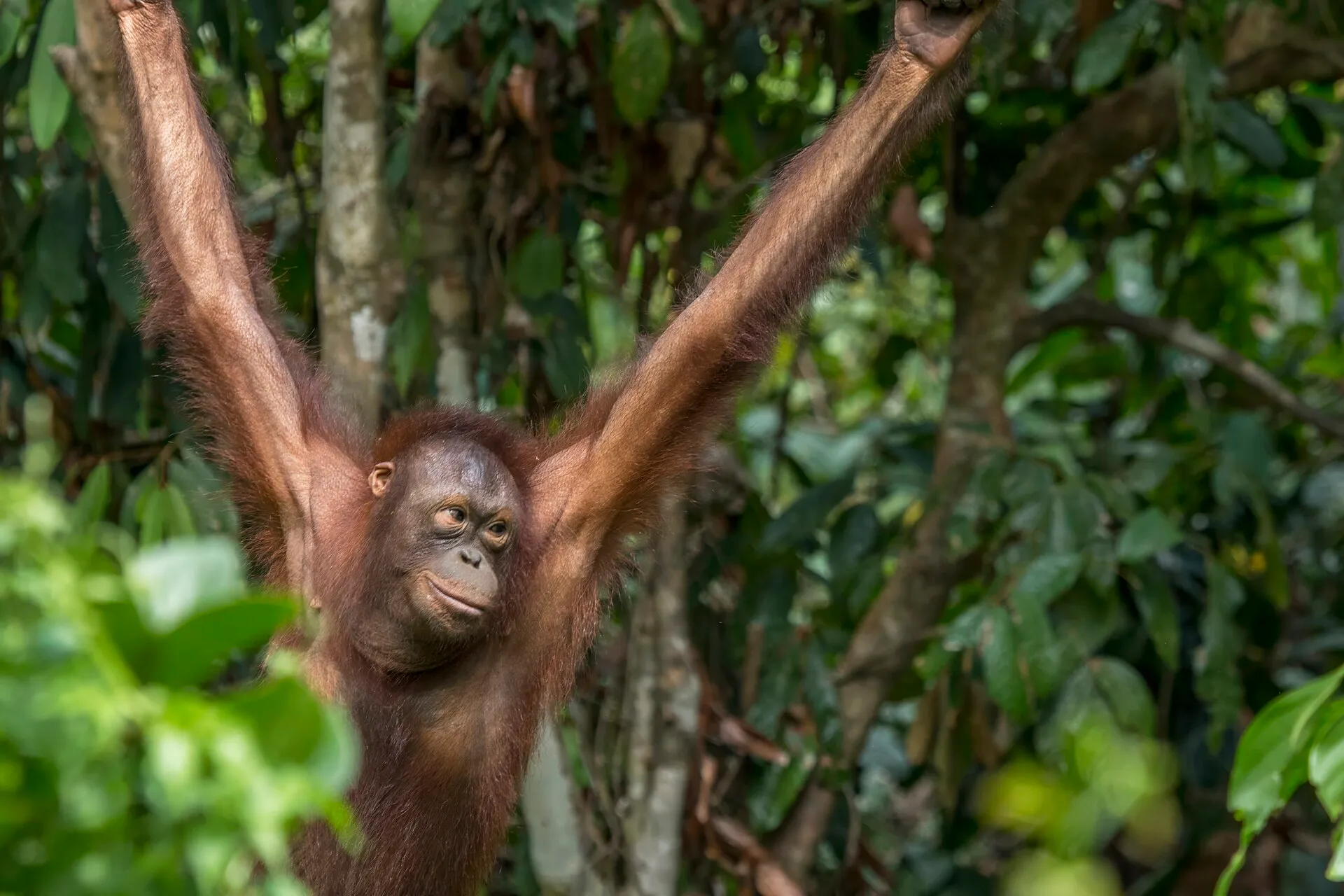
Bornean orangutan in Sepilok, Malaysia, 14 May 2015. Species photograph, not a fire or rescue image.
Photo: Charles J. Sharp / Wikimedia Commons (CC BY-SA 4.0). Resized and converted to WebP.
_Sepilok.jpg)
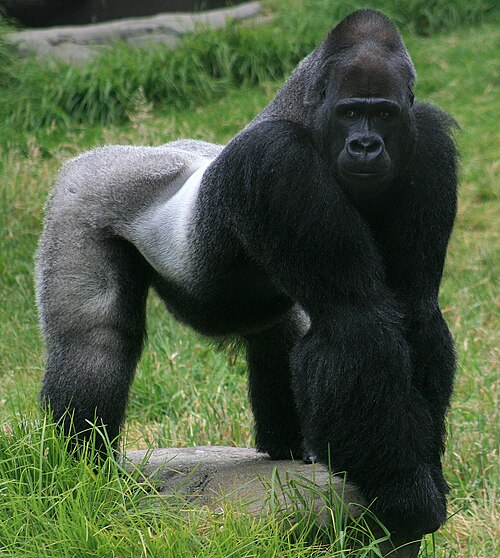
Male western gorilla in San Francisco Zoo. A zoo photograph, not a WARN rescue.
Photo: Brocken Inaglory / Wikimedia Commons (CC BY-SA 3.0). Resized by Wikimedia; displayed without cropping.

Orangutan vs Gorilla: At a Glance
| Feature | Orangutan | Gorilla |
|---|---|---|
| Classification | Pongo: Bornean, Sumatran and Tapanuli orangutans | Gorilla: western and eastern gorillas, with four recognised subspecies |
| Native range | Borneo and Sumatra in Southeast Asia | Equatorial Africa; range differs by species and subspecies |
| Appearance | Orange to reddish-brown hair; arms much longer than legs | Dark hair and a robust body; mature males develop a silver saddle |
| Adult weight examples | Wild males: 77–100 kg; wild females: 36–54 kg (Smithsonian) | Males: 136–181 kg; females: 72–98 kg (San Diego Zoo’s general guide) |
| Movement | Mainly climbs and walks through trees; also travels on the ground | Mainly knuckle-walks on the ground; also climbs |
| Diet | Fruit is important; other plant foods and some animal foods also occur | Mostly plant foods; western lowland gorillas eat substantial seasonal fruit |
| Social life | Semi-solitary, with strong mother–young bonds and other associations | Usually groups; composition varies, and some males live alone |
| Conservation | All three species: Critically Endangered | Both species: Critically Endangered; mountain gorilla subspecies: Endangered |
Size and physical differences
Adult male gorillas are generally heavier than adult male orangutans. Sex, species and living conditions matter, and body weight does not establish a strength ratio or predict a fight.
A good comparison begins with the animal and its setting. Is the photograph of an adult or a youngster? Which species does it show? Was it taken in the wild or in a zoo? These details prevent a large captive male from becoming the supposed normal size of an entire group. The table gives a quick answer; the sections below explain the differences that matter for identification, ecology and conservation.
Which species are we comparing?
Orangutan is a shared name for three species: the Bornean orangutan, Pongo pygmaeus; Sumatran orangutan, Pongo abelii; and Tapanuli orangutan, Pongo tapanuliensis. Borneo is shared by several countries, but wild orangutans occur in its Indonesian and Malaysian parts. Both other species live on Sumatra. Tapanuli orangutans are restricted to the Batang Toru ecosystem.
Gorillas comprise western gorillas, Gorilla gorilla, and eastern gorillas, Gorilla beringei. Western lowland and Cross River gorillas belong to the western species; Grauer’s and mountain gorillas belong to the eastern species. A silverback is a mature male with characteristic back colouring, not a fifth subspecies. WWF’s species guide and IUCN’s Tapanuli assessment explain these distinctions.
Size: compare adults on the same basis
Gorillas are the larger great apes overall. For a documented example, San Diego Zoo gives male gorillas 136–181 kg and females 72–98 kg. Smithsonian gives wild adult orangutans 77–100 kg for males and 36–54 kg for females. These are descriptions from different reference guides, not measurements of paired animals in one study.
They should not be presented as absolute minimums or maximums. Species, sex, age, nutrition and captivity influence mass. A young gorilla can be smaller than an adult orangutan, and photographs reproduced at the same width are not a scale diagram. Reliable body measurements help explain anatomy; they do not provide a scientific “times stronger” calculation.
Trees, ground travel and sleeping nests
An orangutan’s grasping hands and feet help it move among branches. Smithsonian describes climbing and careful walking as normal movement in trees, rather than endless hand-over-hand swinging. Orangutans also descend to the ground, so an animal on a forest path has not automatically been displaced.
Gorillas spend much of their time on the ground, supporting themselves on their knuckles when moving on all fours. They can climb, and youngsters are often more arboreal than large adults. Both kinds of ape make sleeping nests. These flexible behaviours are a better guide than the absolute claim that orangutans never walk or gorillas never enter trees.
What do orangutans and gorillas eat?
Fruit is a major part of orangutan feeding, with leaves, bark and other foods becoming useful when preferred fruit is scarce. Their diet is broader than bananas, and food availability changes across places and seasons.
Gorillas also eat varied diets. Western lowland gorillas consume leaves and stems as well as considerable seasonal fruit; other gorillas rely more heavily on vegetation. Smithsonian’s western lowland gorilla account explicitly distinguishes this fruit consumption from other subspecies. “Orangutans eat fruit; gorillas eat leaves” is therefore an incomplete comparison. Habitat protection needs to retain a range of food plants, not simply a few visually impressive trees.
Social lives: semi-solitary does not mean alone
Orangutan Foundation International Australia describes a semi-solitary system. Adult males often range separately, while females spend years with dependent young and also associate with other orangutans. Fruit distribution helps explain why a permanent large group is not the usual arrangement. A mother and offspring learning together are central to orangutan life, not exceptions to it.
Gorilla groups provide a different social setting, with relationships among adults and youngsters. Group composition varies: young males may leave, form bachelor associations or spend time alone. San Diego Zoo’s account of gorilla troops describes these changes. A single photograph cannot tell us whether an ape normally lives independently or belongs to a nearby group.
Conservation status and the threats behind it
All three orangutan species are Critically Endangered. Both gorilla species are also Critically Endangered, while the mountain gorilla subspecies is assessed separately as Endangered. These statements are compatible: species-level and subspecies-level assessments describe different units. WWF attributes mountain gorilla improvement to sustained conservation; Endangered still denotes a high extinction risk.
IUCN highlights habitat loss, fragmentation and poaching among orangutan threats. Its 2025 guidance prioritises protecting orangutans in place where possible; moving an animal is not automatically the best solution. Gorilla protection also needs secure habitat and action on hunting and disease. Rescue, habitat protection and long-term population monitoring answer different needs and should be judged against evidence.
How learning about apes can help
Share reliable species information and keep dates and original sources attached to emergency reports. When choosing an organisation to support, look for a clear purpose, identified delivery arrangements and published reporting. A source cited in this guide is not automatically a WARN partner.
For readers concerned about Indonesian forest fires, WARN’s Kalimantan appeal explains the proposed wildlife response, recovery and prevention fund. As of this review, grant recipients have not yet been selected. The appeal contains the current terms, review dates and grant register so supporters can check what has been proposed and what has actually been agreed.
Orangutan vs Gorilla: FAQs
Is an orangutan a gorilla?
Which is bigger, an orangutan or a gorilla?
Do orangutans and gorillas meet in the wild?
Are orangutans always solitary?
Can gorillas climb trees?
Is a silverback a separate species of gorilla?
Can I support the Kalimantan wildlife appeal?
Help protect animals
Concerned about orangutans and other wildlife affected by fires in Indonesian Kalimantan? Read WARN’s proposed fund purpose, recipient-selection status and donation terms. Grant recipients have not yet been selected; sharing the dated appeal is another way to help.
Sources
- Smithsonian — orangutan anatomy, wild weights, diet and conservation
- Smithsonian — western lowland gorilla movement, diet and nesting
- San Diego Zoo — gorilla size examples
- San Diego Zoo Wildlife Alliance — how gorilla troops change
- Orangutan Foundation International Australia — social organisation
- WWF — gorilla species, subspecies and conservation
- IUCN — Tapanuli orangutan and its Batang Toru range
- IUCN — 2025 guidance on orangutan translocation