Wildlife Guide · Democratic Republic of the Congo & Gabon
Gorilla
Gorilla gorilla (Savage, 1847) — Western Gorilla; Gorilla beringei (Matschie, 1903) — Eastern Gorilla
The largest primate alive — and our close cousin, now fighting for survival.
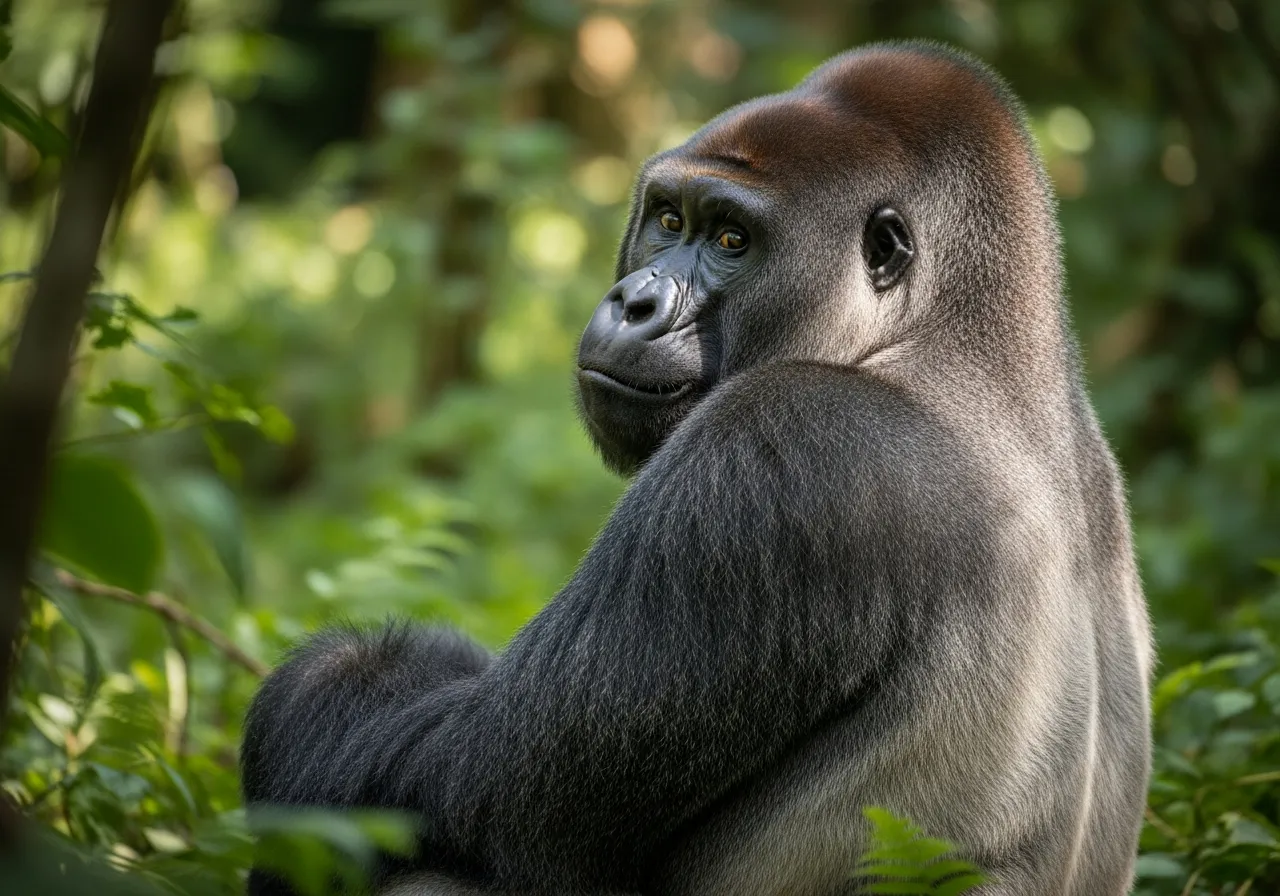
Source: Global Animal Guide (WARN)
In brief
A gorilla is the largest living primate, a ground-dwelling, mostly plant-eating great ape native to the forests of equatorial Africa. There are two Critically Endangered species — the Western and Eastern gorilla — and gorillas share roughly 98% of their DNA with humans.
Also in Animals A to Z · Animals that start with G
How you can help
You can support the related appeal — read its purpose, recipient status and fund terms first — or give once to where it is needed most. Sharing accurate information helps too.
By WARN Research & Conservation TeamLast updated
Gorillas are the largest living primates and, after chimpanzees and bonobos, our closest animal relatives, sharing roughly 98% of our DNA. There are two species — the Western Gorilla (Gorilla gorilla) and the Eastern Gorilla (Gorilla beringei) — and both are listed as Critically Endangered on the IUCN Red List. These powerful yet gentle, mostly plant-eating apes live in close-knit family groups led by a mature male called a silverback, deep in the rainforests and mountain forests of equatorial Africa. Poaching, habitat loss, disease and instability across their range have driven steep declines, though the mountain gorilla offers a rare glimmer of hope.
98%
Of DNA shared with humans
2
Species, both Critically Endangered
~1,000+
Mountain gorillas — a rare recovery
~200 kg
Weight of a wild silverback male
Figures sourced from IUCN Red List — Western Gorilla (Gorilla gorilla), IUCN Red List — Eastern Gorilla (Gorilla beringei), CITES Appendices (Gorilla spp., Appendix I) and other references on this page.
Gorilla: Quick Facts
| Scientific name | Gorilla gorilla (Western) and Gorilla beringei (Eastern) |
|---|---|
| Size | Standing height ~1.5–1.8 m; males much larger than females |
| Weight | Wild males ~150–200 kg; females roughly half that |
| Lifespan | ~35–40 years in the wild; can exceed 50 in human care |
| Diet | Mostly herbivorous — leaves, stems, shoots, pith, bark and fruit, with some insects |
| Habitat | Lowland rainforest, swamp forest and montane forest of equatorial Africa |
| Gestation | ~8.5 months; usually a single infant, roughly every 4 years |
| Social structure | Family groups (~5–30) led by a dominant silverback male |
| DNA shared with humans | About 98% |
| CITES | Appendix I (all gorillas) |
Scientific Classification
| Kingdom | Animalia |
|---|---|
| Phylum | Chordata |
| Class | Mammalia |
| Order | Primates |
| Family | Hominidae (great apes) |
| Genus | Gorilla |
| Species | 2 species: G. gorilla (Savage, 1847) and G. beringei (Matschie, 1903) |
Conservation Status
- IUCN Status
- Critically Endangered (both species: Gorilla gorilla and Gorilla beringei)
- Population
- Western Gorilla in the hundreds of thousands but declining; Eastern Gorilla far fewer; mountain gorilla subspecies above roughly 1,000 and rising
- Trend
- Decreasing overall (mountain gorilla subspecies increasing)
- Assessed
- Both species assessed Critically Endangered by the IUCN Red List (most recent assessments)
- CITES
- Appendix I
Despite an overall decreasing trend, the mountain gorilla is a rare bright spot — intensive protection has lifted it above roughly 1,000 individuals, the only gorilla population currently increasing.
Did you know?
Every night, each gorilla builds itself a fresh sleeping nest from bent branches and leaves — and even tiny infants practise nest-building long before they sleep in one alone.
Key Facts: Gorilla
- There are two gorilla species — the Western Gorilla (Gorilla gorilla) and the Eastern Gorilla (Gorilla beringei) — and both are listed as Critically Endangered on the IUCN Red List.
- Gorillas are the largest living primates: a wild silverback male can weigh around 200 kg and stand about 1.7 m tall when upright.
- They share roughly 98% of their DNA with humans, making them among our closest living relatives after chimpanzees and bonobos.
- Gorillas live in stable family groups led by a dominant adult male, the silverback, and are mostly herbivorous, eating leaves, stems, shoots and fruit.
- Key threats are poaching, habitat loss, disease (including Ebola) and armed instability across their Central and East African range.
- The mountain gorilla, a subspecies of the Eastern gorilla, is a rare conservation success, with numbers rising above roughly 1,000 individuals.
Why Are Gorillas Endangered?
Both gorilla species are Critically Endangered, and the reasons overlap. Poaching is a major pressure: gorillas are killed for bushmeat, caught in snares set for other animals, and infants are sometimes taken for the illegal trade. Habitat loss is equally serious — forests are cleared for agriculture, logging, mining and settlement, fragmenting the connected forest gorillas need. Disease is a distinctive threat for great apes: outbreaks of the Ebola virus have killed thousands of western lowland gorillas in parts of Central Africa, and because gorillas share so much of our biology, they are also vulnerable to human respiratory infections. Finally, much of the gorilla's range sits in regions affected by armed conflict and instability, which makes long-term protection and law enforcement extremely difficult. Gorillas reproduce slowly — females give birth roughly once every four years — so populations recover only gradually, and a single epidemic or surge in poaching can undo decades of gains. The combination of these pressures is why both species carry the Red List's highest threat category short of extinction in the wild.
How Do Gorillas Live? Silverbacks and Family Life
Gorillas are deeply social, living in cohesive groups usually of around 5 to 30 members. Each group is led by a dominant mature male known as a silverback, named for the saddle of silver-grey hair that develops across his back as he matures. The silverback makes the decisions — where the group feeds, travels and rests — and defends it from rivals and predators, sometimes by an intimidating display of chest-beating, hooting and charging that is mostly bluff rather than true aggression. Groups typically include several adult females, their offspring and sometimes younger 'blackback' males. Gorillas build a fresh nest of bent branches and leaves to sleep in each night, on the ground or in low vegetation. They are intelligent and expressive: they use a range of vocalisations and gestures, show signs of grief, and some have learned elements of sign language in research settings. Despite their great strength and fearsome reputation, wild gorillas are generally shy, peaceable animals that prefer to avoid conflict.
Western vs Eastern Gorilla: The Two Species
The two gorilla species are separated by hundreds of kilometres of the Congo Basin. The Western Gorilla (Gorilla gorilla) lives in the lowland rainforests and swamp forests of Central Africa — including Cameroon, Gabon, the Republic of the Congo and neighbouring countries. Its most numerous subspecies, the western lowland gorilla, is the gorilla most often seen in zoos. The Eastern Gorilla (Gorilla beringei) is found further east, in the Democratic Republic of the Congo and along its borders with Rwanda and Uganda, and is split into two subspecies: the eastern lowland (Grauer's) gorilla and the famous mountain gorilla. The mountain gorilla lives at high altitude in cool, misty forest and has longer, thicker fur to cope with the cold. While most gorilla populations are still falling, the mountain gorilla is a notable exception: intensive, sustained protection has lifted its numbers above roughly 1,000 individuals, the only gorilla population currently increasing.
Where Do Gorillas Live?
Gorillas are found only in equatorial Africa, across a band of tropical forest in the centre of the continent. Western gorillas occupy the lowland and swamp forests of Central Africa, with strongholds in Gabon and the Republic of the Congo and further populations in Cameroon, the Central African Republic and Equatorial Guinea. Eastern gorillas live in the eastern Democratic Republic of the Congo and the mountainous border zone shared with Rwanda and Uganda, where the mountain gorilla clings to a few high-altitude forest patches. All gorillas depend on dense, connected forest for food and shelter, which is exactly the habitat being lost to clearance and fragmentation. Because gorillas need large areas of intact forest to thrive, protecting their habitat also safeguards countless other species — birds, forest elephants, and the plants that depend on the forest canopy — that share the same threatened landscapes.
Western vs Eastern gorilla
| Attribute | Western Gorilla | Eastern Gorilla |
|---|---|---|
| Scientific name | Gorilla gorilla | Gorilla beringei |
| Subspecies | Western lowland; Cross River | Eastern lowland (Grauer's); Mountain |
| Main range | Central Africa (Gabon, Congo, Cameroon) | DR Congo and Rwanda/Uganda borders |
| Habitat | Lowland and swamp rainforest | Lowland and high-altitude montane forest |
| IUCN status | Critically Endangered | Critically Endangered |
| Notable point | Most numerous; eats more fruit | Includes the recovering mountain gorilla |
What WARN Does
WARN supports the protection of mountain gorillas and the forests they depend on, alongside our free educational and awareness work like this guide. The same pressures that threaten gorillas — habitat loss, snaring and forest fragmentation — also affect the animals WARN protects in its partner countries, so funding forest and wildlife protection helps gorillas and their neighbours alike.
Gorillas reproduce slowly and recover even more slowly, so every protected family group matters — your support helps fund the habitat and wildlife protection that gives mountain gorillas and their forests a future.
How can I help save the gorilla?
Explore practical ways to support the gorilla, from everyday choices and sharing reliable information to reviewing a related appeal before giving.
Explore ways to support
Read the related appeal’s purpose, recipient status and fund terms. Choose an affordable gift after checking what is proposed and what has been reported.
Ease the pressures
Avoid the wildlife trade and souvenirs, never buy wild animals as pets, and choose sustainable, habitat-friendly products — the threats behind the gorilla's decline fall when demand does.
Spread the word
Share accurate, sourced information about the gorilla. Wider awareness is what turns concern into lasting protection.
Gorilla: Frequently Asked Questions
How can I help save the gorilla?
How much DNA do gorillas share with humans?
How many gorilla species are there?
Are gorillas dangerous to humans?
What do gorillas eat?
What is a silverback gorilla?
Why is the mountain gorilla a conservation success?
Where do gorillas live?
How long do gorillas live?
How big is a gorilla?
Sources & References
Population figures, conservation status and biological facts on this page are drawn from authoritative scientific and intergovernmental sources.
Related Rescue Guides
Selected guides that explain this animal’s rescue, habitat needs or ways to help. Check each appeal for its current funding status.
Uganda · Great ape protection
Mountain Gorilla Rescue in Uganda
Mountain gorilla rescue in Uganda focuses on partner-led veterinary response for snared and injured gorillas, snare removal in Bwindi and Mgahinga, and humane conflict mitigation at park edges — not WARN-run facilities or tourism.
Wildlife rescue · Gorillas
Donate to Gorilla Conservation
You can donate to gorilla conservation through WARN at /appeals/gorillas — gifts are intended to support partner-led veterinary response for snared and injured mountain gorillas, snare removal in Bwindi and Mgahinga and conflict mitigation in Rwanda and Uganda.
Terms used on this page
Plain-English definitions, from our wildlife and conservation glossary.
Latest Gorilla Stories
Quick, fact-checked reads on the gorilla — amazing facts, key questions and the threats it faces.
Explore more animals
Discover more animals, their habitats and their conservation status in the WARN wildlife-guide library.