Wildlife Guide · Indonesia & Malaysia
Orangutan
Pongo pygmaeus (Linnaeus, 1760), Pongo abelii (Lesson, 1827), Pongo tapanuliensis (Nurcahyo, Meijaard et al., 2017)
Asia’s great apes: forest specialists facing habitat loss and slow recovery.
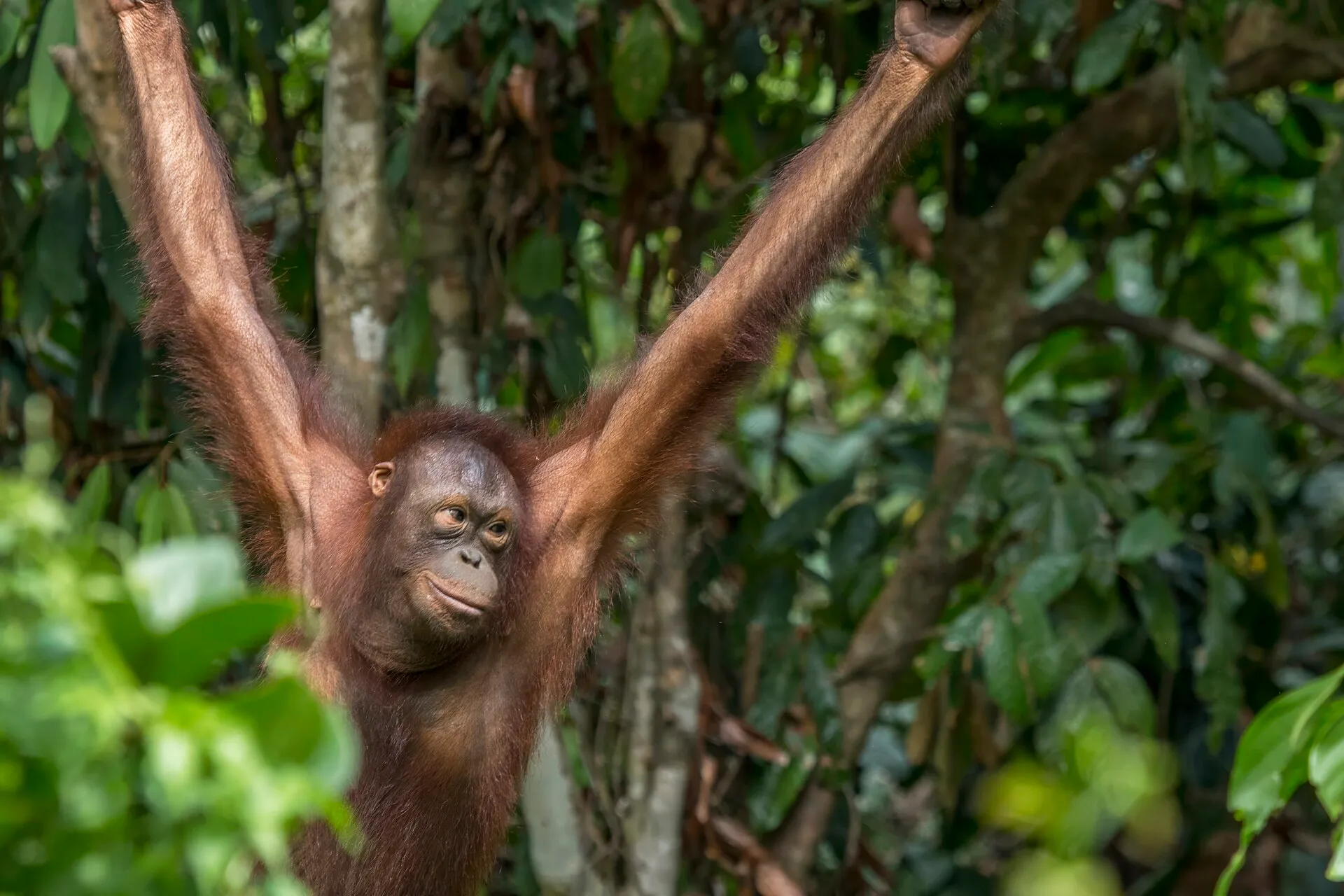
Photo: Charles J. Sharp / Wikimedia Commons (CC BY-SA 4.0). Resized and converted to WebP. · Original photograph · Licence
_Sepilok.jpg)
Species photograph taken at Sepilok, Sabah, Malaysia on 14 May 2015. It does not document the 2026 Kalimantan fires or a WARN-funded rescue.
In brief
Orangutans are Critically Endangered great apes found only in Borneo and Sumatra; all three species — Bornean, Sumatran, and Tapanuli — face extinction driven mainly by habitat loss from palm oil and logging, plus the illegal pet trade.
Also in Animals A to Z · Animals that start with O
How you can help
You can symbolically adopt an orangutan from £5 a month — a donation to WARN’s orangutan welfare and conservation appeal, with a personalised certificate you can keep or give as a gift — or give once to where it is needed most.
How can you help orangutans?
Kalimantan wildlife fire appeal
Read the fund purpose and recipient status before supporting response, recovery and prevention.
How to help orangutans
Compare wider donations, symbolic adoption and practical ways to help without giving money.
Symbolically adopt an orangutan
Understand adoption-themed giving and what your acknowledgement includes.
Orangutans and the 2026 Kalimantan fires
Read the dated reports, Sampurna’s story and the work responders describe.
Learn together: orangutans and forests
Free activities for ages 8–12: explore island habitats, check a wildlife story and try the quiz. Print the activities and answer guide; no account is needed.
By WARN Research & Conservation TeamLast updated
Orangutans are the largest tree-dwelling animals on Earth and the only great apes native to Asia. All three species — Bornean, Sumatran, and Tapanuli — are listed as Critically Endangered on the IUCN Red List, each with a decreasing population trend. Forest clearance, habitat fragmentation, hunting and capture for the pet trade threaten their survival. Protecting remaining populations requires both suitable habitat and effective protection from harm.
3
Orangutan species, all Critically Endangered
11,694
Sumatran estimate — 2021–2023 surveys, published 2026
7–9 yrs
Typical interval between a female’s births
716
Tapanuli estimate — 2021–2023 surveys, published 2026
Figures sourced from Population status of Sumatran and Tapanuli orangutans: 2021–2023 assessment (Global Ecology and Conservation, 2026), BOS Foundation — its rehabilitation, habitat and sanctuary work, Borneo Orangutan Survival — post-release monitoring (24 June 2026) and other references on this page.
Orangutan: Quick Facts
| Lifespan | ~30–45 years in the wild; up to 50–60 years in human care |
|---|---|
| Weight | Males up to ~90 kg in the wild (more in captivity); females ~37–50 kg |
| Height / arm span | Standing height ~1.2–1.4 m; arm span up to ~2 m (longer than the body) |
| Diet | Frugivore — mostly fruit, plus leaves, bark, flowers, honey, and insects |
| Gestation | ~8 months (about 227–275 days) |
| Young per birth | Single infant; ~7.6–8 years between births (longest of any primate) |
| Maturity | Infants depend on the mother ~7–8 years; females mature at ~12–15 years |
| Social structure | Semi-solitary — the least social great ape; no true 'group' |
| DNA shared with humans | About 96.4% |
| CITES | Appendix I (all Pongo species) |
Scientific Classification
| Kingdom | Animalia |
|---|---|
| Phylum | Chordata |
| Class | Mammalia |
| Order | Primates |
| Family | Hominidae (great apes) |
| Genus | Pongo |
| Species | 3 species: P. pygmaeus (Linnaeus, 1760), P. abelii (Lesson, 1827), P. tapanuliensis (Nater, Nurcahyo, Meijaard et al., 2017) |
Conservation Status
- IUCN Status
- Critically Endangered (all three species: P. pygmaeus, P. abelii, P. tapanuliensis)
- Population
- Bornean ~104,700 (2016 assessment); Sumatran 11,694 and Tapanuli 716 (2021–2023 surveys, published 2026)
- Trend
- Decreasing
- Assessed
- IUCN categories: 2016–2017; separate Sumatra population surveys: 2021–2023
- CITES
- Appendix I
Assessment dates, survey periods and publication dates describe different things. These figures are estimates with uncertainty and are not a live count of all orangutans.
Where these figures come from
This guide covers three species. Their extinction-risk assessments and population estimates come from different dates and places.
Assessment records (3)
-
Bornean orangutan · Critically Endangered
Pongo pygmaeus · Global species assessment
8 February 2016; errata published in 2018
IUCN Bornean orangutan assessment -
Sumatran orangutan · Critically Endangered
Pongo abelii · Global species assessment
16 October 2017; errata published in 2018
IUCN Sumatran orangutan assessment -
Tapanuli orangutan · Critically Endangered
Pongo tapanuliensis · Global species assessment
2017 assessment
IUCN Tapanuli orangutan assessment
Population sources and dates
-
Bornean orangutan: About 104,700
Borneo
Historical estimate cited in the 2016 assessment
Derived from earlier density and range data. It is not a 2026 count and cannot be combined with newer Sumatra estimates to make a current global total.
IUCN Bornean orangutan assessment -
Sumatran orangutan: 11,694 estimated individuals
Eight meta-populations in northern Sumatra
Surveys in 2021–2023; published in 2026
The study reports a 95% confidence interval of 10,949–12,518. This is a survey-based estimate, not an exact live headcount.
Original 2026 population study -
Tapanuli orangutan: 716 estimated individuals
Three meta-populations in northern Sumatra
Surveys in 2021–2023; published in 2026
The study reports a 95% confidence interval of 645–792. These surveys do not measure later changes, including events after 2023.
Original 2026 population study
An assessment date records when extinction risk was evaluated. A survey period records when population data were collected; publication can follow later. The date this guide was updated is separate from all three.
Did you know?
Orangutans are master engineers of the canopy: every single night, each one builds a fresh sleeping nest from bent branches and leaves — sometimes adding a leafy 'roof' or 'pillow' — and rarely reuses an old one.
Key Facts: Orangutan
- Three species: Bornean (Pongo pygmaeus), Sumatran (Pongo abelii), and Tapanuli (Pongo tapanuliensis) — all Critically Endangered with a decreasing trend.
- The Tapanuli orangutan was described as a separate species in 2017 and occurs in the Batang Toru landscape of North Sumatra.
- Females typically have seven to nine years between births. This long reproductive cycle makes recovery from losses especially slow.
- Orangutans are the only great apes native to Asia and the largest tree-dwelling (arboreal) mammals on the planet.
- Habitat loss and fragmentation, hunting, fire and the illegal pet trade can act together. A habitat-loss statistic is not interchangeable with a population-decline estimate.
- Specialist rehabilitation can involve years of care and forest learning. Release depends on an individual’s health, skills and a suitable protected site; some animals require long-term sanctuary care.
Why Are Orangutans Endangered?
The principal driver of orangutan decline is habitat loss. Lowland rainforest — where orangutans feed, nest, and raise young — is cleared for palm oil, pulpwood, and mining concessions at a pace that far outstrips population recovery. A female orangutan produces only four or five offspring in her entire lifetime, because she gives birth roughly once every eight years, the longest interbirth interval of any primate. When a forest block is cleared and breeding females are killed, a local population can be functionally destroyed within one generation. Hunting, snaring, and the illegal pet trade compound the pressure: infants are captured live when their mothers are killed, then sold as status pets or arriving at rescue centres in severe distress.
What Does Orangutan Rehabilitation Involve?
Rehabilitation is a professional process shaped by the animal’s age, health, history and ability to live independently. BOS Foundation describes nursery care, forest school and pre-release islands as parts of its work in Kalimantan. Young animals practise climbing, finding food and building nests before staff assess their readiness for more independent forest life. These are examples of BOS’s programmes, not WARN operations.
Release is followed by monitoring. Teams observe health, feeding, ranging and adaptation, using the findings to decide when intervention is needed. A release announcement alone cannot demonstrate long-term survival. Some orangutans need sanctuary care because release would be unsuitable. A proposed grant should explain which part of this pathway it would support, the people qualified to deliver it and how outcomes will be reported.
The Palm Oil Connection
Forest conversion for oil palm is one pressure on orangutan habitat. The useful question is how an ingredient is produced and traced through its supply chain. WWF recommends certified sustainable palm oil alongside stronger no-deforestation commitments and transparent sourcing. It also cautions that replacing palm oil with lower-yielding crops can shift pressure to other habitats.
Consumers can ask brands about their suppliers and policies, while conservation support can address habitat protection and the welfare of affected animals. These actions complement each other. The palm-oil issue does not establish that WARN runs a sanctuary or land-purchase programme; our appeals explain the support being considered and the records that would confirm a grant.
How Are Orangutan Population Estimates Measured?
The 2026 assessment used 208 nest-survey transects. Its 95% confidence intervals were 10,949–12,518 Sumatran and 645–792 Tapanuli orangutans. A survey estimates abundance from sampled evidence. Compare methods, geographic coverage and survey dates before interpreting differences between reports.
Where Do Orangutans Live?
Orangutans survive in just two places on Earth. The Bornean orangutan ranges across the island of Borneo — the Indonesian provinces of Kalimantan and the Malaysian states of Sabah and Sarawak. The Sumatran orangutan is confined to the northern tip of Sumatra, mainly Aceh and North Sumatra, while the Tapanuli orangutan survives only in the isolated Batang Toru forest of North Sumatra. All are dependent on tropical lowland and hill rainforest, the same forests being cleared fastest for plantation agriculture.
Bornean vs Sumatran vs Tapanuli orangutan
| Attribute | Bornean | Sumatran | Tapanuli |
|---|---|---|---|
| Species | Pongo pygmaeus | Pongo abelii | Pongo tapanuliensis |
| Described | Linnaeus, 1760 | Lesson, 1827 | 2017 (most recent great ape) |
| Range | Borneo (Kalimantan, Sabah, Sarawak) | Northern Sumatra (Aceh, North Sumatra) | Batang Toru forest, North Sumatra |
| Population | ~104,700 (2016) | 11,694 (2021–2023 surveys) | 716 (2021–2023 surveys) |
| IUCN status | Critically Endangered | Critically Endangered | Critically Endangered |
| Notable feature | Most numerous; darker, broader face | Lighter coat; longer facial hair | Frizzier coat, smaller skull; rarest great ape |
What WARN Does
WARN staff are meeting organisations in Indonesia to understand animal-welfare needs and possible ways to help; funding shortages have been raised in those meetings. No Kalimantan recipient or grant agreement is confirmed. WARN is assessing potential support and will publish recipient decisions, grant purposes and payments when records exist. This guide does not claim that WARN operates a rehabilitation centre, funds a named orangutan programme or purchases sanctuary land.
A wild female orangutan raises only four or five young in her whole life, and a rescued orphan needs years of forest school before it can go home. Explore the orangutan appeal to compare ways to help, or read the current Kalimantan fire appeal. Check the recipient status, proposed use and fund terms before donating.
How can I help save the orangutan?
Explore practical ways to support the orangutan, from everyday choices and sharing reliable information to reviewing a related appeal before giving.
Explore ways to support
Read the related appeal’s purpose, recipient status and fund terms. Choose an affordable gift after checking what is proposed and what has been reported.
Ease the pressures
Avoid the wildlife trade and souvenirs, never buy wild animals as pets, and choose sustainable, habitat-friendly products — the threats behind the orangutan's decline fall when demand does.
Spread the word
Share accurate, sourced information about the orangutan. Wider awareness is what turns concern into lasting protection.
Orangutan: Frequently Asked Questions
How can I help save the orangutan?
How can I donate to help orangutans through WARN?
Can I help orangutans without donating?
How many orangutans are left in the wild?
Why are orangutans called the "gardeners of the forest"?
Can all rescued orangutans be returned to the wild?
What is the Tapanuli orangutan?
Does buying sustainable palm oil help orangutans?
What do orangutans eat?
How long do orangutans live, and how big do they get?
Where do orangutans live?
Are orangutans dangerous?
Sources & References
Population figures, conservation status and biological facts on this page are drawn from authoritative scientific and intergovernmental sources.
- Population status of Sumatran and Tapanuli orangutans: 2021–2023 assessment (Global Ecology and Conservation, 2026)
- BOS Foundation — its rehabilitation, habitat and sanctuary work
- Borneo Orangutan Survival — post-release monitoring (24 June 2026)
- WWF — palm oil, responsible sourcing and alternatives
- IUCN Red List — Bornean Orangutan (Pongo pygmaeus)
- IUCN Red List — Sumatran Orangutan (Pongo abelii)
- IUCN Red List — Tapanuli Orangutan (Pongo tapanuliensis)
- CITES Appendices (Pongo spp., Appendix I)
- Smithsonian's National Zoo — Orangutan fact sheet
- WWF — Orangutan
- Nater et al. 2017, Current Biology — Pongo tapanuliensis description
- van Noordwijk et al. 2018, 'The slow ape' (PubMed)
Related Rescue Guides
Selected guides that explain this animal’s rescue, habitat needs or ways to help. Check each appeal for its current funding status.
Borneo · Orangutan rescue
Orangutan Rescue in Borneo
Orangutan rescue in Borneo focuses on moving stranded or injured orangutans out of danger, rehabilitating orphans for years, and protecting forest release sites.
Borneo · Rehabilitation method
Orangutan Forest School
Orangutan forest school is the long rehabilitation process where orphaned orangutans learn climbing, nest-building, foraging and social skills before any possible return to protected forest.
Habitat · Forest corridors
Donate to Rainforest Habitat Protection
You can donate to rainforest habitat protection through WARN at /appeals/habitats. Gifts are intended for assessed partner-led forest protection: orangutan habitat in Borneo and jaguar habitat in the Americas. Check the appeal for recipient status, fund terms and any published grant payments.
Terms used on this page
Plain-English definitions, from our wildlife and conservation glossary.
Latest Orangutan Stories
Quick, fact-checked reads on the orangutan — amazing facts, key questions and the threats it faces.
Briefings
Kalimantan forest fires 2026: orangutans, smoke and how to help
What official reports say about Kalimantan’s forest fires, Sempurna the orangutan, smoke and wildlife rescue—and how to help through informed giving or sharing.
Read the storyBriefings
Three Rehabilitated Orangutans Released Back Into the Wild in East Kalimantan
Three Bornean orangutans — Bagus, Eboni and Ruby — were released into a protected forest in East Kutai, East Kalimantan, on 23 June 2026, after years of rehabilitation following rescue from the illegal pet trade. All three are Critically Endangered Pongo pygmaeus.
Read the storyGuides
How Much Does It Cost to Rescue an Orangutan?
Orangutan rescue spans emergency extraction, years of forest-school rehabilitation and soft release — each stage carries real costs. Here is what UK donors actually fund.
Read the storyExplore more animals
Discover more animals, their habitats and their conservation status in the WARN wildlife-guide library.