Wildlife Guide · Brazil & Colombia
Green Anaconda
Eunectes murinus
The heaviest snake on Earth, a silent giant of South America's flooded forests.
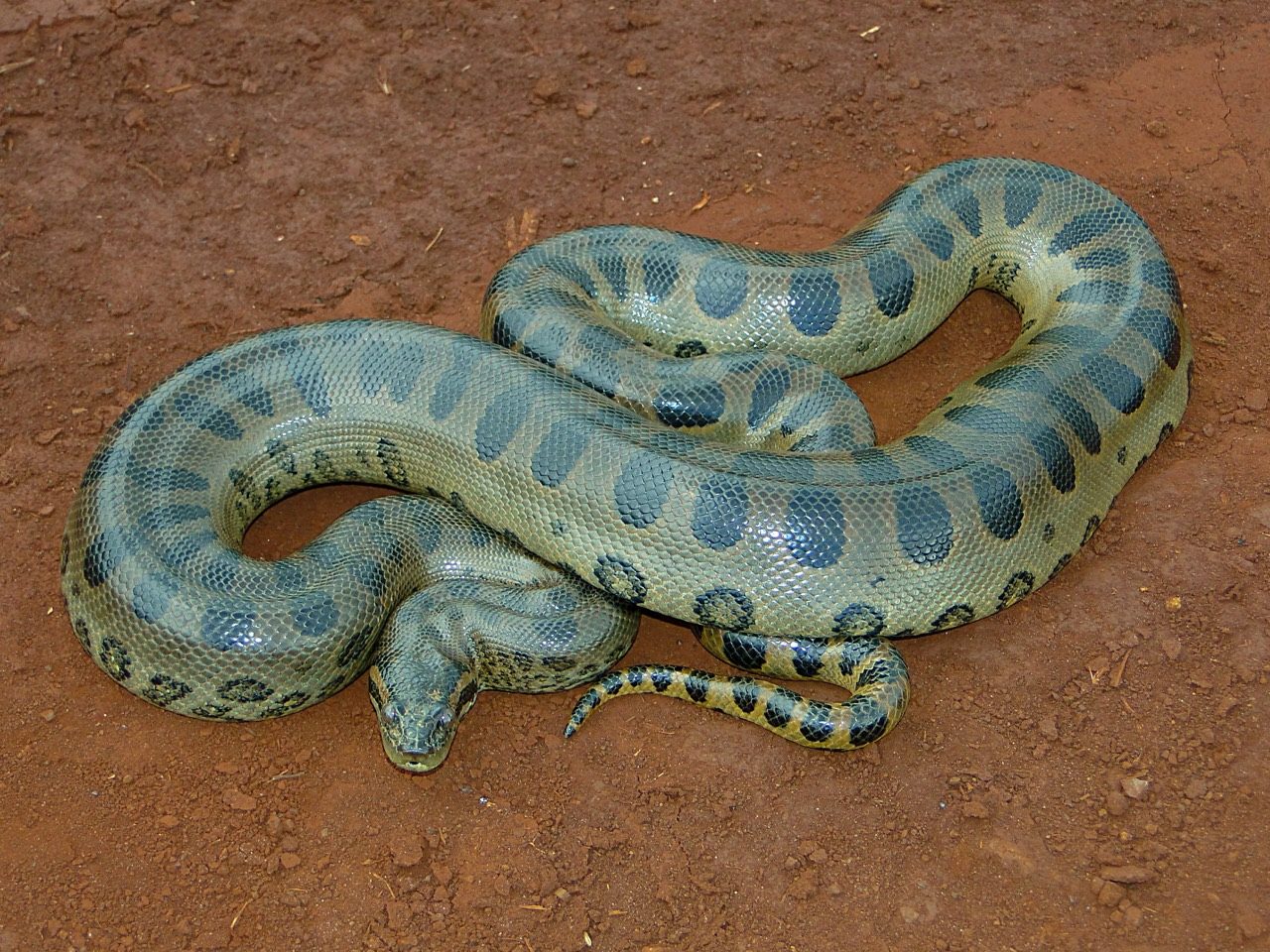
Source: Wikimedia Commons via Wikipedia “Green anaconda”
In brief
A Green Anaconda (Eunectes murinus) is a large, non-venomous, semi-aquatic constrictor snake from tropical South America that is the heaviest snake in the world, killing prey by coiling and squeezing rather than biting.
Also in Animals A to Z · Animals that start with G
By WARN Research & Conservation TeamLast updated
The Green Anaconda (Eunectes murinus) is the world's heaviest snake and one of its longest, a non-venomous constrictor that haunts the slow rivers, swamps and seasonally flooded grasslands of tropical South America. Females dwarf males, reaching lengths over 5 metres and weights near 100 kilograms. In 2024 scientists confirmed that what was long called the green anaconda is in fact two species, reshaping how we count and protect these giants.
~250 kg
Weight of the heaviest snake on Earth
5+ m
Typical length of a large female
20-40
Live young born per litter
Appendix II
CITES trade-controlled listing
Figures sourced from IUCN Red List — Eunectes murinus (Green Anaconda), Smithsonian's National Zoo — Green Anaconda, Rivas et al. 2024, Diversity (MDPI) — Disentangling the Anacondas: a New Green Species and other references on this page.
Green Anaconda: Quick Facts
| Lifespan | ~10 years wild; 30+ years in captivity |
|---|---|
| Weight | Up to ~250 kg; heaviest verified ~97.5 kg female |
| Length | Females commonly 5+ m; males average ~3 m |
| Diet | Carnivore: fish, birds, capybara, deer, caimans |
| Gestation | 6-7 months (live birth in water) |
| Young per litter | 20-40 typically, occasionally up to ~100 |
| Size at birth | ~70-80 cm long, fully independent |
| Baby name | Neonate / snakelet |
| Group name | Bed or knot of snakes |
| CITES | Appendix II |
Scientific Classification
| Kingdom | Animalia |
|---|---|
| Phylum | Chordata |
| Class | Reptilia |
| Order | Squamata |
| Family | Boidae |
| Genus | Eunectes |
| Species | Eunectes murinus (Linnaeus, 1758) — Southern Green Anaconda; the northern populations were split off as E. akayima in 2024 |
Conservation Status
- IUCN Status
- Least Concern (IUCN, assessed 2021)
- Population
- No reliable estimate
- Trend
- Stable (per IUCN), though population data are limited
- Assessed
- 2021
- CITES
- Appendix II
The 2024 recognition of the Northern Green Anaconda (Eunectes akayima) as a separate species means the former 'green anaconda' range is now split; the northern lineage has not yet been separately Red List assessed, so the Least Concern status is best read as honest-but-incomplete.
Did you know?
The Green Anaconda is so heavy that on land it can barely support its own bulk — it relies on water to carry its weight, which is why this 250 kg giant spends most of its life half-submerged.
Key Facts: Green Anaconda
- The Green Anaconda is the heaviest known snake, with verified females weighing close to 100 kg and exceeding 5 metres in length.
- It is non-venomous and kills by constriction, suffocating prey such as capybara, caimans, deer and large birds before swallowing them whole.
- Females are far larger than males, a striking case of reverse sexual size dimorphism among snakes.
- Anacondas give birth to live young in water (they are ovoviviparous), producing roughly 20 to 40 babies per litter, occasionally many more.
- In 2024 the northern green anaconda was described as a separate species, Eunectes akayima, meaning much of the former range is now taxonomically split.
- The species is listed as Least Concern by IUCN but is traded under CITES Appendix II because of demand for skins and the exotic pet trade.
Behaviour and ecology
Green Anacondas are ambush predators built for water. Their eyes and nostrils sit on top of the head, letting them lie almost fully submerged while watching for prey. Despite their bulk they move sluggishly on land but swim with ease, using the buoyancy of water to support their enormous mass. They are apex predators across their wetland range, taking fish, birds, mammals, caimans and capybara, and they may go weeks between meals after a large kill. Solitary for most of the year, they congregate only to breed, when several smaller males may court a single giant female in a so-called breeding ball. Females then carry developing young internally for six to seven months and give birth to live offspring in the water, each newborn already 70 to 80 cm long and entirely independent.
A giant recently split into two species
For centuries the green anaconda was treated as a single wide-ranging species. In February 2024 a team of researchers used genetic analysis to show that anacondas north of the Andes and Amazon differ from southern populations by about 5.5 percent in their DNA, having diverged nearly 10 million years ago. They named the northern lineage the Northern Green Anaconda, Eunectes akayima, leaving Eunectes murinus as the Southern Green Anaconda found across the Amazon and adjoining basins. This matters for conservation: a species once assumed to be abundant everywhere is now two separate entities, and the northern one has yet to receive its own formal Red List assessment, leaving real gaps in what we know about its numbers and threats.
Threats and the skin and pet trade
Although the Green Anaconda has a vast range and is not currently considered globally threatened, it faces mounting pressure. Wetlands are drained and degraded for agriculture, cattle ranching and infrastructure, fragmenting the slow waters anacondas depend on. The animals are killed out of fear, hunted for their large patterned skins, and captured live for the international exotic pet trade, which is why all anacondas are listed on CITES Appendix II to keep commercial trade monitored. Pollution and the loss of prey species add further strain. Because reliable population counts do not exist for most of the range, local declines can go unnoticed until they are severe.
What rescue and protection involve
Protecting Green Anacondas is less about captive rescue and more about keeping their wetlands intact and reducing needless killing. On-the-ground work in range countries includes safely relocating snakes that wander into farms and villages, intercepting animals destined for the illegal skin and pet trade, monitoring populations so declines are caught early, and teaching communities that a healthy anaconda population signals a healthy wetland. Because the species spans many countries and has just been split in two, sound field data and local stewardship are now more valuable than ever.
Green Anaconda vs Yellow Anaconda vs the new Northern Green Anaconda
| Feature | Green Anaconda (E. murinus) | Yellow Anaconda (E. notaeus) | Northern Green Anaconda (E. akayima) |
|---|---|---|---|
| Status | Heaviest snake; Least Concern | Smaller; Least Concern | Split off in 2024; not yet assessed |
| Typical female size | 5+ m, up to ~100 kg | ~3-4 m, much lighter | Comparable to green anaconda; very large |
| Colour | Olive-green with black blotches | Yellow-gold with dark blotches | Green like E. murinus; ~5.5% genetic difference |
| Main range | Amazon and adjoining basins (incl. Brazil, Colombia) | Paraguay-Paraná basin, southern South America | Orinoco Basin and northern South America |
What WARN Does
WARN publishes this guide for education and is developing support through assessed animal-welfare grants. A species range, source citation or photograph does not establish a recipient or funding agreement. Check /about/where-your-money-goes/#grant-register for published grant and payment records; records not yet published must not be read as zero activity. Browse /appeals/ for the purposes currently available to support.
Anacondas survive only where their wetlands do. By backing WARN's local partners in Brazil and Colombia, your gift helps the people who keep these flooded forests intact and these giants safe from the skin and pet trade.
Green Anaconda: Frequently Asked Questions
How long do Green Anacondas live?
What do Green Anacondas eat?
How big do Green Anacondas get?
Are Green Anacondas dangerous to humans?
How many Green Anacondas are left in the wild?
What is a baby Green Anaconda called?
Where do Green Anacondas live?
Sources & References
Population figures, conservation status and biological facts on this page are drawn from authoritative scientific and intergovernmental sources.
- IUCN Red List — Eunectes murinus (Green Anaconda)
- Smithsonian's National Zoo — Green Anaconda
- Rivas et al. 2024, Diversity (MDPI) — Disentangling the Anacondas: a New Green Species
- CITES — Appendices (Eunectes spp., Appendix II)
- Animal Diversity Web — Eunectes murinus
- National Geographic — Scientists reveal new green anaconda species
Terms used on this page
Plain-English definitions, from our wildlife and conservation glossary.
Latest Green Anaconda Stories
Quick, fact-checked reads on the green anaconda — amazing facts, key questions and the threats it faces.
Species
12 Amazing Facts About the Green Anaconda, the World's Heaviest Snake
From females that dwarf males to live births in water and a surprise 2024 split into two species, here are 12 standout facts about the Green Anaconda.
Read the storySpecies
How Big Is a Green Anaconda? The Heaviest Snake on Earth, Explained
Green Anacondas are the heaviest snakes alive. Here is how long and how heavy they really get, why females are so much bigger, and which records are real.
Read the storySpecies
Green Anaconda vs Reticulated Python: Which Snake Is Really the Biggest?
The Green Anaconda is the heaviest snake and the reticulated python is the longest. Here is how the two giants actually compare, point by point.
Read the storyExplore more animals
Discover more animals, their habitats and their conservation status in the WARN wildlife-guide library.