Wildlife Guide · Central America & South America
Armadillo
Dasypus novemcinctus and relatives (order Cingulata)
The Americas' armour-plated insect hunters
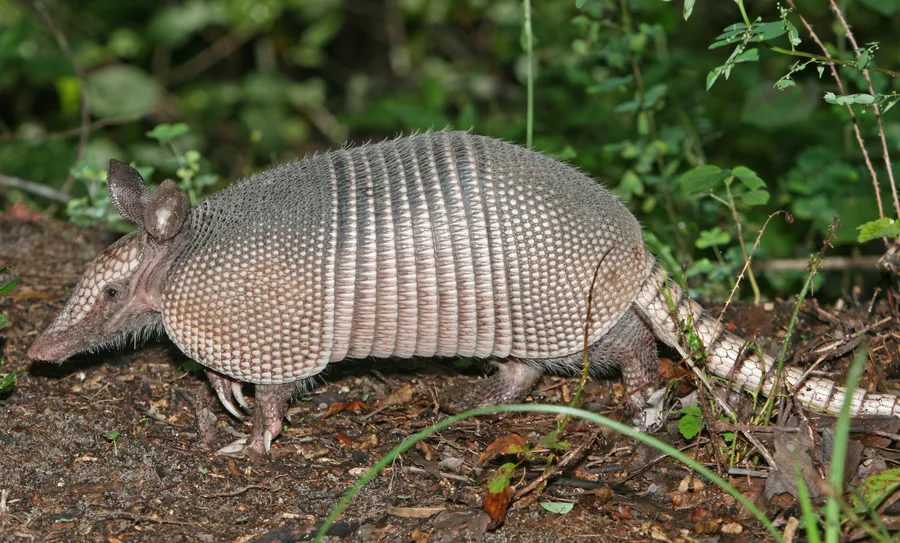
Source: Global Animal Guide (WARN)
In brief
An armadillo is a small to medium New World mammal of the order Cingulata, protected by a distinctive shell of bony plates covered in leathery skin. Around 20 species live across the Americas, digging burrows and feeding mainly on insects, grubs and other invertebrates.
Also in Animals A to Z · Animals that start with A
By WARN Research & Conservation TeamLast updated
Armadillos are small to medium-sized mammals of the Americas, instantly recognised by the bony, leathery shell that armours their back, head and tail. Around 20 living species make up the order Cingulata, ranging from the tiny pink fairy armadillo to the giant armadillo. They are powerful diggers that feed mainly on insects, grubs and other invertebrates, using a long, sticky tongue to raid ant and termite nests. The familiar nine-banded armadillo (Dasypus novemcinctus) has spread north into the southern United States and is classed as Least Concern, while some specialised species, such as the giant armadillo, are far more threatened. Armadillos are the only mammals with a true bony shell.
~20
living species in the Americas
4
identical quadruplets per nine-banded litter
~85 g to 54 kg
weight, fairy to giant armadillo
~34 C
low body temperature
Figures sourced from Armadillo (Wikipedia), Nine-banded armadillo (Wikipedia), Giant armadillo (Wikipedia) and other references on this page.
Armadillo: Quick Facts
| Common name | Armadillo |
|---|---|
| Group | Order Cingulata (~20 living species) |
| Best-known species | Nine-banded armadillo (Dasypus novemcinctus) |
| Range | The Americas, mainly South America |
| Habitat | Grassland, forest, scrub and semi-desert with diggable soil |
| Diet | Insects, grubs and other invertebrates; some plant matter |
| Size range | ~13 cm / 85 g (pink fairy) to ~1.5 m / 54 kg (giant) |
| Defence | Bony shell; digging; rolling into a ball (three-banded only) |
| Body temperature | Unusually low, around 34 C |
| Lifespan | Around 12 to 15 years (nine-banded, in the wild) |
Scientific Classification
| Kingdom | Animalia |
|---|---|
| Phylum | Chordata |
| Class | Mammalia |
| Superorder | Xenarthra |
| Order | Cingulata |
| Families | Chlamyphoridae and Dasypodidae |
| Example species | Dasypus novemcinctus (nine-banded armadillo) |
Conservation Status
- IUCN Status
- Varies by species. The widespread nine-banded armadillo (Dasypus novemcinctus) is assessed by the IUCN as Least Concern with a stable, expanding range, while more specialised species are threatened; the giant armadillo (Priodontes maximus) is listed as Vulnerable. Armadillos as a group are not globally threatened, but several species face pressure from habitat loss, hunting and road mortality.
- Population
- No reliable single global figure; the nine-banded armadillo is abundant and increasing, whereas rarer species such as the giant armadillo occur at low densities.
- Trend
- Stable to increasing for the nine-banded armadillo; decreasing for several threatened species such as the giant armadillo.
- Assessed
- Nine-banded armadillo last assessed by the IUCN in 2014 (Least Concern).
- CITES
- Several armadillos are listed on CITES; the giant armadillo (Priodontes maximus) is on CITES Appendix I.
Because the group spans common and threatened species, conservation needs differ widely; the main shared threats are habitat loss and hunting.
Key Facts: Armadillo
- Armadillos are the only living mammals with a true shell of bony plates (osteoderms) covered by tough skin.
- There are around 20 species, all native to the Americas, from the tiny pink fairy armadillo to the dog-sized giant armadillo.
- The widespread nine-banded armadillo is Least Concern and has expanded north into the southern United States, but the giant armadillo is assessed as Vulnerable.
- Only the three-banded armadillos (Tolypeutes) can curl into a fully enclosed ball; most species rely on digging or fleeing to escape predators.
- The nine-banded armadillo almost always gives birth to four genetically identical quadruplets from a single fertilised egg.
- Armadillos eat mainly insects, grubs and other invertebrates and are valuable natural controllers of ants and termites.
What does an armadillo's shell actually do?
The armadillo's most famous feature is its carapace, a layer of small bony plates called osteoderms set into the skin and overlaid with tough, leathery scales. Across the back this armour is divided into rigid shoulder and hip shields joined by a series of flexible bands, which is why several species are named for the number of bands they show, such as the nine-banded armadillo. The bands let the animal bend and move while still protecting the body, head and tail. Despite the popular image, most armadillos cannot roll into a ball: only the two three-banded species of the genus Tolypeutes can tuck head, tail and feet inside and close up into a near-perfect armoured sphere. For the rest, the shell is partial protection against thorns, predators' teeth and rough burrows, but their main defences are speed, sharp digging claws and the ability to dig themselves out of sight remarkably quickly. The soft underside is left unarmoured, so a threatened armadillo will often press its belly to the ground or wedge into a burrow.
How many armadillo species are there and where do they live?
There are roughly 20 living armadillo species, all confined to the Americas. Diversity is highest in South America, especially around Paraguay, Argentina and Brazil, but the group ranges from the southern United States down through Central and South America. The smallest is the pink fairy armadillo of Argentina, weighing only around 85 grams and measuring some 13 to 15 centimetres in total length; the largest is the giant armadillo, which can reach about 1.5 metres including the tail and weigh up to roughly 54 kilograms. The nine-banded armadillo is the most familiar and widespread species and the only one found in the United States, where it has steadily expanded its range northward into states such as Texas and Florida over the past century, helped by its adaptability and lack of natural predators in the north. Armadillos occupy a wide variety of habitats, including grasslands, rainforest, scrub and semi-desert, generally favouring areas with loose soil suitable for digging the burrows in which they shelter and raise young.
What do armadillos eat and how do they live?
Armadillos are mostly insectivorous, feeding on ants, termites, beetle larvae, grubs and other invertebrates, with some species, including the giant armadillo, specialising almost entirely on ants and termites. They locate prey largely by smell, then dig rapidly with strong forelimbs and claws and lap up insects with a long, sticky tongue. Many also take some plant matter, small vertebrates, eggs and carrion. Most species are solitary and largely nocturnal or crepuscular, spending the day in burrows they excavate themselves. Reproduction in the genus Dasypus is unusual: the nine-banded armadillo produces a single fertilised egg whose implantation is delayed by several months, after which it splits to yield four genetically identical offspring, a reliable case of polyembryony found in no other mammal genus. Armadillos also have an unusually low body temperature of around 34 degrees Celsius. This makes them one of the few animals besides humans able to harbour the bacterium that causes leprosy, and handling or eating wild armadillos carries a small risk of transmission.
Three-banded armadillo vs nine-banded armadillo
| Feature | Three-banded (Tolypeutes) | Nine-banded (Dasypus novemcinctus) |
|---|---|---|
| Rolls into a ball | Yes, fully enclosed sphere | No |
| Number of movable bands | Three | Usually eight to nine |
| Range | Parts of South America | South and Central America into the southern USA |
| Typical litter | Single young | Four identical quadruplets |
| IUCN status | Near Threatened or Vulnerable depending on species | Least Concern |
What WARN Does
World Animal Rescue Network does not run field projects dedicated to armadillos, which live across the Americas rather than in the countries where WARN's partners work. This guide is part of WARN's free educational work, which aims to make accurate, well-sourced wildlife information freely available to everyone. The same pressures that threaten the more specialised armadillos, above all habitat loss and conversion of wild land, also harm the animals WARN does protect, so learning about one species helps support care for many.
If this guide helped you understand armadillos a little better, a small gift helps keep WARN's free wildlife education and hands-on animal care going.
Armadillo: Frequently Asked Questions
Can all armadillos roll into a ball?
Are armadillos endangered?
What do armadillos eat?
Why do nine-banded armadillos have identical quadruplets?
Do armadillos really carry leprosy?
Where do armadillos live?
Are armadillos dangerous?
How long do armadillos live?
How big is an armadillo?
Sources & References
Population figures, conservation status and biological facts on this page are drawn from authoritative scientific and intergovernmental sources.
Terms used on this page
Plain-English definitions, from our wildlife and conservation glossary.
Latest Armadillo Stories
Quick, fact-checked reads on the armadillo — amazing facts, key questions and the threats it faces.
Species
12 Amazing Facts About the Jaguar, the Americas' Biggest Cat
From a skull-piercing bite to a love of swimming, here are 12 fascinating, fact-checked things that make the jaguar the most powerful cat in the Americas.
Read the storySpecies
11 Amazing Facts About the Pink River Dolphin (the Amazon's Blushing Boto)
From a head that swivels 90 degrees to a blush built from battle scars, here are 11 true facts about the Amazon's pink river dolphin, the largest freshwater dolphin on Earth.
Read the storySpecies
Pink River Dolphin vs Tucuxi: How to Tell the Two Amazon Dolphins Apart
Both swim the same Amazon waters, but the pink boto and the grey tucuxi are only distant cousins. Here is how to tell them apart at a glance.
Read the storyExplore more animals
Discover more animals, their habitats and their conservation status in the WARN wildlife-guide library.