Wildlife Guide · Central America & South America
Caiman
Caiman crocodilus and relatives (subfamily Caimaninae)
Ancient architects of South America's wetlands
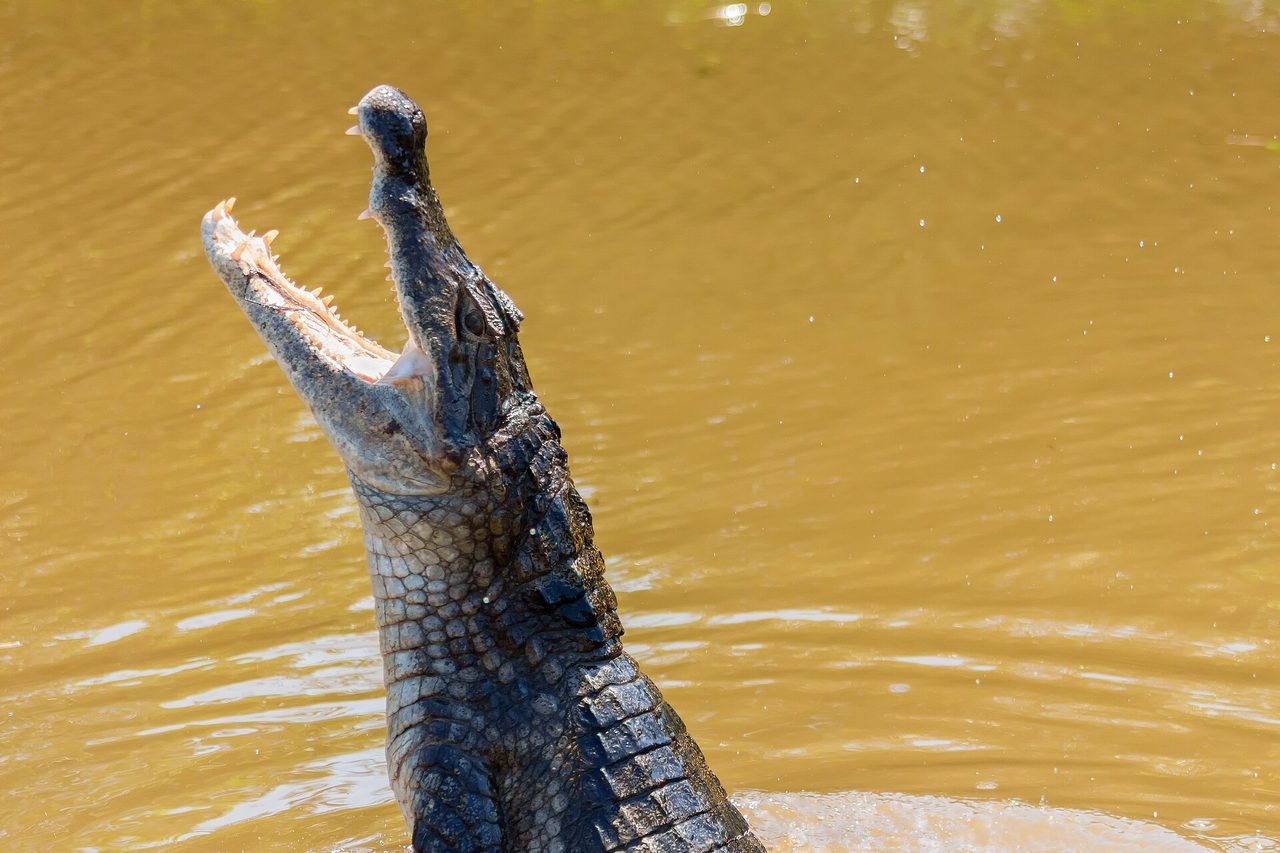
Photo: Fernando Flores / Wikimedia Commons (CC BY-SA 2.0)
In brief
Caimans are freshwater crocodilians native to Central and South America, with the spectacled caiman being the world's most numerous crocodilian — estimated at over one million mature individuals by the IUCN and listed as Least Concern.
Also in Animals A to Z · Animals that start with C
By WARN Research & Conservation TeamLast updated
Caimans are crocodilians of the subfamily Caimaninae, family Alligatoridae, native to Central and South America. Six living species range from the diminutive Cuvier's dwarf caiman — barely 1.2 metres long — to the formidable black caiman, which can exceed four metres and is the apex predator of the Amazon Basin. The most widespread and numerous is the spectacled caiman (Caiman crocodilus), named for the distinctive bony ridge between its eyes that resembles a pair of spectacles. Millions of spectacled caimans inhabit freshwater rivers, swamps, flooded forests, and coastal mangroves from southern Mexico to northern Argentina. These ancient reptiles have patrolled tropical waterways for tens of millions of years, acting as ecosystem engineers and keystone predators whose presence shapes the health of entire wetland communities.
6
living caiman species
>1 million
mature spectacled caimans (IUCN est.)
4 m+
max length (black caiman)
30–40 yrs
typical wild lifespan
Figures sourced from IUCN Red List — Caiman crocodilus (2019 assessment), Animal Diversity Web — Caiman crocodilus, IUCN CSG — Spectacled Caiman status account and other references on this page.
Caiman: Quick Facts
| Length | 1.2 m (dwarf caiman) to over 4 m (black caiman) |
|---|---|
| Weight | 6 kg (dwarf caiman) to 450+ kg (black caiman) |
| Lifespan | 30–40 years typical; up to 60 years recorded in wild |
| Clutch size | 14–40 eggs per nest |
| Incubation | 65–104 days (temperature-dependent sex determination) |
| Diet | Fish, crustaceans, birds, mammals — varies with species and age |
| Habitat | Freshwater rivers, lakes, swamps, flooded forests, mangroves |
| Range | Southern Mexico to northern Argentina; introduced in Caribbean and Florida |
Scientific Classification
| Kingdom | Animalia |
|---|---|
| Phylum | Chordata |
| Class | Reptilia |
| Order | Crocodylia |
| Family | Alligatoridae |
| Subfamily | Caimaninae |
| Genera | Caiman, Melanosuchus, Paleosuchus |
| Key species | Caiman crocodilus (spectacled caiman) |
Conservation Status
- IUCN Status
- Least Concern (most species)
- Population
- Over 1 million mature spectacled caimans (IUCN); Venezuela alone ~4 million
- Trend
- Stable to increasing after historical recovery
- Assessed
- 2019 (Caiman crocodilus, IUCN assessment)
- CITES
- Appendix I (C. c. apaporiensis; most C. latirostris; most M. niger); Appendix II (all other species/subspecies and Brazil/Ecuador M. niger populations)
Black caiman reassessed as Least Concern in 2025 after recovery from near-extinction in the 1970s. Spectacled caiman is the world's most numerous crocodilian. Ongoing threats include illegal hunting and wetland habitat loss.
Did you know?
Sex in caiman embryos is determined not by chromosomes but by nest temperature: eggs incubated at cooler temperatures tend to produce females, while a warmer core — just a fraction of a degree difference at the critical mid-incubation window — shifts the clutch toward males.
Key Facts: Caiman
- The spectacled caiman is the world's most abundant crocodilian, with the IUCN estimating over one million mature individuals globally; Venezuela alone supports an estimated four million.
- Six species make up subfamily Caimaninae, ranging from tiny dwarf caimans to the apex-predator black caiman exceeding four metres.
- All caiman species are listed in CITES Appendix I or II; most have recovered substantially from catastrophic over-hunting in the mid-twentieth century.
- Caimans are ecosystem engineers — their nesting mounds create micro-habitats used by dozens of other species including birds, mammals, and reptiles.
- Temperature inside the nest determines the sex of hatchlings; females guard the nest and escort young to water after hatching.
- Illegal hunting for skins and habitat loss from deforestation remain the primary ongoing threats across the group.
What is a caiman, and how does it differ from a crocodile?
Caimans belong to the order Crocodylia and the family Alligatoridae — making them more closely related to alligators than to true crocodiles (family Crocodylidae). Within Alligatoridae they occupy the subfamily Caimaninae, which diverged from the alligator lineage (Alligatorinae) approximately 60–70 million years ago, near the Cretaceous-Palaeogene boundary. Six living species are recognised: the spectacled caiman (Caiman crocodilus), the broad-snouted caiman (Caiman latirostris), the yacare caiman (Caiman yacare), the black caiman (Melanosuchus niger), Cuvier's dwarf caiman (Paleosuchus palpebrosus), and Schneider's dwarf caiman (Paleosuchus trigonatus). Unlike crocodiles, which have a narrow, pointed snout and visible lower fourth tooth when the mouth is closed, caimans have broader, more rounded snouts and the lower dentition is hidden when the jaws shut. Their osteoderms — bony armour plates embedded in the skin — are particularly thick, which historically made caiman leather less pliable and therefore less commercially prized than crocodile hide. One unmistakable field mark of the spectacled caiman is the prominent bony ridge arching between the eyes like a spectacle bridge, absent in most other species. Body colour ranges from olive-green to grey-brown, with juvenile banding that fades in adults.
Where do caimans live, and what habitats do they prefer?
Caimans occupy an enormous swathe of the New World tropics, from southern Mexico and Central America south through the Amazon and Orinoco basins, the Pantanal of Brazil, Bolivia and Paraguay, and into northern Argentina. The spectacled caiman is by far the most adaptable: it colonises slow-moving rivers, oxbow lakes, flooded savannahs, swamps, mangrove estuaries, and even brackish coastal lagoons, from sea level to around 800 metres elevation. It has also been introduced to Cuba and Puerto Rico and as an invasive species in parts of Florida. The yacare caiman is concentrated in the Pantanal — the world's largest tropical wetland — where it achieves some of the highest crocodilian densities on Earth, with estimates of around ten million individuals in the Brazilian Pantanal alone. The black caiman prefers deep, slow river channels and oxbow lakes within the Amazon Basin. Both dwarf caiman species occupy faster-flowing forested streams and rocky riverbanks that the larger species avoid. Across all habitats, caimans depend on access to water for thermoregulation, hunting, and nesting. They bask on exposed banks during cooler parts of the day to raise body temperature, then slip into the water to hunt or avoid overheating. During dry seasons, they may aestivate in burrows to conserve moisture.
What do caimans eat, and what eats them?
Caimans are opportunistic carnivores whose diet shifts markedly with age and season. Hatchlings and juveniles — measuring only 20–25 cm at birth — target aquatic invertebrates: insects, freshwater shrimp, snails, and small crabs. As they grow, fish become the dietary staple; the spectacled caiman in particular is considered a specialist fish-hunter that helps regulate prey fish populations in Amazonian and Orinolan waterbodies. Larger adults take increasingly diverse prey — turtles, water birds, caimans of other species, capybara, peccaries, and even anacondas in rare encounters. The black caiman, as the largest predator in the Amazon Basin, plays a classic keystone role: by selectively removing competitors and controlling herbivore populations, it prevents any single species from monopolising aquatic resources. Caimans use integumentary sensory organs — pressure-sensitive pits covering the jaws — to detect surface ripples in murky water, allowing them to ambush prey in near-zero visibility. Predators of caimans are few. Jaguar (Panthera onca) and large anacondas (Eunectes murinus) prey on juveniles and small adults. Nest eggs are raided by herons, tegu lizards, and coatis. Hatchlings face the highest mortality, with survival rates in the wild estimated at only 10–25% through the first year of life.
How do caimans reproduce, and how do they raise their young?
Caiman breeding is seasonal, triggered by rainfall cycles and rising water levels. Courtship in the spectacled caiman typically occurs between May and August in South America, with males defending territories and using low-frequency bellowing, head-slapping on the water surface, and bubble-blowing displays to attract females. After mating, the female constructs a mound nest — a dome of rotting vegetation, leaf litter, and mud — usually within a few metres of the water's edge. Mounds of the spectacled caiman average around 1 metre in diameter and 40 centimetres in height. A clutch typically contains 14–40 eggs, depending on the female's size and condition; incubation takes 65–104 days, with the heat of microbial decomposition supplementing solar warmth. Sex determination in caimans is temperature-dependent: eggs incubated at lower temperatures produce more females, while warmer core temperatures favour males. As hatching approaches, juveniles emit high-pitched calls from inside the eggs; the female responds by opening the mound and sometimes gently cracking eggs with her jaws to free hatchlings. She then escorts the crèche — which may include hatchlings from multiple females — to a nursery pool, guarding them against predators for several weeks. Remarkably, caiman nests function as micro-habitats: a 2025 study published in Proceedings of the Royal Society B found that broad-snouted caiman nests support assemblages of birds, mammals, and reptiles — with 100 species recorded across four nesting seasons — indicating an engineering role that extends well beyond the caiman's own offspring.
What threats do caimans face, and how have populations recovered?
In the mid-twentieth century, caimans faced catastrophic commercial hunting for their skins. Between the 1950s and 1970s, millions of hides were exported annually to fuel global demand for exotic leather, and the black caiman was reduced to critically low numbers across most of its range. Brazil banned commercial hunting of wild fauna in 1967 (Law 5,197/67), and international protections via CITES — which lists all caiman species and subspecies in either Appendix I or Appendix II — progressively choked off the legal trade. Following a sustained period of protection, most populations rebounded substantially; the IUCN estimates the spectacled caiman at over one million mature individuals globally, with Venezuela alone supporting approximately four million. The black caiman, once nearly extinct, has recovered to Least Concern status (IUCN, 2025). Today, the principal threats are illegal hunting — still active in remote areas — and habitat loss driven by agricultural expansion, deforestation, dam construction, and pollution of freshwater systems. Pesticide and heavy metal contamination have been recorded in caiman tissues in some Amazonian sites. In Colombia, the subspecies C. c. fuscus faces elevated pressure in degraded lowland habitats. Sustainable-use programmes, where local communities legally harvest a controlled quota of farmed or ranched caimans, have been credited with incentivising habitat protection in Venezuela, Bolivia, and Brazil, demonstrating that economic value and conservation can align when governance is robust.
What WARN Does
WARN publishes this guide for education and is developing support through assessed animal-welfare grants. A species range, source citation or photograph does not establish a recipient or funding agreement. Check /about/where-your-money-goes/#grant-register for published grant and payment records; records not yet published must not be read as zero activity. Browse /appeals/ for the purposes currently available to support.
The wetlands that caimans depend on — and help maintain — are the same habitats that shelter jaguars, giant otters, river dolphins, and countless other species. Supporting WARN's habitat protection work in Brazil and Colombia helps safeguard these irreplaceable ecosystems for all the wildlife within them.
Caiman: Frequently Asked Questions
Are caimans dangerous to humans?
How many caiman species are there?
What is the difference between a caiman and an alligator?
What do caimans eat?
Are caimans endangered?
Can you keep a caiman as a pet?
Where do caimans live?
How long do caimans live?
How big is a caiman?
Sources & References
Population figures, conservation status and biological facts on this page are drawn from authoritative scientific and intergovernmental sources.
- IUCN Red List — Caiman crocodilus (2019 assessment)
- Animal Diversity Web — Caiman crocodilus
- IUCN CSG — Spectacled Caiman status account
- Royal Society Proceedings B — Caiman nests as microhabitats (2025)
- IUCN Red List — Caiman latirostris
- IUCN Red List — Melanosuchus niger (Black caiman)
- Wikipedia — Spectacled caiman
- CITES species listing — Caiman crocodilus apaporiensis
Terms used on this page
Plain-English definitions, from our wildlife and conservation glossary.
Latest Caiman Stories
Quick, fact-checked reads on the caiman — amazing facts, key questions and the threats it faces.
Briefings
The Pink River Dolphin: Why the Amazon's Most Unusual Mammal Is Endangered
The pink river dolphin — the boto — is one of only a handful of freshwater dolphin species left on Earth. It lives in the rivers of Colombia and Peru, and it is now formally listed as Endangered on the IUCN Red List. A briefing on what it is, why it is in trouble, and what frontline rescue work can still do.
Read the storyBriefings
The Kinkajou: The Rainforest Mammal Most People Have Never Heard Of
The kinkajou is a small, golden-brown rainforest mammal with a prehensile tail and enormous dark eyes. It lives in the forests of Colombia and Peru. Its biggest threats are habitat loss and the exotic pet trade — and that is exactly where rescue and sanctuary work can help.
Read the storyBriefings
The Capuchin Monkey: The Tool-Using Primate at the Heart of the South American Pet Trade Problem
Capuchin monkeys are among the most intelligent primates in the Americas — and one of the most heavily trafficked. They live across the forests of Colombia and Peru, and they are a regular caseload at rescue centres dealing with the South American illegal pet trade.
Read the storyExplore more animals
Discover more animals, their habitats and their conservation status in the WARN wildlife-guide library.