Wildlife Guide · Kenya & Tanzania
Gazelle
Eudorcas thomsonii (Barchell, 1833)
The small antelope of the plains — swift, abundant and central to the predator's menu.
Source: Wikimedia Commons
In brief
Gazelles are small swift antelopes of Africa and Asia; Thomson's gazelle (Eudorcas thomsonii) of East Africa is Least Concern with roughly 500,000 individuals and is the cheetah's primary prey.
Also in Animals A to Z · Animals that start with G
By WARN Research & Conservation TeamLast updated
Gazelles are small to medium-sized antelopes of the subfamily Antilopinae, found across Africa and Asia. The Thomson's gazelle — named after explorer Joseph Thomson — is the best-known East African species, inhabiting the short-grass plains of Kenya and Tanzania alongside wildebeest and zebra. Weighing just 12–26 kg, Thomson's gazelles are among the smallest antelopes on the savanna, yet they survive through speed — reaching 80 km/h — and agility. Roughly 500,000 remain, making them one of the most abundant wild ungulates in East Africa. They are a primary prey species for cheetahs, which specialise in hunting small gazelles.
~500,000
Thomson's gazelles remaining in East Africa
80 km/h
Top running speed
19 species
Gazelle species across Africa and Asia
Appendix II
CITES listing (Tanzania population)
Figures sourced from IUCN Red List — Eudorcas thomsonii, IUCN Red List — Nanger dama (dama gazelle), CITES — Checklist of CITES Species .
Gazelle: Quick Facts
| Weight | 12–26 kg (Thomson's gazelle) |
|---|---|
| Speed | Up to 80 km/h |
| Diet | Grazer — short grass |
| Horns | Both sexes carry horns |
| Population | ~500,000 Thomson's gazelles |
| CITES | Appendix II (Tanzania population) |
Scientific Classification
| Kingdom | Animalia |
|---|---|
| Phylum | Chordata |
| Class | Mammalia |
| Order | Artiodactyla |
| Family | Bovidae |
| Subfamily | Antilopinae |
| Species | Eudorcas thomsonii (Burchell, 1833) |
Conservation Status
- IUCN Status
- Thomson's gazelle Least Concern (IUCN, 2016). Dama gazelle Critically Endangered.
- Population
- Roughly 500,000 Thomson's gazelles; dama gazelle fewer than 100 mature individuals
- Trend
- Stable for Thomson's gazelle; decreasing for several Asian and Saharan species
- Assessed
- 2016 (Thomson's gazelle)
- CITES
- Appendix II (Tanzania population)
Key Facts: Gazelle
- Roughly 19 gazelle species exist across Africa and Asia.
- Thomson's gazelle is the cheetah's primary prey on East African plains.
- Gazelles reach speeds of 80 km/h — among the fastest antelopes.
- Thomson's gazelles perform stotting — stiff-legged bouncing — to signal fitness to predators.
- Grant's gazelle is larger and shares the same plains but browses more.
- Habitat loss and poaching threaten Asian gazelle species more than African ones.
Gazelles of Africa and Asia
The term 'gazelle' covers roughly 19 species in the genera Gazella, Eudorcas, Nanger and Procapra. African gazelles include Thomson's gazelle (Eudorcas thomsonii), Grant's gazelle (Nanger granti), dama gazelle (Nanger dama — Critically Endangered) and springbok (Antidorcas marsupialis) of southern Africa. Asian gazelles include the goitered gazelle (Gazella subgutturosa) and the Critically Endangered Arabian sand gazelle.
Gazelles share a graceful build, large eyes, lyre-shaped horns in males and often a dark side stripe. They inhabit open grassland, steppe and desert edge — habitats where speed and vigilance are essential.
Thomson's gazelle on the plains
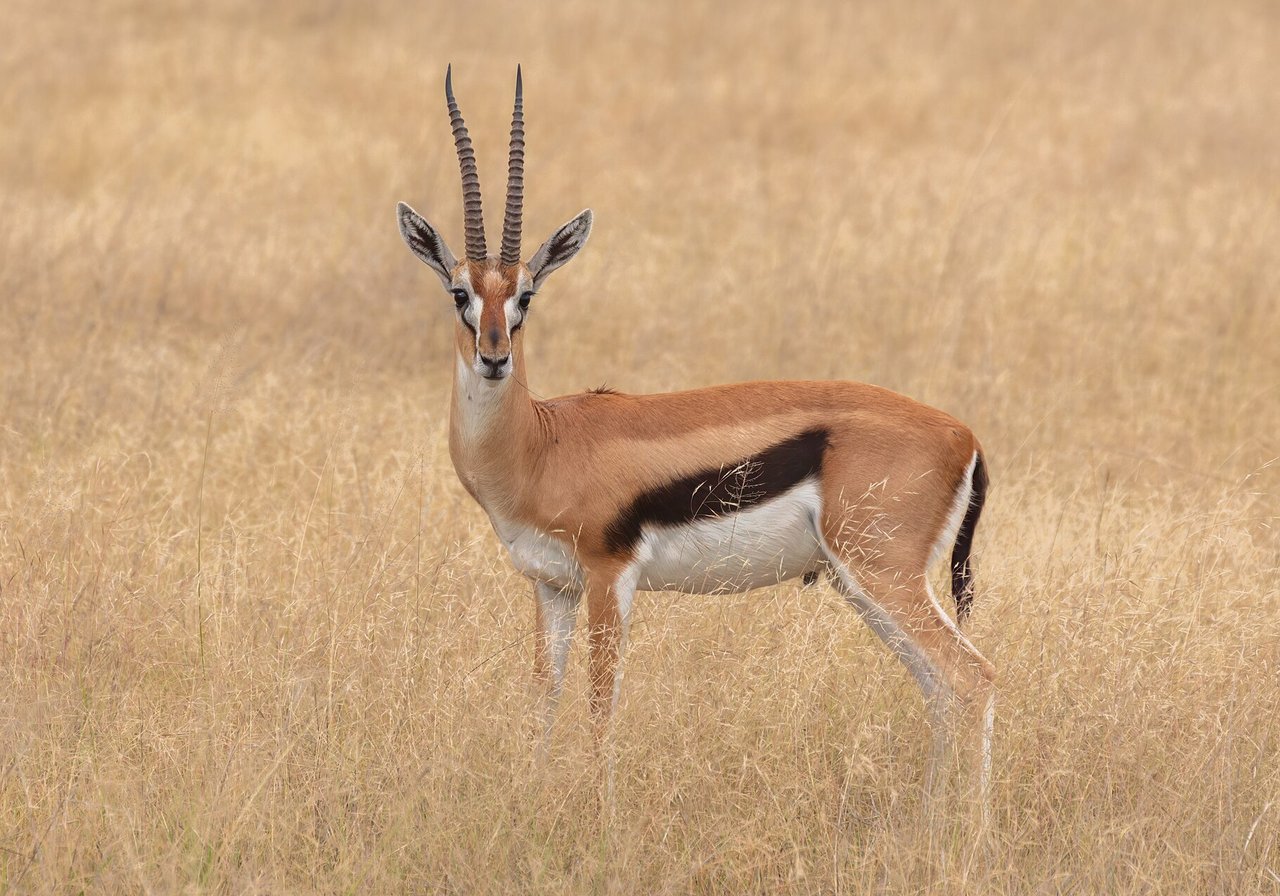
Thomson's gazelle is the archetypal East African plains antelope. It weighs 12–26 kg — small enough for cheetahs to kill — and feeds on short grass too low for wildebeest and zebra.
Both sexes carry horns, though male horns are thicker. During the Great Migration, Thomson's gazelles follow wildebeest herds, benefiting from the larger animals' grazing that keeps grass short. They are extraordinarily fast and manoeuvrable, making them challenging prey even for cheetahs, which succeed in roughly half of hunts. Stotting — a stiff-legged bounce — may signal to predators that pursuit is futile.
Predators and survival strategies
Cheetahs specialise in hunting Thomson's and Grant's gazelles, relying on acceleration rather than endurance. Lions, leopards, hyenas and wild dogs also take gazelles, particularly fawns and sick adults. Gazelles compensate for small size with speed, vigilance and herd behaviour — many eyes scanning for danger. Calving often occurs in synchronised bursts to overwhelm predators. Thomson's gazelles require daily access to water, limiting their range to areas within roughly 10 km of permanent sources.
Conservation across species
Thomson's gazelle is Least Concern with roughly 500,000 individuals and a stable trend in Tanzania's Serengeti. However, the dama gazelle of the Sahara is Critically Endangered with fewer than 100 mature individuals. The Arabian sand gazelle and several Asian species face similar crises from hunting and habitat loss. African savanna gazelles benefit from protected areas and tourism revenue, but snaring and poaching reduce populations outside reserves. CITES Appendix II regulates trade in some populations. This guide focuses on Thomson's gazelle as the most searched African species; see species-specific assessments for dama and Arabian gazelles.
What WARN Does
WARN publishes this gazelle guide as free public education. Gazelles are indicators of savanna health — their abundance supports cheetahs, wild dogs and the entire predator community.
If this guide helps you understand wildlife and the pressures it faces, a gift to WARN supports habitat protection and free public education in our partner countries.
Gazelle: Frequently Asked Questions
How many gazelle species are there?
What is the difference between Thomson's and Grant's gazelle?
Why do gazelles stot?
Are gazelles endangered?
What do gazelles eat?
Where do gazelles live?
Are gazelles dangerous?
How long do gazelles live?
How big is a gazelle?
Sources & References
Population figures, conservation status and biological facts on this page are drawn from authoritative scientific and intergovernmental sources.
Terms used on this page
Plain-English definitions, from our wildlife and conservation glossary.
Latest Gazelle Stories
Quick, fact-checked reads on the gazelle — amazing facts, key questions and the threats it faces.
Briefings
Why Africa's Elephants Are Being Lost to Wire — Not Bullets
Ivory poaching gets the headlines, but across much of East Africa the bigger threat to elephants is cheap snare wire set for bushmeat.
Read the storyBriefings
Bushmeat and the Selous–Niassa Corridor: A Quiet Wildlife Emergency
The forest corridor connecting Tanzania's southern reserves with Mozambique is one of Africa's most ecologically important. It is also one of its most heavily snared.
Read the storySpecies
The African Lion: Vulnerable, Declining, and Disappearing From Most of Africa
African lion numbers have fallen by an estimated 43% over three generations, and the species is now extinct across more than 90% of its historic range. Kenya and Tanzania — two countries WARN plans to expand into — hold some of the last strongholds.
Read the storyExplore more animals
Discover more animals, their habitats and their conservation status in the WARN wildlife-guide library.