Wildlife Guide · Brazil & Colombia
Jaguar
Panthera onca
The Americas' largest cat — and the hardest bite of any big cat on Earth.
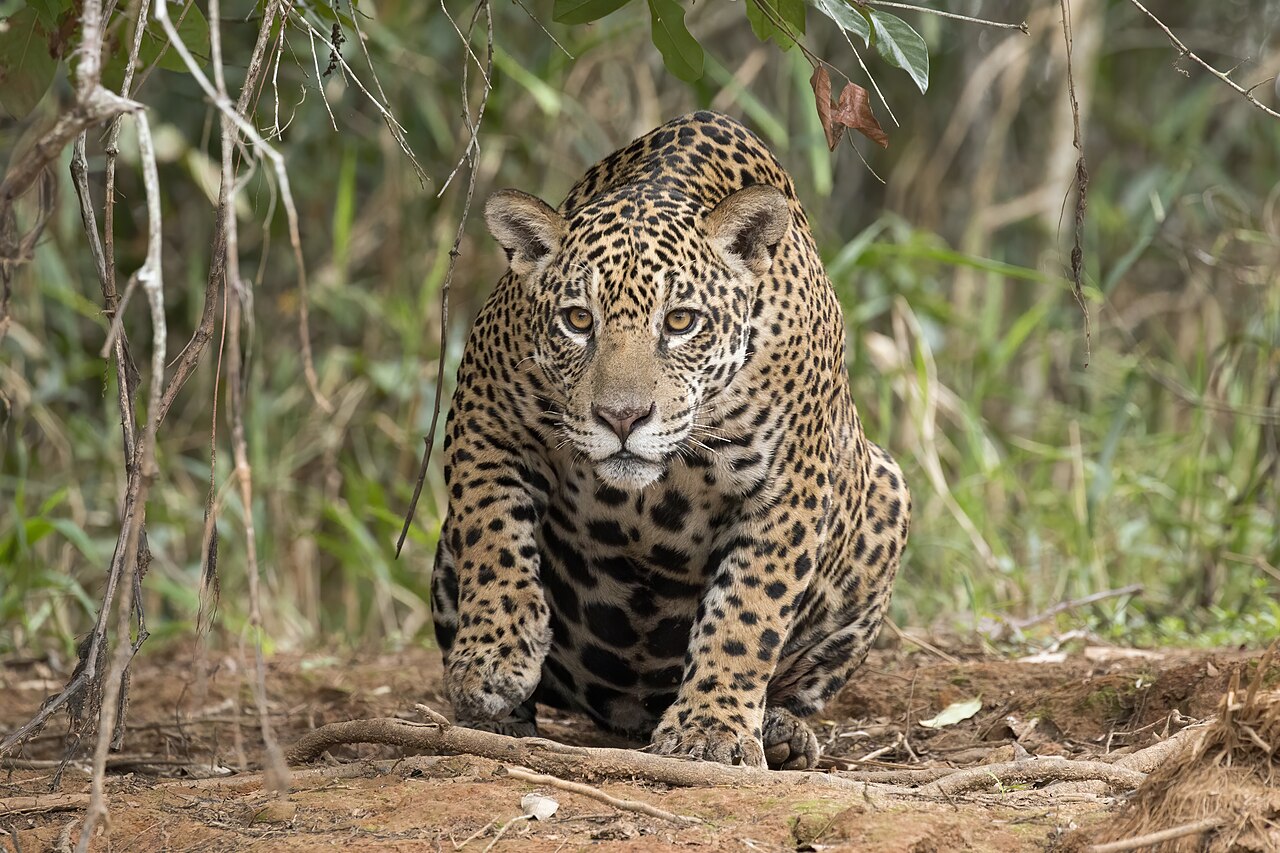
Existing WARN site asset
In brief
A jaguar (Panthera onca) is a large spotted big cat native to the Americas — the largest cat on the continent and the third-largest in the world — known for the strongest bite of any big cat and a habit of killing prey by piercing the skull.
Also in Animals A to Z · Animals that start with J
How you can help
You can support the related appeal — read its purpose, recipient status and fund terms first — or give once to where it is needed most. Sharing accurate information helps too.
By WARN Research & Conservation TeamLast updated
The jaguar (Panthera onca) is the biggest cat in the Americas and the third-largest in the world, after the tiger and lion. Built for ambush in rivers, wetlands and rainforest, it kills with the most powerful bite of any big cat — strong enough to pierce a caiman's hide or crack a turtle shell. Though still listed as Near Threatened overall, jaguars have vanished from roughly half their historic range, and most populations outside the Amazon are already endangered.
Up to ~96 kg
Typical adult male weight (exceptional cats reach ~158 kg)
#1 bite
Strongest bite force of any big cat, relative to size
57,000–64,000
Mature jaguars in Amazonia — about 89% of the global total
Appendix I
CITES listing — all international commercial trade banned
Figures sourced from IUCN Red List — Panthera onca (Jaguar), 2017 assessment, CITES — Jaguar (Panthera onca), Appendix I, Panthera — Jaguar species profile and other references on this page.
Jaguar: Quick Facts
| Lifespan | ~11–15 years in the wild; up to ~22–23 in captivity |
|---|---|
| Weight | Males ~56–96 kg (up to ~158 kg exceptional); females ~10–20% smaller |
| Length | Head-body 1.1–1.85 m; tail 45–75 cm; shoulder height ~57–81 cm |
| Diet | Carnivore — 85+ prey species incl. capybara, peccary, caiman, turtles |
| Gestation | ~91–111 days |
| Young per birth | Usually 1–2 cubs (occasionally up to 4) |
| Baby name | Cub |
| Group name | Largely solitary; a group is informally a "shadow" of jaguars |
| CITES | Appendix I (all commercial international trade banned) |
| Notable | Strongest bite of any big cat for its size; largest cat in the Americas |
Scientific Classification
| Kingdom | Animalia |
|---|---|
| Phylum | Chordata |
| Class | Mammalia |
| Order | Carnivora |
| Family | Felidae |
| Subfamily | Pantherinae |
| Genus | Panthera |
| Species | Panthera onca (Linnaeus, 1758) |
Conservation Status
- IUCN Status
- Near Threatened
- Population
- No precise global figure; the Amazonian subpopulation — about 89% of the total — is estimated at 57,000–64,000 mature individuals
- Trend
- Decreasing
- Assessed
- 2017
- CITES
- Appendix I
Globally Near Threatened, but most subpopulations outside Amazonia are assessed as Endangered or Critically Endangered, and an estimated 20–25% of mature individuals have been lost over the past three generations (~21 years).
Did you know?
Unlike other big cats, a jaguar often kills by biting straight through its prey's skull — its jaws are powerful enough to crack a turtle's shell and crush a caiman's bony hide.
Key Facts: Jaguar
- The jaguar is the largest cat in the Americas and the third-largest big cat in the world, behind only the tiger and lion.
- It has the most powerful bite of any big cat for its size, and uniquely kills by piercing the skull or shell of its prey.
- The IUCN lists the jaguar as Near Threatened (assessed 2017) with a decreasing population trend.
- Around 89% of all jaguars live in the Amazon; most populations elsewhere are Endangered or Critically Endangered.
- Jaguars eat more than 85 prey species, including capybara, peccary, caiman and turtles.
- Habitat loss, prey depletion, and killing in retaliation for livestock losses are the biggest threats.
Why the jaguar is in trouble
The jaguar carries a global IUCN status of Near Threatened, but that single label hides a stark divide. The species has been lost from roughly half its historic range, and its assessed range fell about 20% in little more than a decade. The reason the overall status is not worse is the Amazon: the vast Amazonian subpopulation holds an estimated 57,000–64,000 mature jaguars — close to 89% of the world total — and is the only subpopulation rated Least Concern. Almost every population outside it is fragmented and rated Endangered or Critically Endangered. As a result the IUCN suspects a 20–25% decline in mature jaguars over the past three generations (about 21 years), and the trend is still downward.
Behaviour and ecology
Jaguars are solitary, territorial ambush hunters most at home near water — riverbanks, swamps, flooded grassland and dense forest. They are strong swimmers and unusually comfortable hunting in and around rivers, taking caimans, capybara, peccary, fish and turtles among more than 85 recorded prey species. Their signature is the killing bite: rather than suffocating prey at the throat like most big cats, a jaguar often bites straight through the skull or pierces a turtle's shell, using jaw muscles powerful enough to give it the strongest bite of any big cat for its body size. The largest jaguars of all are found in open wetlands such as Brazil's Pantanal, where males can be far heavier than forest-dwelling cats.
Threats
Three pressures drive the decline. First, habitat loss and fragmentation: as forest and wetland are cleared for cattle, soy and infrastructure, jaguar populations are cut off from one another and lose the room a wide-ranging predator needs. Second, prey depletion from hunting, which empties habitat that still looks intact. Third, direct killing — jaguars are shot in retaliation when they take livestock, and despite a CITES Appendix I ban there is renewed illegal trade in jaguar teeth, skulls and skins. Connecting protected areas through habitat corridors and reducing conflict with ranchers are central to keeping populations viable.
What rescue and protection involve
Saving jaguars is mostly about people and land, not captivity. The work includes protecting and linking core habitat, supporting ranchers to prevent and tolerate livestock losses, funding ranger patrols and camera-trap monitoring, and rehabilitating orphaned or injured cats for release where possible. Because a single jaguar may range over hundreds of square kilometres, conservation has to operate at landscape scale and across borders — which makes locally led teams who know the terrain and the communities essential.
Jaguar vs leopard: how to tell them apart
| Feature | Jaguar (Panthera onca) | Leopard (Panthera pardus) |
|---|---|---|
| Where it lives | The Americas (Mexico to Argentina) | Africa and Asia |
| Build | Bigger, stockier, broad head and chest | Slimmer and more lightly built |
| Rosettes | Larger rosettes, often with spots inside | Smaller, tighter rosettes with no inner spots |
| Typical male weight | ~56–96 kg (up to ~158 kg) | ~30–90 kg |
| Signature behaviour | Kills by piercing the skull; hunts in and around water | Often hauls kills up into trees |
| IUCN status | Near Threatened | Vulnerable |
What WARN Does
WARN publishes this guide for education and is developing support through assessed animal-welfare grants. A species range, source citation or photograph does not establish a recipient or funding agreement. Check /about/where-your-money-goes/#grant-register for published grant and payment records; records not yet published must not be read as zero activity. Browse /appeals/ for the purposes currently available to support.
If you would like to help, read /appeals/ and choose a purpose that matches your intentions. WARN is raising funds towards assessed support; donations do not guarantee a treatment or rescue. Sharing accurate information is another welcome way to help.
How can I help save the jaguar?
Explore practical ways to support the jaguar, from everyday choices and sharing reliable information to reviewing a related appeal before giving.
Explore ways to support
Read the related appeal’s purpose, recipient status and fund terms. Choose an affordable gift after checking what is proposed and what has been reported.
Ease the pressures
Avoid the wildlife trade and souvenirs, never buy wild animals as pets, and choose sustainable, habitat-friendly products — the threats behind the jaguar's decline fall when demand does.
Spread the word
Share accurate, sourced information about the jaguar. Wider awareness is what turns concern into lasting protection.
Jaguar: Frequently Asked Questions
How can I help save the jaguar?
How big is a jaguar and how much does it weigh?
How long do jaguars live?
What do jaguars eat?
Are jaguars dangerous to humans?
How many jaguars are left in the wild?
Why are jaguars threatened?
What is a baby jaguar called?
Where do jaguars live?
Sources & References
Population figures, conservation status and biological facts on this page are drawn from authoritative scientific and intergovernmental sources.
Related Rescue Guides
Selected guides that explain this animal’s rescue, habitat needs or ways to help. Check each appeal for its current funding status.
Terms used on this page
Plain-English definitions, from our wildlife and conservation glossary.
Latest Jaguar Stories
Quick, fact-checked reads on the jaguar — amazing facts, key questions and the threats it faces.
Species
12 Amazing Facts About the Jaguar, the Americas' Biggest Cat
From a skull-piercing bite to a love of swimming, here are 12 fascinating, fact-checked things that make the jaguar the most powerful cat in the Americas.
Read the storySpecies
How Strong Is a Jaguar's Bite? The Most Powerful Jaws of Any Big Cat
Pound for pound, the jaguar bites harder than any other big cat. Here's how its skull-crushing jaws work and what they let it hunt.
Read the storySpecies
Jaguar vs Leopard: How to Tell These Spotted Cats Apart
Jaguars and leopards look almost identical at a glance, but their spots, size, range and hunting style give them away. Here's how to tell which is which.
Read the storyExplore more animals
Discover more animals, their habitats and their conservation status in the WARN wildlife-guide library.