Wildlife Guide · Europe — from Portugal to Ukraine; introduced locally elsewhere
Salamander
Salamandra salamandra (Linnaeus, 1758)
Living jewels of damp woodland — amphibians of myth, pet trade and emerging disease.
Source: Wikimedia Commons
In brief
Salamanders are tailed amphibians of order Caudata; the fire salamander (Salamandra salamandra) is Near Threatened in Europe, threatened by Bsal fungus linked to the pet trade, while many species face habitat loss and overharvesting.
Also in Animals A to Z · Animals that start with S
How you can help
You can support the related appeal — read its purpose, recipient status and fund terms first — or give once to where it is needed most. Sharing accurate information helps too.
By WARN Research & Conservation TeamLast updated
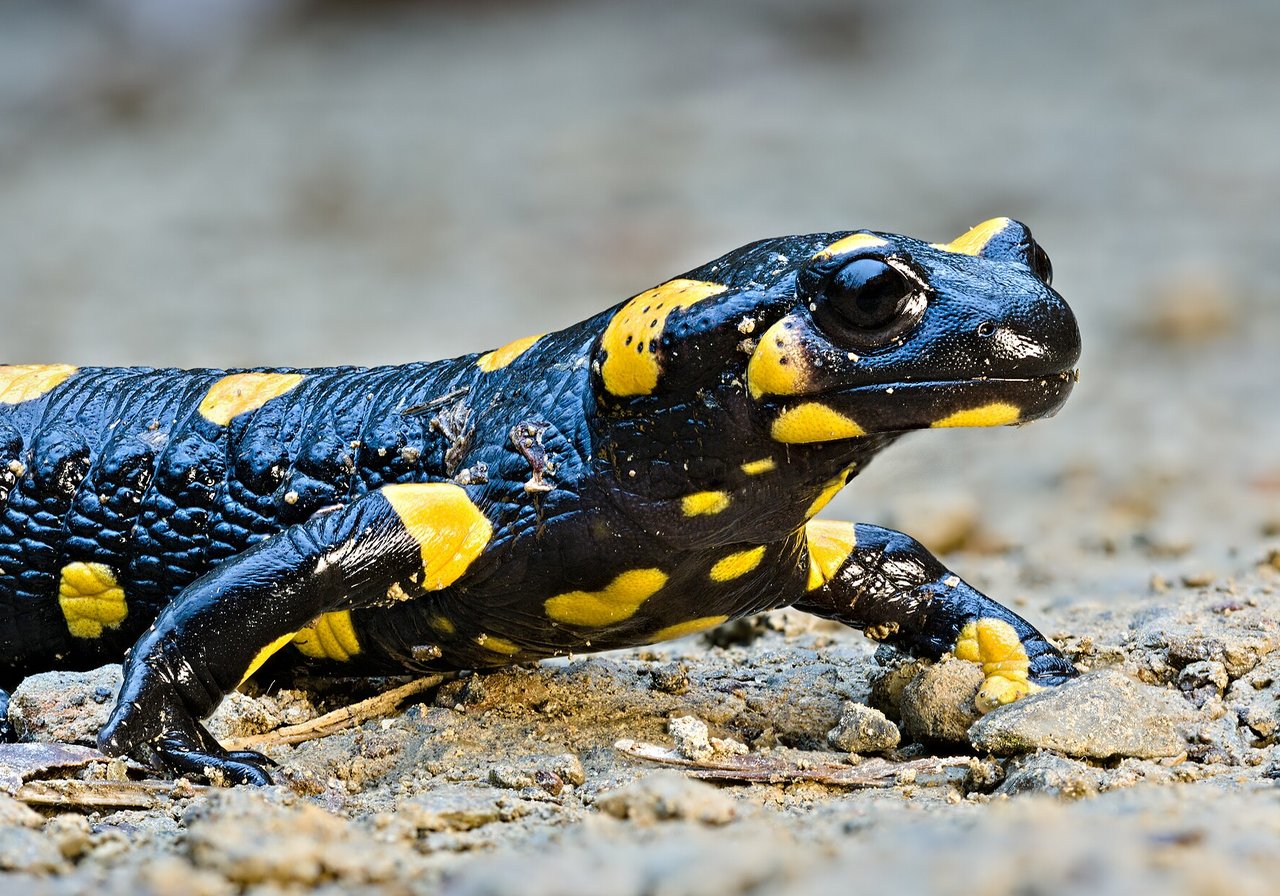
Salamanders are tailed amphibians of the order Caudata, inhabiting moist forests, streams and caves across the Northern Hemisphere. The fire salamander — black with vivid yellow or orange warning markings — is among Europe's most recognisable amphibians and a staple of folklore. Listed as Near Threatened, fire salamanders face a lethal fungal disease called Bsal (Batrachochytrium salamandrivorans) spreading from the pet trade. Globally, over 40% of amphibian species are threatened — salamanders epitomise the crisis. They are popular in the exotic pet trade, yet most species need specialist cool, humid enclosures and live food. Chinese giant salamanders — the world's largest amphibians — are Critically Endangered from overharvesting.
Near Threatened
IUCN status — fire salamander (2020)
760+
Salamander species worldwide
40%+
Amphibian species globally threatened
Appendix II
CITES listing — Chinese giant salamander
Figures sourced from IUCN Red List — Salamandra salamandra, IUCN Red List — Andrias davidianus (Chinese giant salamander), AmphibiaWeb — salamander information .
Salamander: Quick Facts
| Length | 15–25 cm (fire salamander) |
|---|---|
| Defence | Skin toxins — samandarin alkaloids |
| Reproduction | Live-bearing — fully formed juveniles |
| Bsal impact | Up to 96% mortality in affected populations |
| Global species | 760+ salamander species |
| CITES | Appendix I (Chinese giant salamander) |
Scientific Classification
| Kingdom | Animalia |
|---|---|
| Phylum | Chordata |
| Class | Amphibia |
| Order | Caudata (Urodela) |
| Family | Salamandridae |
| Genus | Salamandra |
| Species | Salamandra salamandra (Linnaeus, 1758) |
Conservation Status
- IUCN Status
- Fire salamander Near Threatened (IUCN, 2020). Bsal causing local extirpations. Chinese giant salamander Critically Endangered.
- Population
- Fire salamander declining; exact global count unknown
- Trend
- Decreasing — Bsal and habitat loss
- Assessed
- 2020
- CITES
- Appendix I (Chinese giant salamander); Appendix II (others vary)
Key Facts: Salamander
- Salamanders are tailed amphibians — distinct from frogs and caecilians.
- Fire salamanders are Near Threatened; Bsal fungus devastates wild populations.
- Bsal spread is linked to the international amphibian pet trade.
- Chinese giant salamanders are Critically Endangered — largest amphibians on Earth.
- Most salamanders are poor beginner pets — they need cool, humid, specialist care.
- Amphibians indicate freshwater and forest health — their decline signals ecosystem stress.
Amphibians of forest and stream
Salamanders belong to order Caudata — one of three living amphibian groups alongside frogs and caecilians. Roughly 760 species occupy moist habitats across the Northern Hemisphere, with greatest diversity in eastern North America and eastern Asia. They breathe through skin as well as lungs, requiring clean, damp environments.
The fire salamander ranges across European woodland from Iberia to Ukraine. Its aposematic yellow-on-black pattern warns predators of skin toxins — alkaloids called samandarin that can cause convulsions. Other species include the spotted salamander of North America, alpine newts of mountain streams and the bizarre olm — a blind cave-dweller of Balkan karst systems.
Salamanders undergo varied life histories. Some hatch as aquatic larvae with gills; others bear live young or skip the larval stage entirely. Fire salamanders give birth to fully formed juveniles — a rare strategy among amphibians.
Wild salamanders and ecosystem role
In healthy forest ecosystems, salamanders are abundant predators of invertebrates — earthworms, slugs, insects and spiders. A single square metre of Appalachian forest floor may contain more biomass in salamanders than in birds and mammals combined. This hidden abundance regulates detritus food webs and nutrient cycling.
Fire salamanders are nocturnal, emerging after rain to hunt along stream banks and under logs. They are indicators of woodland and water quality — sensitive to pesticide runoff, acidification and habitat fragmentation. Populations persist in old-growth and well-connected forest; they vanish from intensively managed landscapes.
The olm — a pale, eyeless salamander of Slovenian caves — can live over 100 years, making it one of the longest-lived amphibians. Its extreme specialisation illustrates the vulnerability of range-restricted species.
The pet trade and captive care
Salamanders are traded as exotic pets — fire salamanders, tiger salamanders and axolotls are common in the hobby. Axolotls — neotenic Mexican salamanders retaining larval form — are Critically Endangered in the wild but widely bred in captivity.
Responsible keeping demands cool temperatures (most species 10–18 °C), high humidity, live invertebrate food and secure enclosures preventing escape. Salamanders absorb chemicals through skin — tap water must be dechlorinated; pesticides are lethal. Many purchased on impulse die within months.
The international trade in wild-caught and captive-bred amphibians is the primary vector for Bsal — Batrachochytrium salamandrivorans — a chytrid fungus that causes skin lesions and rapid mortality. Bsal arrived in Europe from imported Asian newts and has wiped out fire salamander populations in the Netherlands and Belgium.
Bsal and the amphibian crisis
Bsal represents an existential threat to salamander diversity. First detected in the Netherlands in 2013, it has caused up to 96% mortality in affected fire salamander populations within months. The fungus persists in soil and water, preventing recolonisation.
Genetic evidence traces Bsal to Asian salamander species carried asymptomatically in the pet trade. Europe's salamander fauna — with no evolutionary exposure — has no resistance. North America, home to the world's greatest salamander diversity, faces catastrophic risk if Bsal establishes.
The IUCN lists the fire salamander as Near Threatened; regional populations hit by Bsal qualify as Critically Endangered. Chinese giant salamanders — reaching 1.8 metres — are Critically Endangered from overharvesting for food and traditional medicine. CITES Appendix I protects the Chinese giant salamander.
Protecting salamanders wild and captive
Conservation requires biosecurity: disinfecting footwear near amphibian habitat, never releasing pet salamanders into the wild and supporting trade restrictions on high-risk species. Several European countries ban imports of certain Asian salamanders.
Habitat protection — maintaining damp woodland, clean streams and connected corridors — benefits wild populations. Captive assurance colonies may preserve genetics if Bsal makes field recovery impossible.
Readers considering salamanders as pets should research species-specific needs, buy only captive-bred animals from reputable sources and never release unwanted animals outdoors. WARN publishes this salamander guide as free public education about amphibians whose quiet decline carries warnings for freshwater ecosystems worldwide.
What WARN Does
WARN publishes this salamander guide as free public education. Amphibians are among the most threatened vertebrate groups — understanding their ecology and the pet trade's role in disease spread supports informed conservation.
If this guide helps you understand wildlife and the pressures it faces, a gift to WARN supports habitat protection and free public education in our partner countries.
How can I help save the salamander?
Explore practical ways to support the salamander, from everyday choices and sharing reliable information to reviewing a related appeal before giving.
Explore ways to support
Read the related appeal’s purpose, recipient status and fund terms. Choose an affordable gift after checking what is proposed and what has been reported.
Ease the pressures
Avoid the wildlife trade and souvenirs, never buy wild animals as pets, and choose sustainable, habitat-friendly products — the threats behind the salamander's decline fall when demand does.
Spread the word
Share accurate, sourced information about the salamander. Wider awareness is what turns concern into lasting protection.
Salamander: Frequently Asked Questions
How can I help save the salamander?
Are salamanders good pets?
What is Bsal?
Are fire salamanders endangered?
What is the difference between a salamander and a newt?
Are salamanders dangerous?
How long do salamanders live?
How big is a salamander?
Sources & References
Population figures, conservation status and biological facts on this page are drawn from authoritative scientific and intergovernmental sources.
Terms used on this page
Plain-English definitions, from our wildlife and conservation glossary.
Explore more animals
Discover more animals, their habitats and their conservation status in the WARN wildlife-guide library.