Wildlife Guide · Indonesia & Malaysia
Saltwater Crocodile
Crocodylus porosus
The largest living reptile, ruling the tidal rivers and estuaries of Southeast Asia and Australasia.
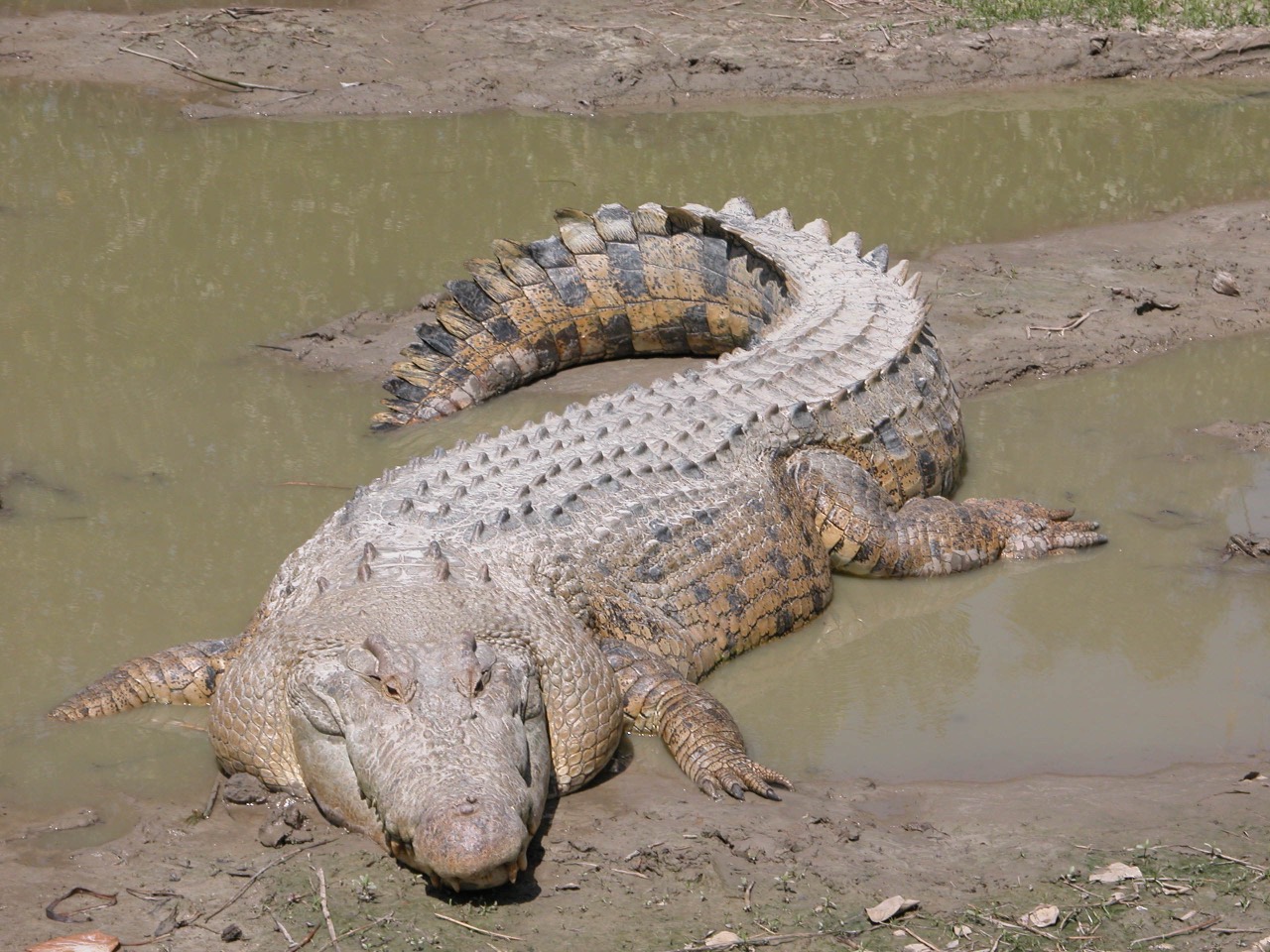
Source: Wikimedia Commons via Wikipedia “Saltwater crocodile”
In brief
The saltwater crocodile (Crocodylus porosus) is the world's largest living reptile, found in the estuaries and mangroves of Southeast Asia and Australasia; it is listed as Least Concern globally by the IUCN, though some local populations remain depleted.
Also in Animals A to Z · Animals that start with S
By WARN Research & Conservation TeamLast updated
The saltwater crocodile (Crocodylus porosus) is the biggest reptile alive today and one of the planet's most formidable apex predators. Equally at home in brackish estuaries, mangrove channels and the open sea, it ranges from the coasts of eastern India through Southeast Asia to northern Australia and the western Pacific. While the species is listed globally as Least Concern thanks to large, well-managed populations in places like Australia, many local populations across Southeast Asia have been thinned by decades of hunting, egg collection, and the loss of nesting habitat. In WARN partner countries such as Indonesia and Malaysia, the saltwater crocodile sits at the heart of a delicate balance between healthy wetlands, human safety, and coastal livelihoods.
Up to 6+ m
Length of the largest males
Up to ~1,000 kg
Weight of a large adult male
~70+ years
Typical lifespan in the wild
40–60 eggs
Per nest, in a single clutch
Figures sourced from IUCN Red List — Crocodylus porosus, Wikipedia — Saltwater crocodile, CITES — Appendices (Crocodylus porosus listing) and other references on this page.
Saltwater Crocodile: Quick Facts
| Lifespan | Around 70+ years in the wild |
|---|---|
| Weight | Up to ~1,000 kg (large males) |
| Size | 4–5 m typical; over 6 m for the largest males |
| Diet | Carnivore (fish, crustaceans, birds, mammals, reptiles) |
| Incubation | About 80–90 days |
| Young | 40–60 eggs per clutch |
| Baby name | Hatchling |
| Group name | A bask (on land) or a float (in water) |
| Top speed | Short bursts to ~25–29 km/h in water; fast lunges on land |
| CITES | Appendix I; Appendix II for Australia, Indonesia and Papua New Guinea |
Scientific Classification
| Kingdom | Animalia |
|---|---|
| Phylum | Chordata |
| Class | Reptilia |
| Order | Crocodilia |
| Family | Crocodylidae |
| Genus | Crocodylus |
| Species | Crocodylus porosus |
Conservation Status
- IUCN Status
- Least Concern
- Population
- Hundreds of thousands of mature individuals globally; large stronghold populations in Australia, with smaller and locally depleted populations across Southeast Asia
- Trend
- Stable globally (locally variable)
- Assessed
- 2020 (published 2021)
- CITES
- Appendix I, with Appendix II listings for the populations of Australia, Indonesia and Papua New Guinea
Although globally Least Concern, the species has been heavily reduced or locally lost across parts of its historic Southeast Asian range, so the global status masks real local conservation needs.
Did you know?
Saltwater crocodiles have special salt-excreting glands on their tongues, which is part of how they survive in the ocean and have been recorded crossing hundreds of kilometres of open sea between islands.
Key Facts: Saltwater Crocodile
- Saltwater crocodiles are the largest living reptiles, with big males reaching over 6 metres and roughly a tonne in weight.
- They thrive in salty and brackish water, using mangroves, estuaries and open coastlines, and can travel long distances by sea.
- Globally the species is Least Concern (IUCN, assessed 2020), but local populations in parts of Southeast Asia are reduced and need protection.
- As ambush apex predators they regulate prey populations and keep estuary and wetland ecosystems in balance.
- Females build mound nests of vegetation and guard their eggs and hatchlings, with nest temperature determining the sex of the young.
- Human–crocodile conflict is a major challenge, making safety education and habitat management essential for both people and crocodiles.
Where saltwater crocodiles live
Saltwater crocodiles occupy a vast range stretching from the eastern coast of India, through the rivers, estuaries and mangrove forests of Southeast Asia, across the islands of Indonesia and Malaysia, and on to northern Australia and the western Pacific. Despite their name, they are not confined to the sea: they move freely between freshwater rivers, brackish tidal channels and saltwater coasts, and individuals have been recorded crossing open ocean between islands. This flexibility once made them one of the most widespread crocodilians on Earth, but it also means they frequently share waterways with fishing communities and coastal villages.
The largest reptile on Earth
No living reptile grows larger than a mature male saltwater crocodile. The biggest verified individuals exceed 6 metres in length and can approach 1,000 kilograms, with females considerably smaller. Their power comes from a heavily muscled tail, an armored hide, and one of the strongest bite forces measured in any animal. As ambush hunters, they lie motionless near the water's edge and explode forward to seize prey ranging from fish, crabs and birds to deer, wild boar and other large animals. This raw capability is exactly why coexistence with people requires careful management rather than fear alone.
Conservation status and local pressures
On the global IUCN Red List the saltwater crocodile is classified as Least Concern, reflecting large and recovering populations in well-managed regions such as northern Australia. That single label, however, hides a more uneven reality. Across much of Southeast Asia, including parts of Indonesia and Malaysia, populations were heavily reduced by historic skin hunting, egg and hatchling collection, and the steady loss of mangrove and wetland nesting habitat. Trade is regulated under CITES, with most wild populations on Appendix I and managed populations in Australia, Indonesia and Papua New Guinea on Appendix II. Protecting nesting beaches and intact estuaries is the key to keeping local populations healthy.
Living alongside a giant predator
In the WARN partner countries where saltwater crocodiles occur, the central conservation question is coexistence. Fishers, farmers and families often use the same rivers and shorelines that crocodiles rely on, and attacks, though rare relative to the number of encounters, can be severe. Effective solutions combine community safety education, well-placed warning signage and barriers, the safe relocation of dangerous individuals, and the protection of breeding habitat so crocodiles have wild space away from people. When this balance works, both communities and crocodiles benefit, and healthy wetlands continue to support fisheries, storm protection and biodiversity.
Saltwater crocodile vs Nile crocodile
| Feature | Saltwater Crocodile | Nile Crocodile |
|---|---|---|
| Scientific name | Crocodylus porosus | Crocodylus niloticus |
| Main range | SE Asia and Australasia | Sub-Saharan Africa |
| Typical habitat | Estuaries, mangroves, coasts | Rivers, lakes, freshwater wetlands |
| Salt tolerance | High; travels by sea | Lower; mainly freshwater |
| Maximum size | Largest living reptile, over 6 m | Large, up to about 5–6 m |
| IUCN status | Least Concern | Least Concern |
What WARN Does
In WARN network partner countries including Indonesia and Malaysia, the World Animal Rescue Network is building early-stage support for saltwater crocodile coexistence: backing local partners working on nesting-beach and mangrove protection, safe response and relocation of crocodiles caught in conflict situations, and community safety education along high-risk waterways. This work is at launch-stage scale, focused on strengthening on-the-ground partners rather than running large field programs directly, so that both coastal communities and the wetlands these crocodiles depend on can thrive.
Healthy estuaries and mangroves keep saltwater crocodiles, coastal wildlife and local communities safe. Support habitat protection in WARN partner countries to help our partners safeguard nesting grounds and reduce human–crocodile conflict.
Saltwater Crocodile: Frequently Asked Questions
How big is a saltwater crocodile?
Are saltwater crocodiles endangered?
Where do saltwater crocodiles live?
What do saltwater crocodiles eat?
How long do saltwater crocodiles live?
What is the difference between a saltwater crocodile and a Nile crocodile?
Sources & References
Population figures, conservation status and biological facts on this page are drawn from authoritative scientific and intergovernmental sources.
Terms used on this page
Plain-English definitions, from our wildlife and conservation glossary.
Latest Saltwater Crocodile Stories
Quick, fact-checked reads on the saltwater crocodile — amazing facts, key questions and the threats it faces.
Briefings
Kalimantan forest fires 2026: orangutans, smoke and how to help
What official reports say about Kalimantan’s forest fires, Sempurna the orangutan, smoke and wildlife rescue—and how to help through informed giving or sharing.
Read the storyBriefings
Three Rehabilitated Orangutans Released Back Into the Wild in East Kalimantan
Three Bornean orangutans — Bagus, Eboni and Ruby — were released into a protected forest in East Kutai, East Kalimantan, on 23 June 2026, after years of rehabilitation following rescue from the illegal pet trade. All three are Critically Endangered Pongo pygmaeus.
Read the storySpecies
Why Are Orangutans Endangered? Palm Oil, Deforestation and the Rescue Crisis in Borneo
Orangutans are endangered because of a single dominant cause: deforestation. All three remaining species have been reduced to small, fragmented populations in what remains of Borneo's and Sumatra's lowland and peat-swamp forests — and the crisis is getting worse, not better.
Read the storyExplore more animals
Discover more animals, their habitats and their conservation status in the WARN wildlife-guide library.