Wildlife Guide · Central America & South America
Tapir
Family Tapiridae — 4 living species in Asia and the Americas
Forest gardeners with trunk-like snouts — ancient odd-toed ungulates under siege.
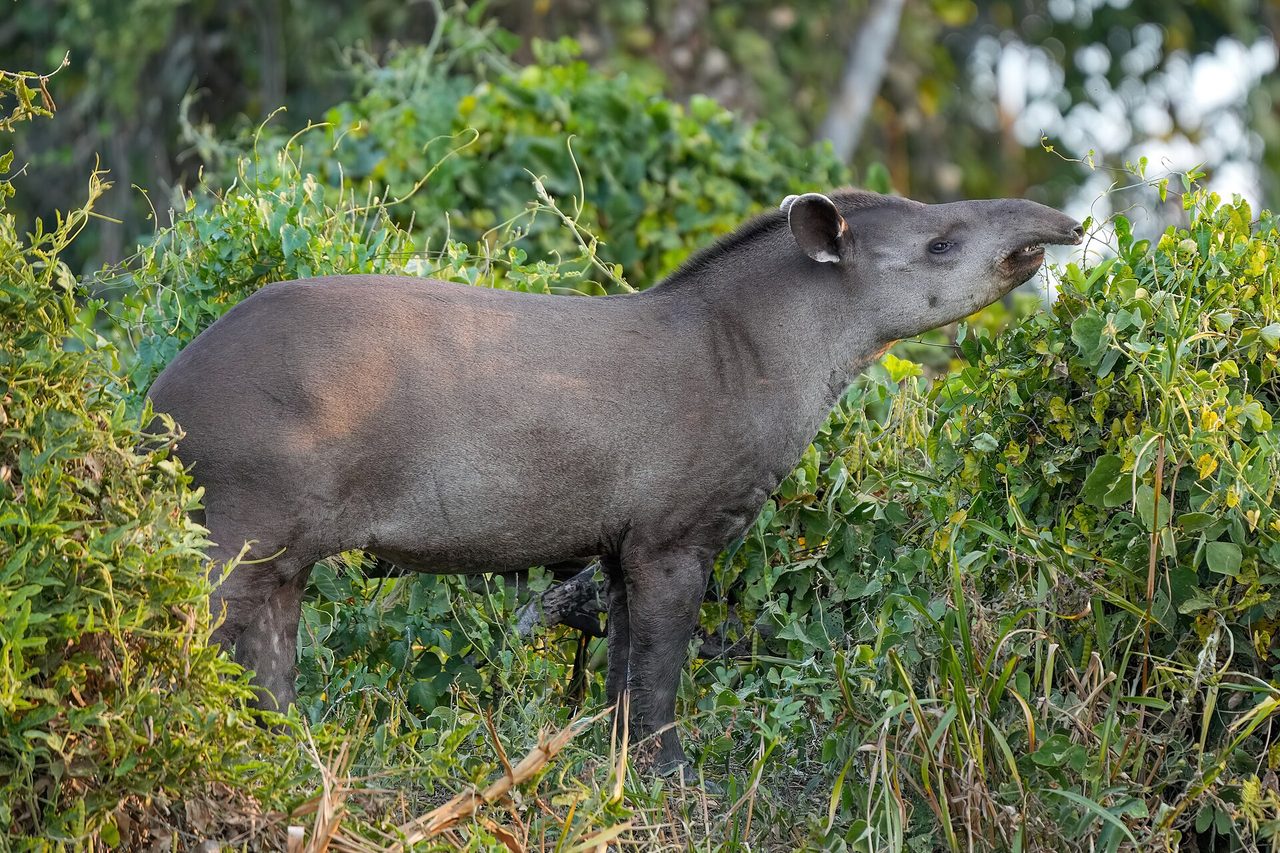
Photo: Giles Laurent / Wikimedia Commons (CC BY-SA 4.0)
In brief
Tapirs are four threatened species of forest herbivore in Asia and the Americas — all Endangered or Vulnerable — serving as seed dispersers; WARN covers the Malayan tapir in detail.
Also in Animals A to Z · Animals that start with T
By WARN Research & Conservation TeamLast updated
Tapirs are large herbivorous mammals of the family Tapiridae, distantly related to horses and rhinos. Four species survive: Malayan tapir of South-east Asia; Baird's, lowland and mountain tapirs of Central and South America. All are threatened — Endangered or Vulnerable — from deforestation, hunting and road collisions. Tapirs are 'gardeners of the forest', dispersing seeds in droppings across vast home ranges. Their short flexible proboscis grabs leaves and fruit. Malayan tapirs — black with a white saddle — are the largest and most distinctive. WARN's Malayan tapir guide covers that species in detail for Malaysia and Indonesia partner regions.
4
Living tapir species
Endangered
Malayan tapir and Baird's tapir
250 kg
Typical adult Malayan tapir weight
CITES I/II
International trade regulated
Figures sourced from IUCN Red List — Tapiridae, Tapir Specialist Group, Malaysian Nature Society .
Tapir: Quick Facts
| Species | 4 living tapir species |
|---|---|
| Related guide | Malayan tapir |
| Ecological role | Seed dispersers — 'gardeners of the forest' |
| Distinctive trait | Flexible proboscis-like snout |
| Main threats | Deforestation, hunting, road kills |
| CITES | Appendix I or II by species |
Scientific Classification
| Kingdom | Animalia |
|---|---|
| Class | Mammalia |
| Order | Perissodactyla |
| Family | Tapiridae |
| Genus | Tapirus |
Conservation Status
- IUCN Status
- All four species threatened — Malayan and Baird's tapir Endangered; lowland tapir Vulnerable.
- Population
- Malayan tapir fewer than 2,500 mature individuals; precise counts difficult
- Trend
- Decreasing for all species
- Assessed
- 2014 (Malayan tapir)
- CITES
- Appendix I or II depending on species
Key Facts: Tapir
- Four tapir species survive — one in Asia, three in the Americas.
- All four are threatened — Endangered or Vulnerable on the IUCN Red List.
- Tapirs disperse seeds across forest — earning the nickname 'gardeners of the forest'.
- Malayan tapirs inhabit Malaysia and Indonesia — WARN partner countries.
- WARN's Malayan tapir guide covers the Asian species in detail.
- Road kills, hunting and deforestation are primary threats.
Four species across two continents
The Malayan tapir (Tapirus indicus) — black with a white or grey saddle — is the only Asian species, ranging from Myanmar through Malaysia, Thailand and Indonesia. Baird's tapir (Tapirus bairdii) inhabits Central American forest from Mexico to Colombia. The lowland tapir (Tapirus terrestris) is the most widespread South American species; the mountain tapir (Tapirus pinchaque) is the smallest, restricted to Andean cloud forest.
All tapirs share a compact body, short legs, three toes on each hind foot and a flexible proboscis formed from the upper lip and nose. Young tapirs of all species wear spotted or striped coats that fade with age — camouflage in dappled forest light.
Tapirs belong to order Perissodactyla alongside horses and rhinos — an ancient lineage of odd-toed ungulates. Fossil tapirs once ranged across Europe and North America.
Ecology and seed dispersal
Tapirs are mainly nocturnal browsers, eating leaves, shoots, fruit and aquatic vegetation. Home ranges span dozens of square kilometres — Malayan tapirs traverse lowland and hill forest, following fruiting cycles seasonally. Seeds pass through the gut and germinate in droppings far from parent trees, linking tapir survival to forest regeneration.
Tapirs swim well, using water to escape predators and cool down. Jaguars and tigers prey on tapirs where their ranges overlap. Low reproductive rate — one calf every two years — makes population recovery slow after hunting pressure.
As large herbivores, tapirs maintain forest structure by browsing and creating trails used by other species. Their loss allows vegetation shifts that reduce biodiversity.
Threats and conservation
Deforestation for palm oil, logging, cattle ranching and infrastructure removes tapir habitat across Malaysia, Indonesia, Brazil and Colombia — all WARN partner regions. Hunting for bushmeat persists despite legal protection. Road kills fragment populations as highways cross forest — a growing threat as Asia and Latin America develop transport networks.
All four species are CITES Appendix I or II. Protected areas harbour tapirs but enforcement against hunting and snaring is weak in many reserves. Camera-trap surveys monitor populations; wildlife corridors link forest fragments.
Captive breeding supports reintroduction for Baird's tapir in some regions. Malayan tapir captive programmes operate in zoos worldwide while wild populations decline.
Tapirs and people
Tapirs appear in indigenous folklore across the Amazon and Malay Peninsula — often as shy forest spirits. Today they are flagship species for rainforest protection: saving tapir habitat preserves jaguars, hornbills and thousands of plant species.
Ecotourism in the Pantanal, Amazon and Taman Negara can fund anti-poaching when conducted responsibly. Consumers can choose certified sustainable palm oil and support habitat appeals.
Read WARN's Malayan tapir guide for species-level detail on South-east Asia's black-and-white forest specialist.
What WARN Does
WARN publishes this guide for education and is developing support through assessed animal-welfare grants. A species range, source citation or photograph does not establish a recipient or funding agreement. Check /about/where-your-money-goes/#grant-register for published grant and payment records; records not yet published must not be read as zero activity. Browse /appeals/ for the purposes currently available to support.
If this guide helps you understand wildlife and the pressures it faces, a gift to WARN supports habitat protection and free public education in our partner countries.
Tapir: Frequently Asked Questions
How many tapir species are there?
Are tapirs endangered?
Why do tapirs have a snout?
Where do Malayan tapirs live?
What do tapirs eat?
Where can I read about the Malayan tapir?
Are tapirs dangerous?
How long do tapirs live?
How big is a tapir?
Sources & References
Population figures, conservation status and biological facts on this page are drawn from authoritative scientific and intergovernmental sources.
Terms used on this page
Plain-English definitions, from our wildlife and conservation glossary.
Latest Tapir Stories
Quick, fact-checked reads on the tapir — amazing facts, key questions and the threats it faces.
Species
12 Amazing Facts About the Jaguar, the Americas' Biggest Cat
From a skull-piercing bite to a love of swimming, here are 12 fascinating, fact-checked things that make the jaguar the most powerful cat in the Americas.
Read the storySpecies
11 Amazing Facts About the Pink River Dolphin (the Amazon's Blushing Boto)
From a head that swivels 90 degrees to a blush built from battle scars, here are 11 true facts about the Amazon's pink river dolphin, the largest freshwater dolphin on Earth.
Read the storySpecies
Pink River Dolphin vs Tucuxi: How to Tell the Two Amazon Dolphins Apart
Both swim the same Amazon waters, but the pink boto and the grey tucuxi are only distant cousins. Here is how to tell them apart at a glance.
Read the storyExplore more animals
Discover more animals, their habitats and their conservation status in the WARN wildlife-guide library.