Animal Comparison
Hippopotamus vs Rhinoceros
Compare hippos and rhinos by size, feet, horns, diet and habitat. Learn how the five rhino species differ and what their conservation status means.
By WARN Research & Conservation TeamLast updated
In brief — Hippopotamus vs Rhinoceros
A common hippo has a broad muzzle, four toes on each foot and no horn. Rhinos have three toes and usually one or two horns. Their size comparison depends on the rhino species.
Hippos and rhinos are different groups of mammals. Common hippos spend much of the day in water and usually graze on land at night. The five rhino species include grassland grazers, floodplain animals and forest browsers. White and greater one-horned rhinos can outweigh a common hippo; the Sumatran rhino is substantially smaller.
See the difference
Images are shown at different scales. Read each caption for the species, source and context.
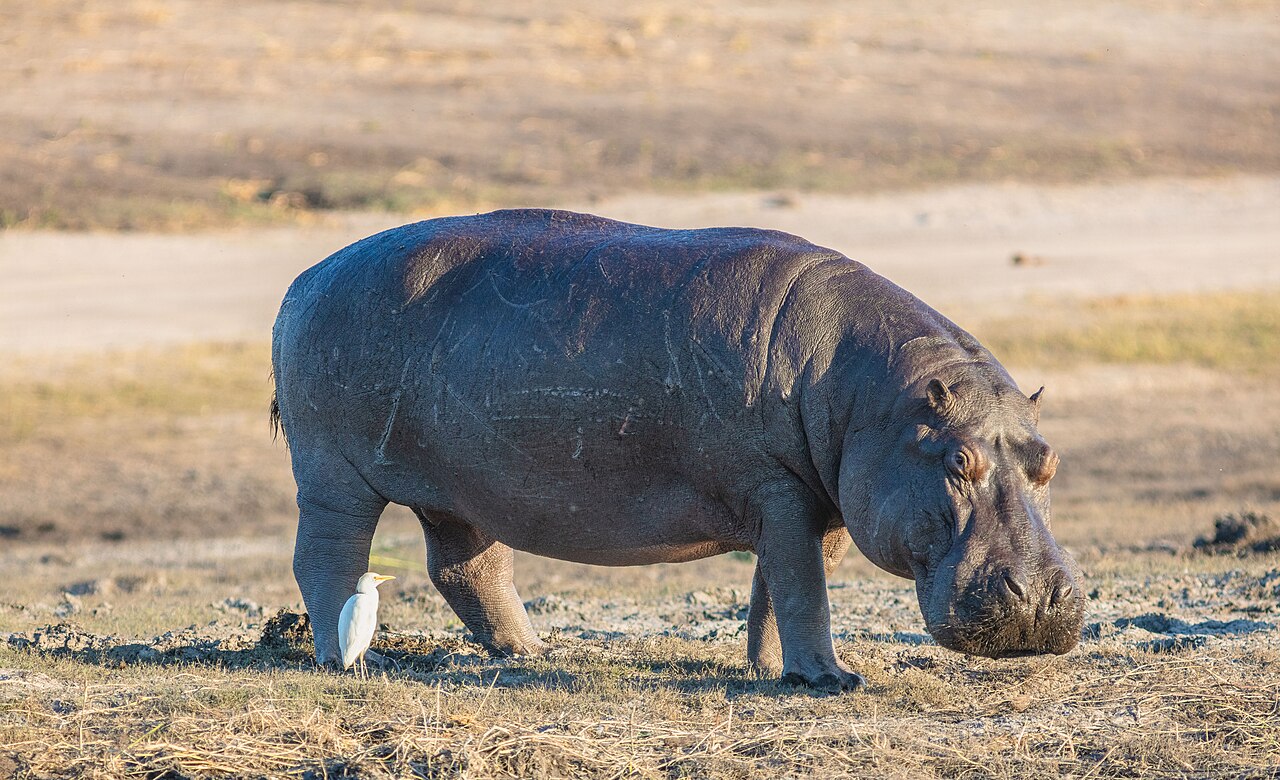
Common hippo in Chobe National Park, Botswana, 28 July 2018. Species photograph; not shown to the same scale as the rhino.
Photo: Diego Delso, delso.photo / Wikimedia Commons (CC BY-SA 4.0). Resized by Wikimedia.
,_parque_nacional_de_Chobe,_Botsuana,_2018-07-28,_DD_82.jpg)
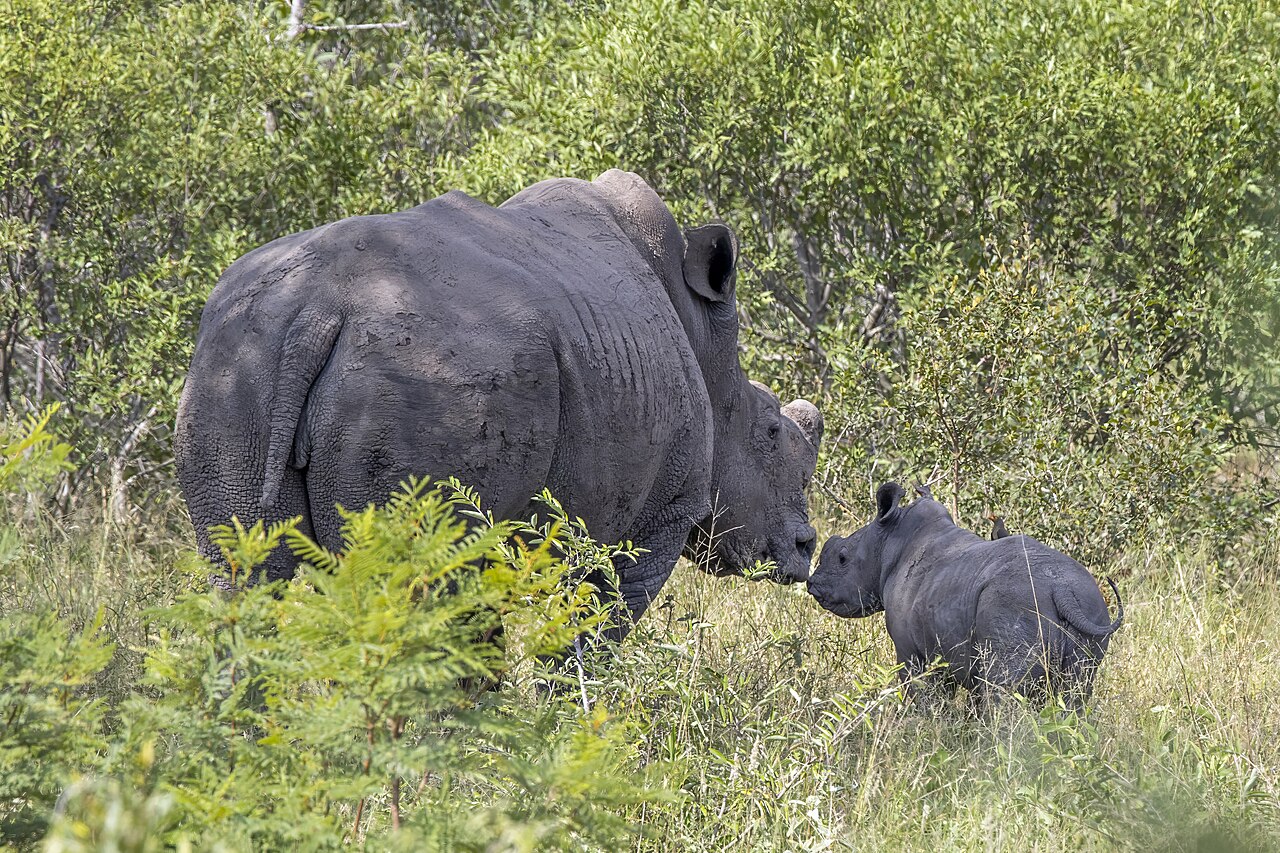
White rhino and calf in Kruger National Park, South Africa, 26 April 2024. One of five rhino species; not a WARN-funded project.
Photo: Charles J. Sharp / Wikimedia Commons (CC BY-SA 4.0). Resized by Wikimedia.
_with_calf_Kruger.jpg)
Hippopotamus vs Rhinoceros: At a Glance
| Feature | Common hippopotamus | Rhinoceroses: five living species |
|---|---|---|
| Species covered | Common hippopotamus: Hippopotamus amphibius | White, black, greater one-horned, Javan and Sumatran rhinos |
| Head and mouth | Broad muzzle; eyes, ears and nostrils high on the head | More elongated face; lip shape varies with feeding strategy |
| Horns and teeth | No horn; enlarged canine and incisor teeth | Usually one or two keratin horns; some Asian rhinos also have enlarged incisors |
| Toes on each foot | Four | Three |
| Adult weight examples | Average about 1,550 kg male and 1,385 kg female in the Hippo Specialist Group account | 600–950 kg Sumatran; 1,800–2,700 kg white or greater one-horned (IRF) |
| Native range | Suitable rivers, lakes and wetlands across sub-Saharan Africa | White and black: Africa; the other three species: Asia |
| Water use | Daytime resting habitat; usually leaves water to feed | Drinking and wallowing; greater one-horned rhinos also use wetlands extensively |
| Food | Mainly grass, with other foods sometimes eaten | White: mainly grass; black, Javan and Sumatran: browse; greater one-horned: mainly grass and aquatic plants |
| Social life | Groups in water; mothers and calves have close bonds | Varies by species, sex and age; not all rhinos are solitary |
| Global conservation category | Vulnerable | White: Near Threatened; greater one-horned: Vulnerable; black, Javan and Sumatran: Critically Endangered |
Size and physical differences
There is no single rhino weight. International Rhino Foundation examples range from 600–950 kg for Sumatran rhinos to 1,800–2,700 kg for white and greater one-horned rhinos. The Hippo Specialist Group reports common-hippo adult averages of about 1,550 kg for males and 1,385 kg for females. These are reference figures, not limits for every animal.
A hippo and a rhino can both look like a large grey animal with a heavy body and short legs. Look more closely at the head, feet and feeding behaviour, and the differences become clearer. The photographs show a common hippo in Botswana and a white rhino with its calf in South Africa. They are species photographs, not animals shown at the same scale or records of WARN-funded work.
This comparison explains identification first, then size, habitat, diet, social life and conservation. “Hippo” here means the common hippopotamus, Hippopotamus amphibius. The smaller, forest-dwelling pygmy hippo, Choeropsis liberiensis, is a separate species and should not be included in the same weight range.
How to tell a hippo from a rhino
Start with the head rather than colour. A common hippo has a wide muzzle and eyes, nostrils and ears positioned high enough to remain exposed when the body is submerged. A rhino has a longer face; a side view can also reveal the shape of the upper lip. White rhinos have a broad mouth adapted to grazing, while black rhinos have a pointed, grasping upper lip.
Feet provide another clue: four toes on a hippo, three on a rhino. In a distant photograph, mud or vegetation can hide these details. Use several visible features together. Water alone is not an identification test, because both animals use it.
Horns, tusks and teeth: a useful distinction
Rhino horns are made of keratin, the protein found in hair and nails. They are different from the enlarged teeth commonly called a hippo’s tusks. White, black and Sumatran rhinos have two horns; greater one-horned rhinos have one. Male Javan rhinos have a single small horn, but females may have only a small horn or none. A missing visible horn therefore does not, by itself, identify a hippo.
It is also inaccurate to say rhinos never have tusk-like teeth. San Diego Zoo describes enlarged incisors in Asian rhinos. The clearest contrast is a horn growing on the snout versus a tooth growing from the jaw. Hippos use their prominent front teeth chiefly in defence and interactions with other hippos, rather than to clip grass.
Hippo vs rhino size: which species is bigger?
White rhinos overlap in mass with common hippos and are heavier on average, according to South African National Parks. International Rhino Foundation gives white and greater one-horned rhinos a reference weight range of 1,800–2,700 kg. The greater one-horned rhino is Asian, so “African rhinos are larger than Asian rhinos” is not a reliable rule.
The same Foundation gives black rhinos at 800–1,350 kg, Javan rhinos at 900–2,300 kg and Sumatran rhinos at 600–950 kg. These ranges describe very different animals. For common hippos, the Hippo Specialist Group gives adult averages of approximately 1,550 kg for males and 1,385 kg for females, drawing on published species accounts.
These sources do not measure every species in one controlled study. Sex, age, condition and the population sampled matter. A maximum reported for one animal cannot fairly be compared with the average for another. The photographs above are for identification and should not be used as a size chart.
Water, mud and the difference between resting and feeding habitat
Common hippos typically spend daylight hours in water and leave after sunset to graze. Their skin needs protection from prolonged drying. San Diego Zoo explains that underwater movement includes walking along the bottom and pushing off from it; it is different from the paddling stroke people often imagine when they say a hippo is swimming.
Rhinos use mud and water too. Wallowing helps them cool down and care for their skin. Greater one-horned rhinos live in riverine grasslands and adjoining woodland in India and Nepal, and feed on aquatic vegetation as well as on land. Asian rhinos can swim. A picture of an animal standing in water therefore tells you about its activity at that moment, not its identity.
What do hippos and rhinos eat?
Common hippos feed mainly on grass. Their lips gather vegetation and the back teeth grind it; their large front teeth are not grass-cutting tools. The Hippo Specialist Group also records browsing and occasional consumption of animal remains. “Mainly a grazer” describes the usual diet more accurately than claiming that a hippo never eats anything else.
Rhino diets divide along species lines. White rhinos graze with broad lips close to the ground. Black rhinos grasp leaves and shoots with a flexible upper lip. Javan and Sumatran rhinos browse forest vegetation. Greater one-horned rhinos feed predominantly on grasses, including aquatic plants. This is why conserving “rhino habitat” can mean maintaining open grasslands in one place and protecting tropical forest in another.
Where do hippos and the five rhino species live?
Common hippos are native to sub-Saharan Africa, where suitable water and nearby feeding areas occur. The pygmy hippo has a much more restricted West African forest distribution. The two African rhinos, white and black, occupy different combinations of grassland, savanna and bush habitat.
The greater one-horned rhino survives in India and Nepal. Javan rhinos are confined to Ujung Kulon National Park in Indonesia. Sumatran rhinos persist in fragmented Indonesian forest populations. These are current species ranges, not a suggestion that every country within a broad region has rhinos. Range maps and captions should distinguish a wild population from an animal in a zoo or a historical distribution.
Groups, territories and mothers with calves
Common hippos often rest together in water, but a gathering is not a reason to assume the animals are relaxed around people. Social conditions change when water is scarce and animals concentrate in the same pools. Mothers maintain close contact with their calves.
Rhino social behaviour also needs a species-specific explanation. White-rhino females and younger animals may associate, while adult males are often solitary. International Rhino Foundation notes that female black rhinos have overlapping ranges and are less solitary than popular descriptions suggest. Greater one-horned, Javan and Sumatran rhinos are generally solitary, with mothers and dependent young an important exception. “Hippos are social and rhinos always live alone” misses these differences.
Are hippos and rhinos related?
They are both mammals, but their similar bulk does not make them close relatives. Rhinos belong to the odd-toed ungulates, along with horses and tapirs. The American Museum of Natural History explains that rhinos and tapirs are more closely related to one another than either is to horses.
Hippos belong to a different branch. Genetic research, including the 1999 PNAS study linked below, places hippos with cetaceans: whales and dolphins. This describes shared ancestry, not a claim that a modern whale descended from a modern hippo. Body outline is a useful starting point for recognition, but not a dependable guide to an animal’s family tree.
Conservation status: which animals are threatened?
Conservation categories were checked on 8 September 2026. The IUCN SSC Hippo Specialist Group lists the common hippo as Vulnerable. International Rhino Foundation lists white rhinos as Near Threatened, greater one-horned rhinos as Vulnerable, and black, Javan and Sumatran rhinos as Critically Endangered. These are global species categories, not interchangeable labels for every local population or subspecies.
The Foundation’s annual report available at this review is the 2025 State of the Rhino. It describes poaching losses for Javan and white rhinos alongside improvements for black and greater one-horned rhinos. Calling every rhino population either “recovering” or “declining” would conceal those differences. Report dates also matter: an estimate cited in a 2025 report is not a live count for today.
What protection do hippos and rhinos need?
For hippos, protecting water and neighbouring feeding areas also means working with people whose farms and livelihoods share that landscape. African Wildlife Foundation describes supporting protected habitats and helping communities reduce crop conflict. Hunting for meat and teeth is another pressure. For rhinos, the appropriate response depends on the species and place: protection from poaching, connected habitat, population management and qualified conservation care can all matter.
You can read WARN’s rhino appeal to understand its proposed funding approach and how awards would be reviewed. The organisations cited as educational sources here are not thereby confirmed WARN grant recipients. If you cannot donate, sharing a sourced guide or appeal with its date and funding context can still help people understand the issue. Keep location details for vulnerable animals to information already published responsibly by conservation authorities.
Hippo vs rhino fights: what can actually be concluded?
A species comparison cannot establish a universal fight winner. Outcome claims usually ignore the species of rhino, the individual animals, their condition and the setting. Horn size or body weight alone does not supply that missing evidence. An isolated encounter video is not a controlled comparison.
Both animals require distance and appropriate observation rules. Do not approach for a photograph, obstruct their movement or try to provoke a reaction. Follow the guidance of the park or trained guide responsible for the visit. The practical lesson from their anatomy and behaviour is how to recognise and respect them, rather than treating either animal as a competitor in a staged contest.
Hippopotamus vs Rhinoceros: FAQs
What is the main difference between a hippo and a rhino?
Is a hippo bigger than a rhino?
Do all rhinos have horns?
Can rhinos go in water?
Are hippos and rhinos herbivores?
Are all rhinos Critically Endangered?
Would a hippo or rhino win a fight?
Help protect animals
WARN’s rhino appeal seeks contributions towards assessed welfare and conservation needs. The responsible organisation, permissions, activity and costs are reviewed before an award. Read the appeal and funding records before giving; this comparison does not establish a dedicated hippo project or a grant to any cited organisation.
Sources
- IUCN SSC Hippo Specialist Group — common hippo measurements, feeding and status; checked 8 September 2026
- San Diego Zoo — hippo water movement, skin and behaviour
- African Wildlife Foundation — hippo species, habitats and community conservation
- International Rhino Foundation — white rhino size, diet and social behaviour
- International Rhino Foundation — black rhino size, browsing and behaviour
- International Rhino Foundation — greater one-horned rhino size and wetland habitat
- International Rhino Foundation — Javan rhino size, horns and range
- International Rhino Foundation — Sumatran rhino size, forest habitat and diet
- International Rhino Foundation — three toes and other rhino anatomy
- San Diego Zoo — rhino horns, Asian-rhino incisors and swimming
- South African National Parks — white rhino and hippo mass overlap
- International Rhino Foundation — 2025 State of the Rhino report; checked 8 September 2026
- American Museum of Natural History — rhino and tapir relationships
- Nikaido, Rooney and Okada (1999), PNAS — genetic evidence for the hippo–cetacean relationship