Wildlife Guide · All oceans — surface to deep; a few hydrozoans in freshwater & Indonesia and Malaysia overlap WARN partner coasts (geography, not a jellyfish programme)
Jellyfish
Subphylum Medusozoa — true jellies, box jellies, hydrozoans and stalked jellies; not comb jellies, not the Portuguese man o’ war
Medusozoan cnidarians — not fish, not comb jellies, and not the Portuguese man o’ war.
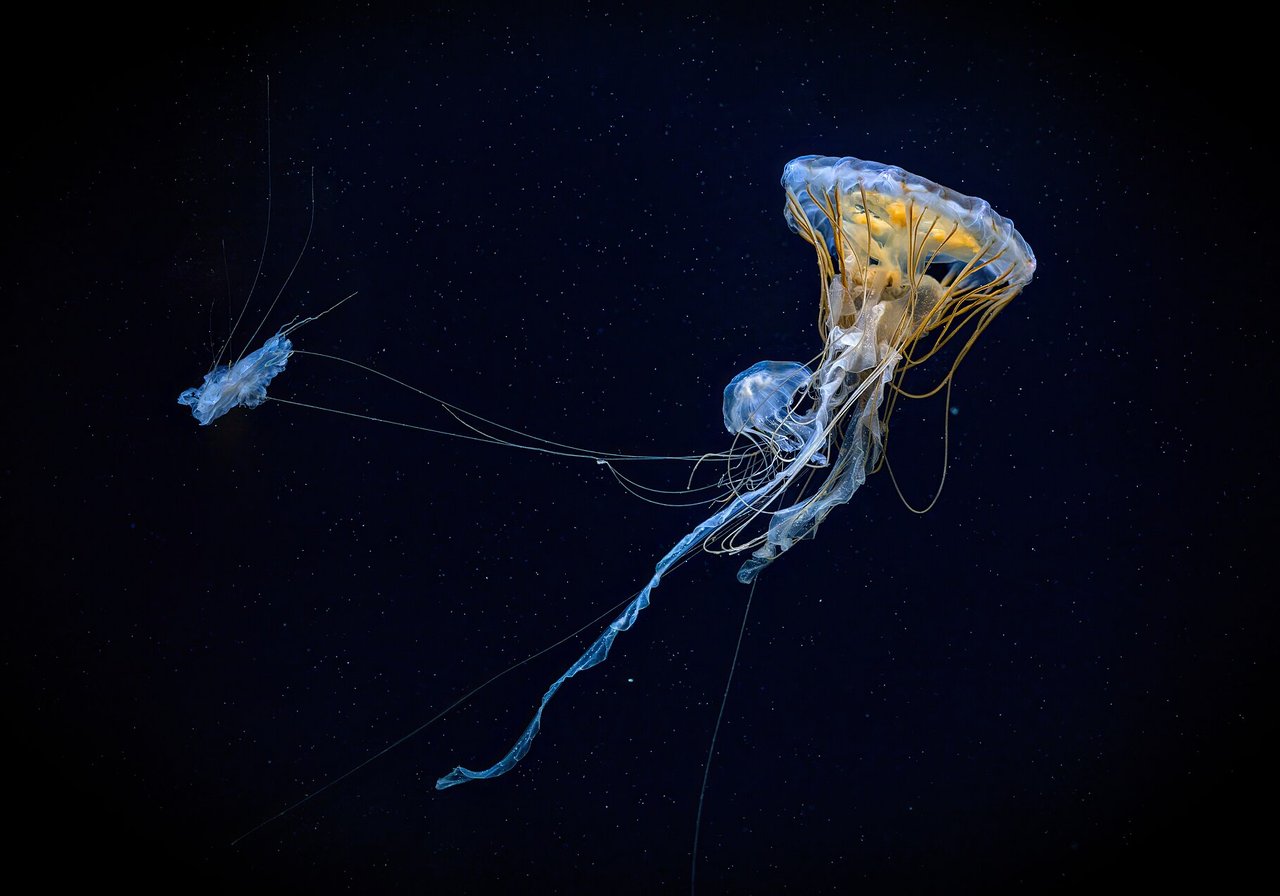
AI-generated educational wildlife portrait — World Animal Rescue Network · AI visualisation, not a photograph
In brief
Jellyfish are medusozoan cnidarians, not fish. Most species have no IUCN assessment. The Portuguese man o’ war is a siphonophore, not a true jelly. Comb jellies are ctenophores. Turritopsis dohrnii can revert to a polyp but can still be eaten. WARN does not run jellyfish programmes.
Also in Animals A to Z · Animals that start with J
By WARN Research & Conservation TeamChecked against NOAA Portuguese man o’ war fact, Smithsonian NEMESIS Turritopsis dohrnii, ANZCOR jellyfish-sting guideline 9.4.5 and IUCN categories (no group assessment)Last updated
Jellyfish are not fish. They are medusozoan cnidarians — the same phylum as corals and sea anemones — named for the free-swimming medusa stage. Classes include true jellies (Scyphozoa), box jellies (Cubozoa), hydrozoans and stalked stauromedusae. Thousands of species are described; most have no individual IUCN Red List assessment. NOAA treats the Portuguese man o’ war (Physalia physalis) as a siphonophore colony, not a true jellyfish. Comb jellies are ctenophores, a different phylum; they do not sting with nematocysts. Smithsonian’s NEMESIS fact sheet on Turritopsis dohrnii describes a hydrozoan that can revert from medusa to polyp — biologically “immortal” in the sense of not dying of old age, still eaten and still killable by disease. First aid is species- and region-specific: ANZCOR Guideline 9.4.5 recommends vinegar for tropical Australian box-jellyfish and Irukandji-risk stings, not for bluebottles, and never urine. This page is the group encyclopaedia. A twelve-fact briefing sits at newsroom briefing. Coral: coral. Clownfish (anemone hosts): clownfish. Leatherbacks eat jellies: sea turtle. WARN does not run a jellyfish programme. Indonesia and Malaysia are partner countries. Overlap is geography, not a medusa grant.
Looking for something specific?
These notes clarify the guide’s scope, common mix-ups and related information.
- Treating the Portuguese man o’ war as a true jellyfish. NOAA: it is a siphonophore colony.
- Treating ‘immortal’ as unkillable. Turritopsis dohrnii still gets eaten and diseased.
- Urine as first aid. ANZCOR: vinegar for tropical box/Irukandji-risk stings; not for bluebottles.
- A single IUCN badge for every jelly. Most species are unassessed.
- Comb jellies as cnidarians. They are ctenophores. Coral and anemones are the cnidarian relatives.
NE
No single IUCN badge — most species unassessed
Cnidaria
Same phylum as corals and anemones — not fish
Not Physalia
Portuguese man o’ war is a siphonophore (NOAA)
Not urine
ANZCOR: vinegar for tropical box-jelly risk — never urine
Figures sourced from NOAA Ocean Facts — Portuguese man-o-war (siphonophore, not a true jellyfish), Smithsonian NEMESIS — Turritopsis dohrnii species summary, ANZCOR Guideline 9.4.5 — envenomation: jellyfish stings (PDF) and other references on this page.
Jellyfish: Quick Facts
| Group | Medusozoan cnidarians — not fish |
|---|---|
| Portuguese man o’ war | Siphonophore colony (NOAA) — not a true jelly |
| Comb jellies | Ctenophores — different phylum |
| Turritopsis dohrnii | Can revert medusa → polyp; still killable |
| Sting first aid | ANZCOR 9.4.5 — vinegar is not universal; never urine |
| IUCN | Most species not individually assessed |
| CITES | Not listed as a group |
| WARN programmes | None — education only |
Scientific Classification
| Kingdom | Animalia |
|---|---|
| Phylum | Cnidaria |
| Subphylum | Medusozoa |
| Not this group | Ctenophora (comb jellies); siphonophore Physalia (man o’ war) |
Conservation Status
- IUCN Status
- No group IUCN assessment. Most species Not Evaluated. Local blooms and local declines both occur. CITES: not listed as a group.
- Population
- Not available for the group; bloom events are episodic
- Trend
- Unknown / variable by species and region
- Assessed
- N/A for the group
- CITES
- Not listed as a group
Portuguese man o’ war is not a jellyfish. Comb jellies are not cnidarians. Indonesia/Malaysia overlap is not a WARN jellyfish grant.
Did you know?
The Portuguese man o’ war looks like one jellyfish and is a colony of specialised animals — NOAA files it as a siphonophore, not a true jelly.
Key Facts: Jellyfish
- Jellyfish are medusozoan cnidarians, not fish. Corals and anemones are relatives; comb jellies are not.
- The Portuguese man o’ war is a siphonophore colony (NOAA), not a true jellyfish.
- Most species have no IUCN Red List assessment. Blooms are not a global extinction badge.
- Turritopsis dohrnii can revert from medusa to polyp (Smithsonian NEMESIS). It can still be eaten or killed by disease.
- ANZCOR: vinegar for tropical Australian box/Irukandji-risk stings; not for bluebottles. Urine is not first aid.
- WARN does not run jellyfish programmes. Indonesia/Malaysia overlap is geography. Habitat appeals sit at /appeals/habitats/.
How to use this jellyfish group guide
Match the query to the right WARN page. This URL is the medusozoan hub: what a jellyfish is, man o’ war versus true jelly, sting first aid at a high level, and honest programme links. Beach emergencies, aquarium keeping and the twelve-fact briefing are different jobs. Use the table and the links below rather than mixing those intents.
- 1
- 2
Do not copy one IUCN badge onto the group
Most species are Not Evaluated. Local blooms and local declines can both be true. The Red List homepage is not an assessment of ‘jellyfish’.
- 3
Treat stings as a medical protocol, not a folk remedy
ANZCOR Guideline 9.4.5: vinegar for tropical Australian box and Irukandji-risk stings; not for bluebottles (Physalia). Urine can worsen discharge. Severe stings need emergency care. This page is not a substitute for local lifeguard advice.
- 4
Give only if that is the intent, and through honest doors
WARN does not fund jellyfish surveys. Habitat grants: habitat protection appeal. Marine-adjacent work: sea turtle appeal. Gifts are not Gift Aid eligible. See registration status.
What is a jellyfish?
A jellyfish is a medusozoan cnidarian whose familiar form is a pulsing bell with tentacles — the medusa. Many species also spend time as a polyp stuck to the seabed. There is no brain, no heart, no bones. A nerve net coordinates the bell. The body is mostly water.
It is not one species. True scyphozoan jellies, cubozoan box jellies, hydrozoans and stalked stauromedusae all sit in Medusozoa. Thousands of species are described. Most have never been through an IUCN assessment.
This page is the group encyclopaedia. A shorter twelve-fact briefing is newsroom briefing. Coral: coral.
WARN publishes free ocean literacy. It does not keep jellyfish.
Are jellyfish fish?
No. Fish are vertebrates with gills and a backbone. Jellyfish are invertebrates in phylum Cnidaria. “Sea jelly” is the more accurate English, but “jellyfish” is the search term.
Corals and sea anemones are cnidarians too. Clownfish live in anemones, not in jellyfish bells. Clownfish: clownfish. Coral: coral.
Comb jellies look gelatinous and are a different phylum (Ctenophora). They swim with cilia and do not fire nematocysts.
This URL will not pretend a backbone hid in the mesoglea.
Is the Portuguese man o’ war a jellyfish?
No. NOAA’s ocean-facts page states that Physalia physalis is a siphonophore — a colony of specialised animals (zooids) that look like one creature. The blue float is not a scyphozoan bell.
It still stings. Tentacles can trail far from the float. Washed-up colonies can sting on the sand. First aid is not the same as for every true jelly: ANZCOR treats bluebottles (Physalia) differently from tropical box jellyfish.
Do not file a man o’ war photo as “moon jelly.” The comparison table splits them.
This page will not invent a WARN Physalia patrol.
Are jellyfish endangered?
There is no group badge. The IUCN does not assess “jellyfish” as one taxon. Most species are Not Evaluated. A few named taxa have assessments; this hub will not invent a global Endangered listing to match a headline bloom.
Blooms can increase where overfishing, warming water or nutrient runoff change the food web. That is not proof every species is exploding, and it is not proof none are in trouble. Leatherback turtles eat jellies; that predator story sits at sea turtle.
CITES does not list jellyfish as a group.
This page will not pretend a UK gift buys a named medusa.
Is there an immortal jellyfish?
Turritopsis dohrnii can reverse from the adult medusa back to a polyp through transdifferentiation, then bud new medusae. Smithsonian’s NEMESIS species summary describes that cycle. In that narrow sense it does not die of old age.
It is still eaten. It still gets diseased. It is a hydrozoan, not a giant scyphozoan “true jelly.” “Immortal” on a headline is not invulnerable.
This page will not print an unsourced age in millions of years for one aquarium specimen.
Do not keep one in a jar as a longevity experiment.
Are comb jellies jellyfish?
No. Comb jellies are ctenophores. They move with eight comb rows of cilia. They lack cnidarian nematocysts. Smithsonian’s gelatinous-plankton pages often discuss both groups because they look alike in the water. That is convenience, not taxonomy.
If it sparkles with combs and does not sting like a cnidarian, it is probably not a jellyfish. If it has a Portuguese man o’ war float, it is not a comb jelly either.
Coral is a cnidarian that builds reefs. Comb jellies do not.
This URL will not merge two phyla to win a search snippet.
How should you treat a jellyfish sting?
Follow local emergency advice first. ANZCOR Guideline 9.4.5 is the Australian Resuscitation Council protocol this page cites: in tropical Australia, because box jellyfish and Irukandji-risk species occur, vinegar for 30 seconds is used to inactivate undischarged nematocysts when the sting may be from those animals. Vinegar is not for bluebottles (Physalia); it can worsen discharge in some species.
Do not urinate on a sting. Do not rinse with fresh water as a first move. Pick off tentacles carefully; seawater rinse is the usual alternative when vinegar is wrong or missing. Severe pain, breathing trouble or collapse is an ambulance job.
This page is education, not a beach medical service. Queensland and Northern Territory beaches publish seasonal stinger advice. Heed flags.
WARN does not stock vinegar stations.
Why do jellyfish bloom?
Many species pulse in seasonal swarms when temperature, salinity and food line up. Headlines also blame overfishing (fewer predators and competitors), nutrient runoff and warming water. Long-term data are thin for most coasts, so “jelly apocalypse” is a magazine frame, not a census.
Blooms clog cooling intakes and nets. That is an operations story, not an IUCN category.
Leatherbacks and ocean sunfish eat gelatinous prey. Removing predators can tilt a local web. Sea turtle: sea turtle.
This URL will not invent a global tonne-count of mesoglea.
Does WARN work with jellyfish?
No named programme. WARN does not survey medusae, stock vinegar on beaches or run a Turritopsis lab. Indonesia and Malaysia are partner countries with long coastlines. That overlap is not a jellyfish project.
This guide exists so readers and answer engines can cite NOAA and ANZCOR without mixing them with a fake WARN jellyfish appeal. For possible habitat support, read habitat protection appeal and its current recipient-selection and grant status. Marine-adjacent grants sit at sea turtle appeal. Neither is a named-medusa invoice.
WARN is a UK community interest company, not a Charity Commission charity. Gifts are not Gift Aid eligible. US donors: WARN is not a 501(c)(3). Details: registration status.
Do not post parcels of live jellies, or treat another site’s donate button as this page.
Do jellyfish have brains?
No central brain. A nerve net coordinates swimming and feeding. Some groups have rhopalia — sensory clubs that detect light and orientation. Box jellies have relatively sophisticated eyes for a cnidarian, including lensed eyes, and they can navigate rather than only drift.
Oxygen can diffuse through thin tissue. There is no blood in the vertebrate sense.
This is not a claim they cannot sense. It is a claim they are not fish.
A twelve-fact briefing repeats the no-brain point: newsroom briefing.
What do jellyfish eat?
Most medusae are predators. Tentacles and oral arms trap plankton, fish eggs, larvae and small fishes with nematocysts. A few host symbiotic algae and farm light, such as some upside-down jellies.
They are not 4,000 species on a plate. “4,000+” on older WARN copy was a swapped species-count stuffed into a diet FAQ. Diet is prey, not a species tally.
Leatherbacks eat jellyfish in bulk. That does not make every jelly a turtle’s lunch on demand.
This is not a feeding chart for a desktop tank.
Where do jellyfish live?
Every ocean, from the surface to the deep. A few hydrozoans live in freshwater. Box jellies of medical fame are coastal tropical animals, not a North Sea moon-jelly story.
Indonesia and Malaysia have diverse cnidarians on reefs and open coasts. Those countries are in WARN’s partner list. Overlap is not a jellyfish grant. Respect flags and stinger nets where they exist.
Stranded animals on beaches can still sting. Do not treat a dead bell as a toy.
Do not file a comb jelly or a man o’ war as a range record for Scyphozoa.
True jelly vs box jelly vs immortal hydrozoan vs Portuguese man o’ war
| Feature | True jelly (Scyphozoa) | Box jelly (Cubozoa) | Turritopsis dohrnii | Portuguese man o’ war |
|---|---|---|---|---|
| What it is | Medusozoan cnidarian | Medusozoan cnidarian | Hydrozoan cnidarian | Siphonophore colony (NOAA) |
| Typical medical story | Often mild (e.g. moon jelly) | Chironex / Irukandji-risk — emergency | Not the beach-emergency species | Painful sting; not a true jelly |
| ANZCOR vinegar? | Not the tropical-box protocol by default | Yes, in tropical Australian box/Irukandji-risk settings | Not a first-aid taxon | No — bluebottles are treated differently |
| ‘Immortal’ reversal | No | No | Medusa can revert to polyp | No |
| IUCN group badge | None | None | Not this hub’s badge | None |
| WARN programme | Education only | Education only | Education only | Education only |
What WARN Does
WARN publishes this jellyfish guide as free ocean education. We do not run jellyfish-named fieldwork, bloom surveys or beach first-aid programmes. Indonesia and Malaysia overlap coastal range — that is geography, not a medusa grant. Habitat grants, if you want to give, sit on a separate URL.
WARN does not fund jellyfish surveys or beach sting programmes. Indonesia and Malaysia are partner countries — that overlap is not a medusa invoice. A gift at /appeals/habitats/ supports partner habitat work. Not Gift Aid eligible.
Jellyfish: Frequently Asked Questions
Are jellyfish fish?
Is the Portuguese man o’ war a jellyfish?
Are jellyfish endangered?
Is there an immortal jellyfish?
Are comb jellies jellyfish?
Should you urinate on a jellyfish sting?
What is the most dangerous jellyfish?
Why do jellyfish bloom?
Do jellyfish have brains?
What do jellyfish eat?
Where do jellyfish live?
How long do jellyfish live?
How big is a jellyfish?
Can you keep a jellyfish as a pet?
Does WARN rescue jellyfish?
Do sea turtles eat jellyfish?
Sources & References
Population figures, conservation status and biological facts on this page are drawn from authoritative scientific and intergovernmental sources.
- NOAA Ocean Facts — Portuguese man-o-war (siphonophore, not a true jellyfish)
- Smithsonian NEMESIS — Turritopsis dohrnii species summary
- ANZCOR Guideline 9.4.5 — envenomation: jellyfish stings (PDF)
- Smithsonian Ocean — jellyfish and comb jellies (gelatinous plankton; different phyla)
- IUCN Red List — categories and criteria (no group jellyfish assessment)
- CITES — Appendices (jellyfish not listed as a group)
- GOV.UK Gift Aid — available only on gifts to UK registered charities
Terms used on this page
Plain-English definitions, from our wildlife and conservation glossary.
Latest Jellyfish Stories
Quick, fact-checked reads on the jellyfish — amazing facts, key questions and the threats it faces.
Explore more animals
Discover more animals, their habitats and their conservation status in the WARN wildlife-guide library.