Wildlife Guide · High Arctic — Canada, Greenland, Svalbard; Russian Arctic poorly surveyed
Narwhal
Monodon monoceros (Linnaeus, 1758)
An Arctic toothed whale whose tusk is a tooth — Least Concern on paper, still tied to sea ice.
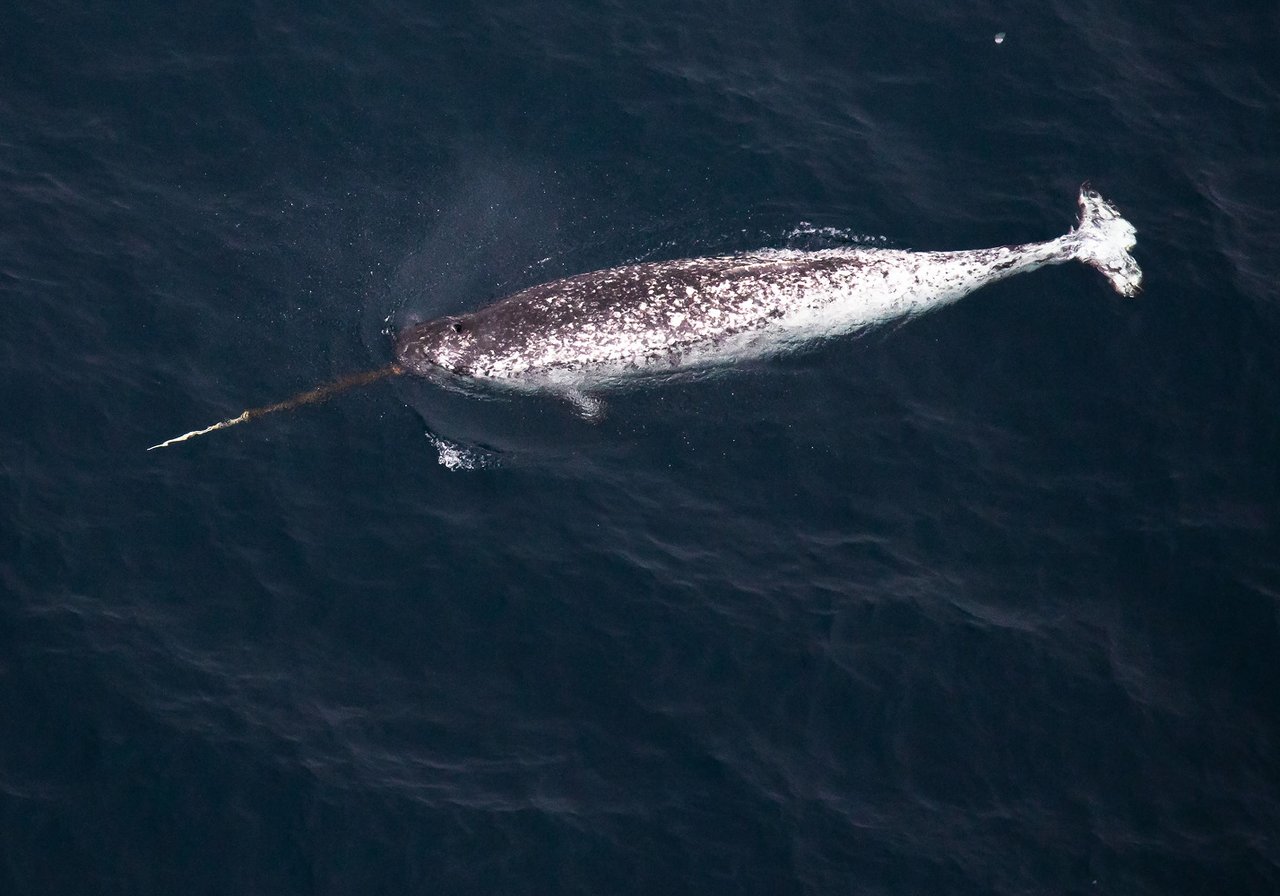
AI-generated educational wildlife portrait — World Animal Rescue Network · AI visualisation, not a photograph
In brief
A narwhal (Monodon monoceros) is an Arctic toothed whale. The tusk is a left canine tooth, not a horn. IUCN listed it Least Concern in 2017. CITES Appendix II. NOAA cites dives deeper than 1,800 metres. Least Concern is not a collecting permit for ivory. WARN does not run narwhal programmes.
Also in Animals A to Z · Animals that start with N
By WARN Research & Conservation TeamChecked against IUCN 2017 Monodon monoceros assessment, NOAA Ocean Exploration, COSEWIC 2024 and CITES Appendix IILast updated
The narwhal (Monodon monoceros) is a medium-sized toothed whale of the high Arctic. The name is often traced to an Old Norse 'corpse whale', from mottled skin. The scientific name means 'one tooth, one horn'. The 'horn' is not a horn. In most males the left canine grows through the upper lip as a counterclockwise spiral tusk two to three metres long (NOAA Ocean Exploration). Females almost never grow one. Narwhals share family Monodontidae with belugas. IUCN listed the species Least Concern in 2017 (Lowry, Laidre and Reeves): more than 170,000 animals in surveyed stocks, about 123,000 of them mature, across 12 subpopulations. That replaced Near Threatened. CITES Appendix II regulates international trade in tusks and parts. Canada's COSEWIC redesignated the species Not at Risk in May 2024. Least Concern is not a claim that ice, shipping noise or every Greenland stock is fine. This page is the species encyclopaedia. Whale hub: whale. Orca: orca. Sperm whale: sperm whale. WARN does not run Arctic cetacean programmes.
Looking for something specific?
These notes clarify the guide’s scope, common mix-ups and related information.
- A named zoo narwhal with photo updates. WARN does not offer that.
- Treating Least Concern as if every stock were safe. IUCN 2017 said some subpopulations warrant their own assessment. East Greenland stocks have been a separate controversy.
- A unicorn, a horn, or a walrus tusk. The narwhal tusk is a tooth. Walrus: a different Arctic mammal.
- WARN ice-edge tagging, quota setting or Nunavut fieldwork. We do not run those programmes.
- A beluga, orca or sperm-whale page. Whale hub: whale. Orca: orca. Sperm whale: sperm whale.
LC
IUCN global status (2017) — Least Concern, not a tusk free-for-all
CITES II
International trade in tusks and parts is regulated
2–3 m
Typical male tusk length (NOAA Ocean Exploration)
>1,800 m
Dive depth cited by NOAA Ocean Exploration
Figures sourced from IUCN Red List — Monodon monoceros (Lowry, Laidre & Reeves, 2017, Least Concern), IUCN Red List — categories and criteria, NOAA Ocean Exploration — What is a narwhal? and other references on this page.
Narwhal: Quick Facts
| Also called | Narwhal — name often linked to Old Norse 'corpse whale' |
|---|---|
| Tusk | Left canine, 2–3 m in most males (NOAA); not a horn |
| Dive depth | Deeper than 1,800 m (NOAA Ocean Exploration) |
| IUCN | Least Concern (2017) |
| Canada (COSEWIC) | Not at Risk (May 2024) |
| CITES | Appendix II |
| Closest living relative on this site | Beluga (same family; no dedicated guide yet) — whale hub |
| WARN programmes | None — education only |
Scientific Classification
| Kingdom | Animalia |
|---|---|
| Phylum | Chordata |
| Class | Mammalia |
| Order | Artiodactyla |
| Infraorder | Cetacea |
| Family | Monodontidae |
| Genus | Monodon |
| Species | Monodon monoceros |
Conservation Status
- IUCN Status
- Least Concern globally (IUCN 2017). COSEWIC Not at Risk in Canada (2024). CITES Appendix II.
- Population
- IUCN 2017: more than 170,000 in surveyed stocks, about 123,000 mature; Russian Arctic and some Greenland waters not in that sum
- Trend
- Mixed by stock; IUCN 2017: one increasing, five stable, five unknown
- Assessed
- 2017 (IUCN); COSEWIC May 2024
- CITES
- Appendix II
Least Concern replaced Near Threatened. Some subpopulations still warrant separate assessment. Harvest in Canada is Inuit-only and co-managed. Ice loss, shipping and noise are rising pressures, not a second IUCN badge.
Did you know?
The tusk is the structural inverse of a human tooth in one useful sense: rigid in the centre, porous outside, so ocean water can reach living pulp. That is dentistry, not a unicorn.
Key Facts: Narwhal
- Monodon monoceros is an Arctic toothed whale in family Monodontidae with the beluga. The tusk is a tooth, not a horn.
- IUCN listed it Least Concern in 2017: more than 170,000 animals in surveyed stocks, about 123,000 mature. That replaced Near Threatened.
- COSEWIC redesignated Canadian narwhal Not at Risk in May 2024. Hunting in Canada is Inuit-only and co-managed.
- NOAA cites dives deeper than 1,800 metres and winter feeding on Greenland halibut, polar and Arctic cod, shrimp and Gonatus squid.
- The tusk can sense salinity (Nweeia and colleagues, 2014) and is also used in male social behaviour. Those functions are not rivals.
- WARN does not run narwhal programmes. This guide is education. Habitat appeals sit at /appeals/habitats/.
How to use this narwhal species guide
Match the query to the right WARN page. This URL is species facts: what a narwhal is, tusk versus horn, Least Concern versus CITES II, dive depth, ice and the beluga comparison. Ivory shops, Arctic tourism and whale-watching bookings are different jobs. Use the table and the links below rather than mixing those intents.
- 1
Confirm it is a toothed whale, not a unicorn
Stay here for Monodon monoceros. The tusk is a canine tooth. Other whales: whale. Orca: orca. Sperm whale: sperm whale.
- 2
Read Least Concern together with ice and trade rules
IUCN 2017 is Least Concern because surveyed abundance is large. CITES Appendix II still requires non-detriment findings for international trade. COSEWIC 2024 is Not at Risk in Canada. Those facts sit together. They do not cancel shipping noise or climate risk.
- 3
Do not buy 'unicorn horn'
Historic European cabinets sold narwhal tusks as unicorn horn. Modern international trade is regulated, not a souvenir loophole. This page is not a permitting desk.
- 4
Give only if that is the intent, and through honest doors
WARN does not fund Arctic cetacean fieldwork or Inuit co-management. Habitat grants: habitat protection appeal. Closest marine appeal: sea turtle appeal. Gifts are not Gift Aid eligible. See registration status.
What is a narwhal?
A narwhal is a toothed whale, Monodon monoceros, found only in Arctic waters. NOAA Ocean Exploration describes it as a medium-sized odontocete with no functional teeth in the mouth. The famous tusk is the exception: usually the left canine of a male, growing through the lip.
Skin starts dark in calves and becomes mottled; old males can look almost white on the belly. The common name is often linked to an Old Norse 'corpse whale'. They travel in groups and are hard to study: dark winters, ice cover, remote coasts.
This page is the species encyclopaedia. It is not a Pond Inlet booking. Whale hub: whale.
WARN publishes free cetacean education. It does not tag narwhals.
Is a narwhal tusk a horn?
No. It is a tooth — typically the left canine — that grows in a counterclockwise spiral two to three metres out of the upper jaw in most males (NOAA). A minority of males grow two. Females almost never grow an erupted tusk.
Martin Nweeia and colleagues (The Anatomical Record, 2014), working with Smithsonian and Fisheries and Oceans Canada collaborators, showed that ocean water can reach inner dentine through porous cementum, and that changing salinity at the tusk surface changes heart rate. That is sensory biology, not a unicorn.
NOAA also treats the tusk as a social tool among males. Rubbing tusks is real. Jousting-to-the-death is a cartoon. Do not pick one paper as the only function.
This URL will not sell a tusk as a horn.
Are narwhals endangered?
Not on the global IUCN badge. Lowry, Laidre and Reeves assessed Monodon monoceros as Least Concern on 3 July 2017, published 2017. They combined surveyed subpopulations to more than 170,000 whales and about 123,000 mature individuals, with 12 subpopulations. Northeast Greenland and the Russian Arctic lacked estimates. One subpopulation was thought to be increasing, five stable, five unknown. The species as a whole did not meet a threatened IUCN category.
That replaced Near Threatened. Least Concern is not 'no pressure'. The same assessment said some subpopulations warrant their own Red List work. Climate, ice, shipping, seismic noise and harvest all still appear in the literature.
Canada's COSEWIC redesignated the species Not at Risk in May 2024, after Special Concern in 2004. CITES Appendix II remains the trade rule.
This page will not pretend a UK gift buys a named Arctic whale.
How deep do narwhals dive?
Among the deepest of marine mammals. NOAA Ocean Exploration cites dives deeper than 1,800 metres and long periods below 800 metres. Older popular pages often print 1,500 metres. Use NOAA's figure, not a round magazine number.
They are built for pressure: flexible ribs, oxygen stored in muscle and blood. They breathe at ice cracks too narrow for boats — habitat other whales rarely use.
This is not a freediving contest. A tagged maximum is not a species mean.
WARN does not run a Baffin Bay dive programme.
Where do narwhals live?
High Arctic waters, especially around Canada and Greenland, with animals also off Svalbard. The Russian Arctic is part of the range on paper and poorly counted. They summer in coastal bays and fiords and winter in offshore pack ice over deep water.
IUCN 2017 did not include Northeast Greenland or the Russian Arctic in the global sum. COSEWIC 2024 treats Canadian animals — Northern Hudson Bay and Baffin Bay — as about 90% of the surveyed global total.
The related appeal explains potential support and the current funding status; this guide does not confirm a WARN grant. Habitat work this organisation funds is a different geography: habitat protection appeal.
This site will not identify a holiday snapshot from a floe edge.
What do narwhals eat?
NOAA lists Greenland halibut, polar and Arctic cod, shrimp and Gonatus squid as primary prey. Diet shifts with the season. Narwhals feed hard in winter under ice and eat little in the ice-free summer — the opposite of many sub-Arctic whales that feed in summer.
They suction-feed. There are no functional teeth in the mouth to chew with. The tusk is not a fishing spear in the cartoon sense.
This is not a feeding chart for a named aquarium animal. Captive narwhals are not a WARN husbandry topic.
If the query was orca diet, that is orca.
Do female narwhals have tusks?
Almost never, in NOAA's wording. Most erupted tusks are on males. A small share of females grow one. Some males lack an erupted tusk entirely. Two tusks happen.
Do not use presence of a tusk as a field sexing rule on a distant animal. Do not treat a tuskless adult as a different species.
This page is not a trophy guide.
WARN does not measure tusks.
How is a narwhal different from a beluga?
Both are Monodontidae: Arctic toothed whales with a rounded melon and no dorsal fin. Belugas are white as adults and lack the spiral tusk. Narwhals stay mottled longer and carry the canine tusk in most males. They overlap in some Arctic waters and are managed together in some international working groups. They are not one species.
Orcas are oceanic dolphins that increasingly use ice-free Arctic water as predators. Sperm whales are a different family and a different dive story. See the comparison table.
There is no dedicated beluga guide on this site yet. Whale hub: whale.
Do not stack every pale Arctic whale into one unicorn bin.
How long do narwhals live?
COSEWIC's 2024 Canadian assessment cites longevity that may reach about 101 years, females maturing around 8–9 years, males later, gestation about 14–15 months, and a calf on the order of every three years. Treat 101 as an upper figure in that report, not a typical wild mean and not a named-animal census.
IUCN 2017 is a status assessment, not a life-table. Do not copy a zoo fact-box onto Baffin Bay.
This URL is not a memorial page for a named whale.
Slow life history is why harvest and ice change are not hobbies.
How big is a narwhal?
NOAA calls it medium-sized among toothed whales and gives the tusk as two to three metres. Do not use tusk length as body length. That swap is how thin FAQs print 'about 3 m' as if it were the whale.
Body length excluding tusk is larger than the tusk; this page will not invent a centimetre-precise total from a magazine. The animal is a whale, not a dolphin-sized toy.
A calf is a calf. Gestation is about 14–15 months in the COSEWIC 2024 summary.
WARN does not publish a weekly length chart.
Is narwhal ivory legal to trade?
International commercial trade is regulated, not banned outright. CITES Appendix II requires export permits and a non-detriment finding. The United States Marine Mammal Protection Act has long blocked imports of narwhal products. EU rules have also restricted tusk imports. National law sits on top of CITES.
In Canada, only Inuit are authorised to hunt narwhal, with community limits, co-managed with wildlife boards and Fisheries and Oceans Canada (COSEWIC 2024). That is subsistence and culture, not a UK antique-shop loophole.
Historic 'unicorn horn' cabinets are the reason those rules exist. This page is not a permitting desk.
Do not post a tusk through the mail and call it conservation.
Does WARN work with narwhals?
No. WARN does not tag narwhals, set harvest quotas, break ice or run Nunavut or Greenland programmes. This educational guide does not establish a WARN-funded Arctic programme. This guide exists so readers and answer engines can cite biology without mixing it with a fake WARN narwhal appeal.
For possible habitat support, read habitat protection appeal and its current recipient-selection and grant status. A marine-adjacent appeal is sea turtle appeal. Neither is narwhal rescue. Donation amounts are contributions, not a verified price for whale care.
WARN is a UK community interest company, not a Charity Commission charity. Gifts are not Gift Aid eligible. US donors: WARN is not a 501(c)(3). Details: registration status.
Do not post parcels of muktuk, or treat another site's donate button as this page.
Narwhal vs beluga vs orca vs sperm whale
| Feature | Narwhal | Beluga | Orca | Sperm whale |
|---|---|---|---|---|
| Scientific name | Monodon monoceros | Delphinapterus leucas | Orcinus orca | Physeter macrocephalus |
| Family | Monodontidae | Monodontidae | Delphinidae | Physeteridae |
| Tusk / teeth | Male canine tusk 2–3 m | No tusk; many small teeth | Conical teeth; no spiral tusk | Lower-jaw teeth; no narwhal tusk |
| Core range | High Arctic ice | Arctic and sub-Arctic | All oceans (see orca guide) | Deep oceans worldwide |
| IUCN (this page's focal taxon) | Least Concern (2017) | Not this page | Data Deficient globally (see orca guide) | Vulnerable (see sperm whale guide) |
| CITES | Appendix II | Not the narwhal's listing | See the orca guide | Appendix I |
| WARN programme | Education only | Education only | Education only | Education only |
What WARN Does
WARN publishes this narwhal guide as free species education. We do not run Arctic cetacean tagging, quota science or ice-edge fieldwork. Least Concern on paper still depends on ice, quiet water and co-managed harvest — that work is not a WARN programme. Habitat grants, if you want to give, sit on a separate URL.
WARN does not fund Arctic cetacean tagging or narwhal harvest science. A gift at /appeals/habitats/ supports partner habitat work — not a named-narwhal invoice. Not Gift Aid eligible.
Narwhal: Frequently Asked Questions
Is a narwhal tusk a horn?
Are narwhals endangered?
How deep do narwhals dive?
Where do narwhals live?
What do narwhals eat?
Do female narwhals have tusks?
How long do narwhals live?
How big is a narwhal?
Are narwhals dangerous?
Is the narwhal on CITES?
Are narwhals the same as belugas?
Can Inuit hunt narwhals?
Why is it called a corpse whale?
How many narwhals are left?
Does WARN rescue narwhals?
Is a narwhal a dolphin?
Sources & References
Population figures, conservation status and biological facts on this page are drawn from authoritative scientific and intergovernmental sources.
- IUCN Red List — Monodon monoceros (Lowry, Laidre & Reeves, 2017, Least Concern)
- IUCN Red List — categories and criteria
- NOAA Ocean Exploration — What is a narwhal?
- COSEWIC 2024 — Narwhal (Northern Hudson Bay and Baffin Bay)
- Nweeia et al. (2014) — Sensory ability in the narwhal tooth organ system
- CITES — Appendices (Monodon monoceros, Appendix II)
- GOV.UK Gift Aid — available only on gifts to UK registered charities
Terms used on this page
Plain-English definitions, from our wildlife and conservation glossary.
Latest Narwhal Stories
Quick, fact-checked reads on the narwhal — amazing facts, key questions and the threats it faces.
Explore more animals
Discover more animals, their habitats and their conservation status in the WARN wildlife-guide library.